Understanding active and passive cooling strategies and choosing the right camping locations can keep your camper comfortable during peak summer heat. Read on to keep your cool.

If you’ve been camping for any length of time, you’ve probably sweated through a few nights you’d rather forget. My camping journey started in a tent in my childhood backyard—chasing fireflies, making s’mores, and hunting for Bigfoot in the Michigan woods. I wouldn’t trade those memories for anything. But I also remember waking up sticky and dehydrated in a tent that had turned into a greenhouse after sunrise.
After two years of full-time life on the road and traveling in more than a dozen different campers, I’ve used a wide range of tools to combat the heat. From simple portable fans to full-powered air conditioning units, I’ve learned to stay cool in some of the hottest climates out there; Death Valley, Joshua Tree, the Nevada deserts, and Baja.
Staying cool isn’t just about having the biggest battery bank or the most efficient air conditioner. Whether your camper is bare bones or fully loaded, there are practical ways to stay comfortable all summer long. It’s a balance of planning your destination and working with what you have.
In this article, we’ll walk through how to manage heat based on the amenities in your rig. Then we’ll get into the fun part: where to go when things heat up. You might be closer to the coolest locations than you think.
Before planning your summer road trip, it’s important to understand your cooling setup. Whether you have a simple camper with a roof-mounted vent, or a fully equipped camper with a rooftop air conditioner, there’s a mix of tools and strategies to keep you cool. Let’s start with the basics.
Firstly, airflow is the most accessible tool against heat, no matter your setup. Your goal is to push hot air out while pulling cooler air in.
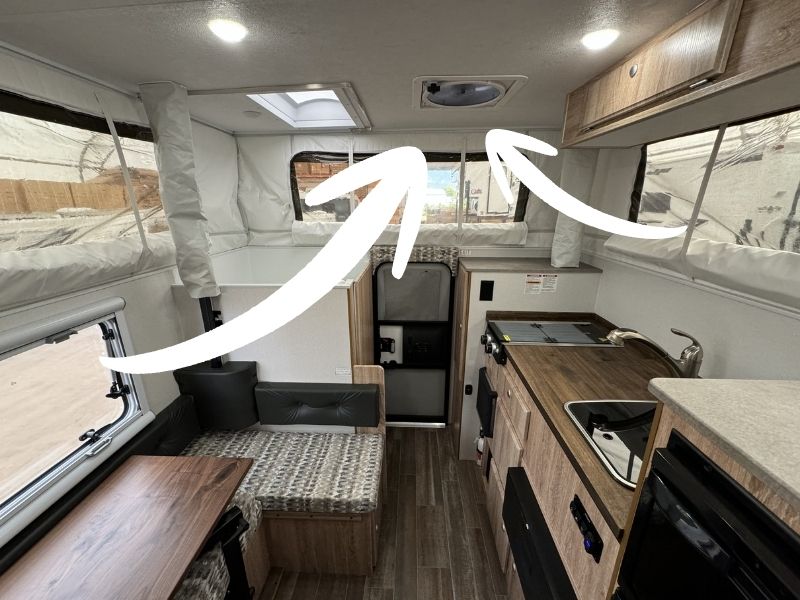
When parked, let cool air in by opening lower windows, truck bed access doors, or turnbuckle access doors—these act as intake points. Then open an upper window on the shaded side of your truck camper. This creates a cross-breeze, continuously bringing in cooler air and exhausting warm air.
I know it sounds simple, but I’ve been genuinely surprised more than once by the rush of air from simply cracking a window or a turnbuckle access door. Sometimes the fix really is that easy.
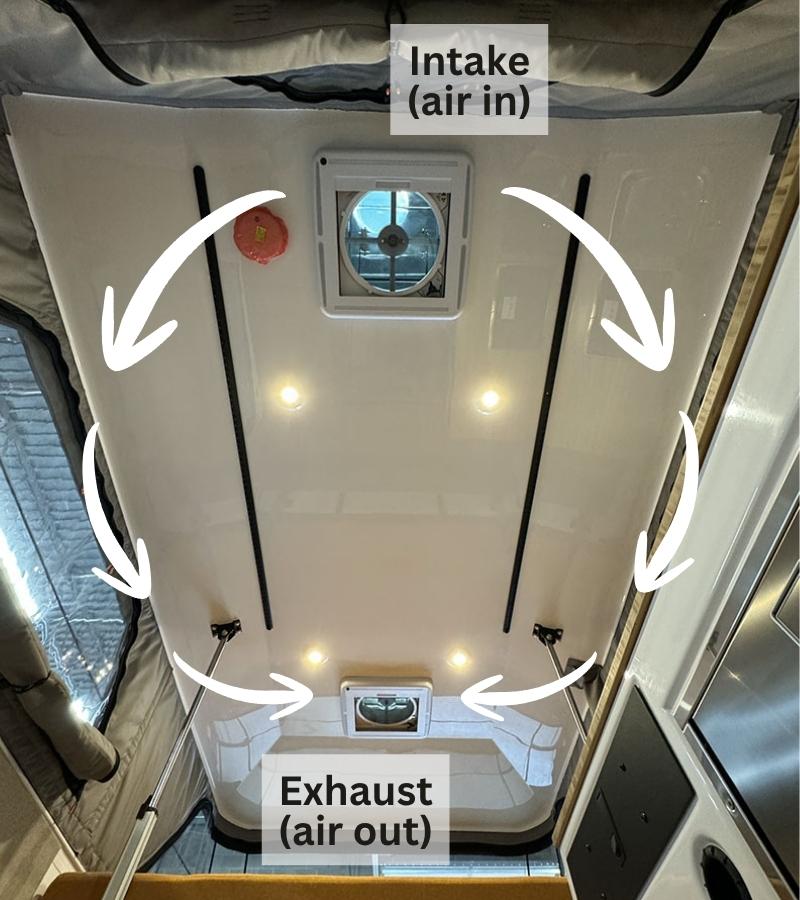
When it comes to beating the heat, fans punch well above their weight. If you’re relying on passive airflow alone, trust me, a good fan will make a dramatic difference. Roof vent fans, like MaxxAir, are especially effective at pulling hot air out of your camper. Run them on exhaust (air out) during the day to help prevent heat buildup, then switch to intake (air in) in the evening to bring in cooler air.
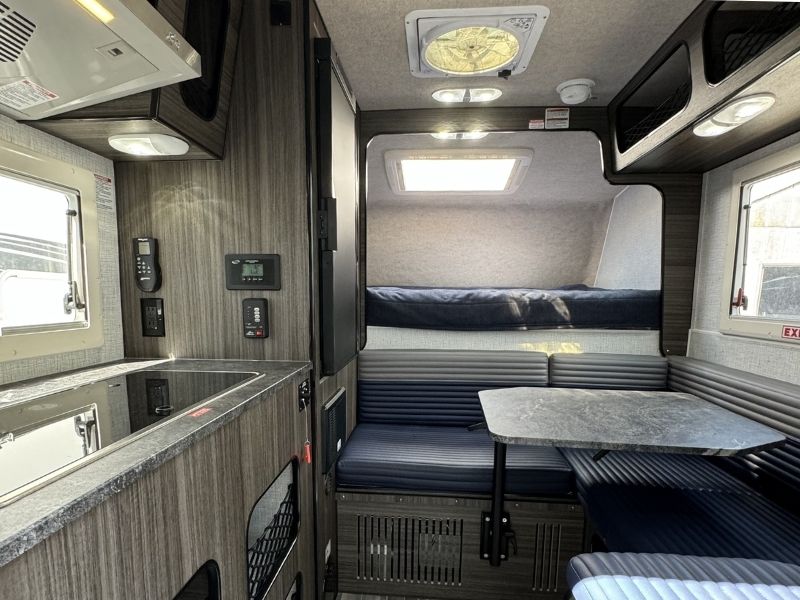
With two roof vent fans, you can take things a step further. Set one to intake and the other to exhaust to create a strong crossflow, and what I affectionately call the “wind tunnel effect.” After experiencing it, you’ll wonder how you ever camped without it.
Two roof-mounted fans in a Supertramp LT truck camper
Most roof-mounted fans are energy efficient, whisper-quiet, and include built-in covers so you can run them while driving or in the rain. It’s a feature that pays for itself during the first hot weekend you use it.
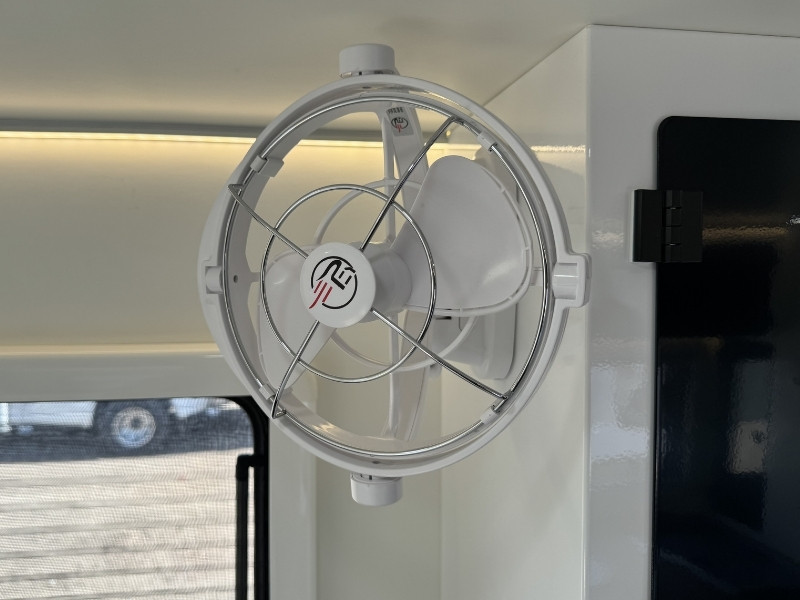
Small built-in fan inside a Star Comet truck camper
Don’t overlook small portable or clip-on 12-volt or battery-powered fans, either. They aren’t the most powerful option, but they’re great for targeting problem spots like the cabover, where hot air loves to collect. If you’ve ever tried to sleep in a cabover on a sweltering night, you know a small fan pointed at you makes a world of difference.
Air conditioning is, of course, the most powerful way to cool a truck camper. The tradeoff is energy consumption. You’ll need to plug into shore power, run a generator, or have a substantial off-grid solar and battery system.
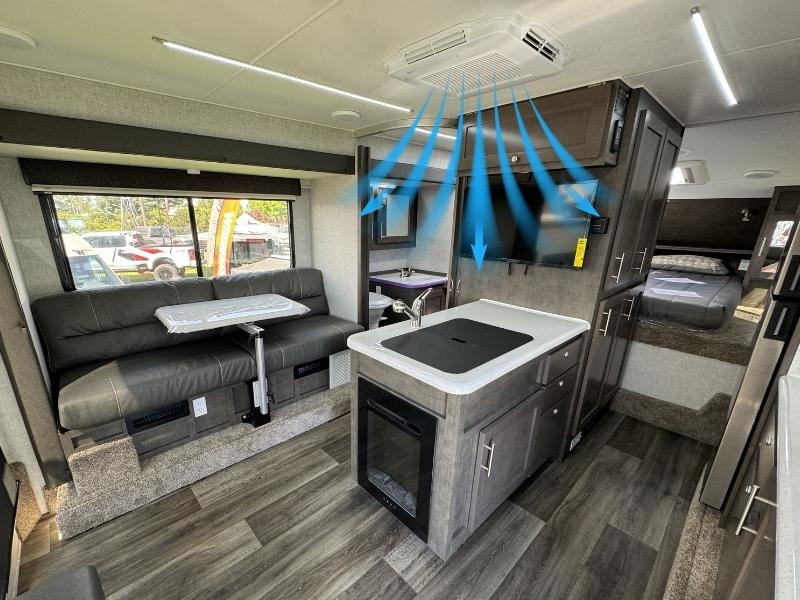
Host truck camper with a roof-mounted air conditioner
No matter how you supply that power, running an air conditioner consistently takes planning. You may need to book campsites months in advance, maintain a steady fuel supply for a generator, or recharge your batteries through DC-to-DC charging and solar. If your truck camper has air conditioning, understanding how much power it requires—and how you plan to supply that power—needs to be factored into where you camp, how you camp, and how often you use air conditioning.
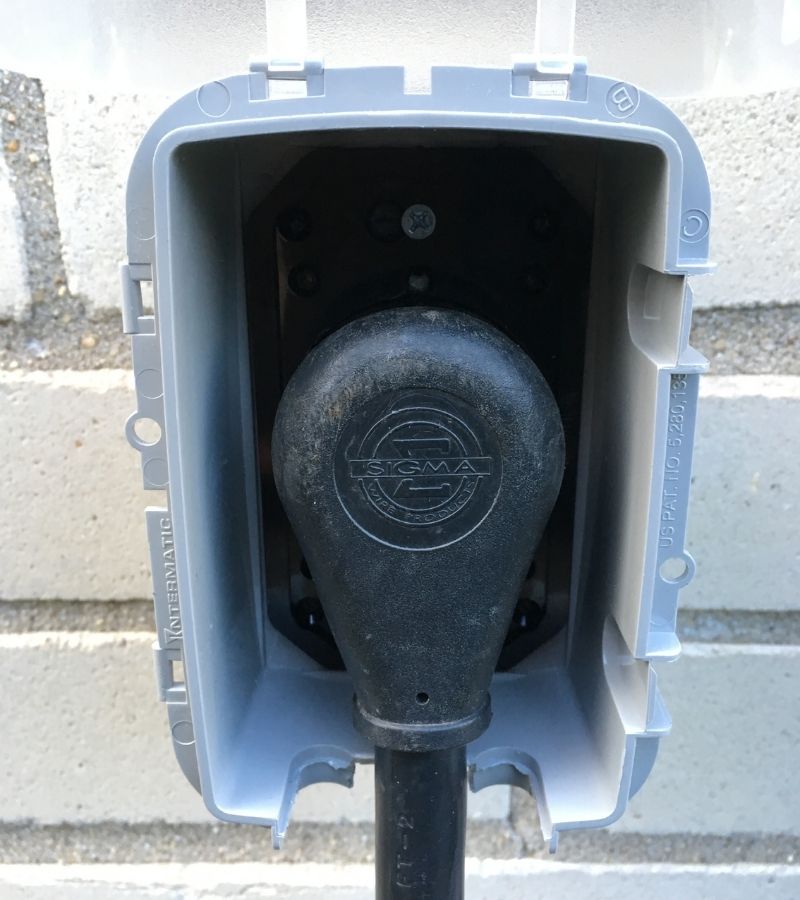
Using shore power at a designated campground is the easiest and most reliable way to run your air conditioner as much as you want. If you plan to run your air conditioner regularly, confirm that you have a 30-amp power cord instead of a 15-amp cord, and consider upgrading if not. No matter how you power your air conditioner, a few simple habits can help it run more efficiently.
While you’re running your air conditioner, close the window blinds to trap cool air inside, run a fan to help distribute cool air evenly, and regularly clear or replace the air filters in your air conditioner. And don’t forget the most important rule: book ahead. Full hookup campsites can fill quickly in peak summer.
Running your air conditioner on shore power both expands and limits your options. You’re restricted to hookup sites and their availability, but you gain the ability to camp comfortably in hotter locations. For those living in warm climates or heading to southern destinations, air conditioning is often essential.
Generators allow you to run air conditioners without shore power, giving you more flexibility to camp off-grid and dramatically increasing your range of camping options. When it comes to running air conditioning in a truck camper with a generator, it helps to understand how much power the unit requires.
Air conditioners are rated in BTUs, which measure how much heat they can remove per hour. Higher BTU ratings provide more cooling capacity, but they also typically require more electricity. A typical 9,000 to 11,000 BTU unit may use around 700 to 1,100 watts while running, while a 13,500 to 15,000 BTU unit often needs 1,200 to 2,000 watts.
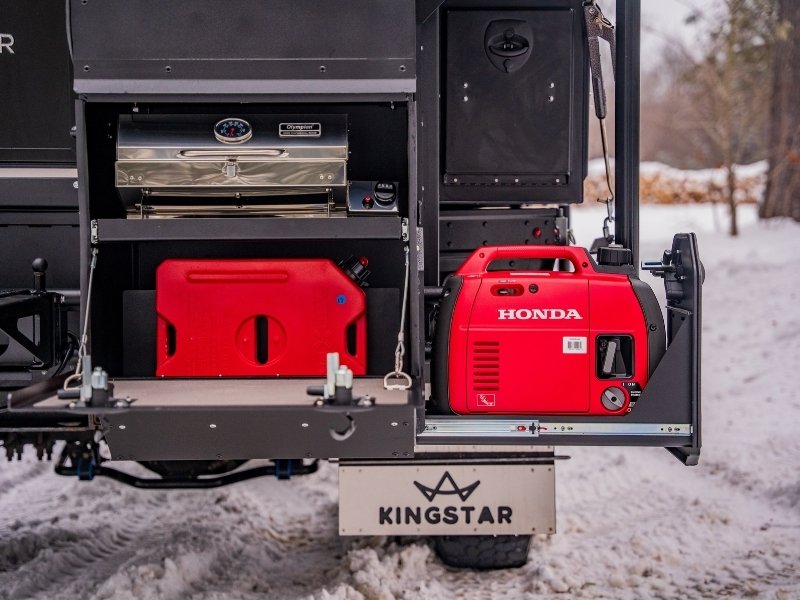
Kingstar truck camper with generator and fuel supply
The biggest challenge, however, is startup. When the compressor turns on, an air conditioner briefly requires two to three times its running power. Because of this surge, a generator that can run an air conditioner may not always be able to start it. This is where soft-start devices can make a significant difference. A soft start reduces the startup surge, allowing smaller generators, inverters, or battery systems to operate an air conditioner more easily and reliably. With a soft start installed, what might otherwise require a larger generator can often be handled by a smaller, quieter, and more fuel-efficient option.
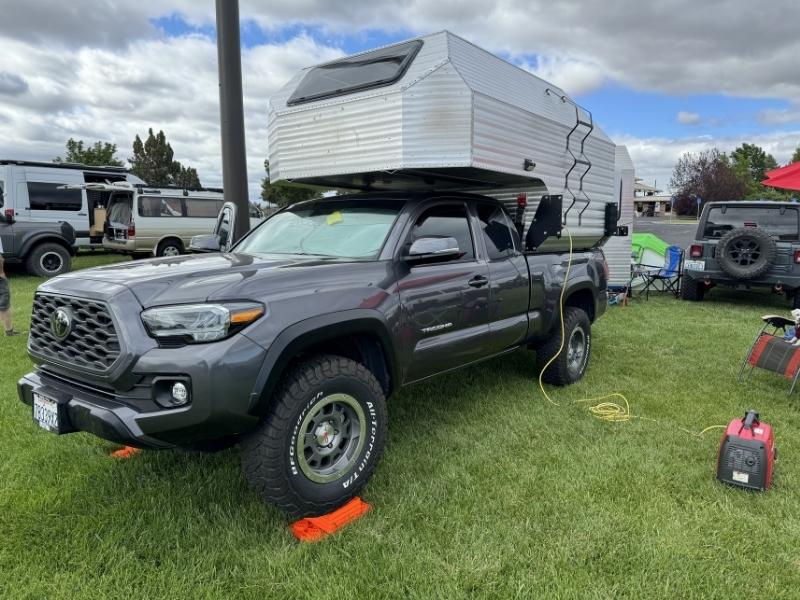
Kimbo truck camper with generator hookup
Some additional tips for using an air conditioner with a generator are to shut off other appliances when starting your air conditioner on low-watt generators to prevent overload. Run the generator only when necessary to conserve fuel. Take advantage of your mobility by seeking out shaded areas to reduce cooling demand. Position the generator away from your camper and neighbors to minimize noise and exhaust. Finally, research campground rules ahead of time, as many areas limit or prohibit generator use.
Generators are a time-tested way to run air conditioning off-grid, but they’re not the only option. Solar-powered high-capacity lithium battery systems are making off-grid air conditioning more achievable than ever. There’s something special about harnessing energy from the sun to power your entire camper.
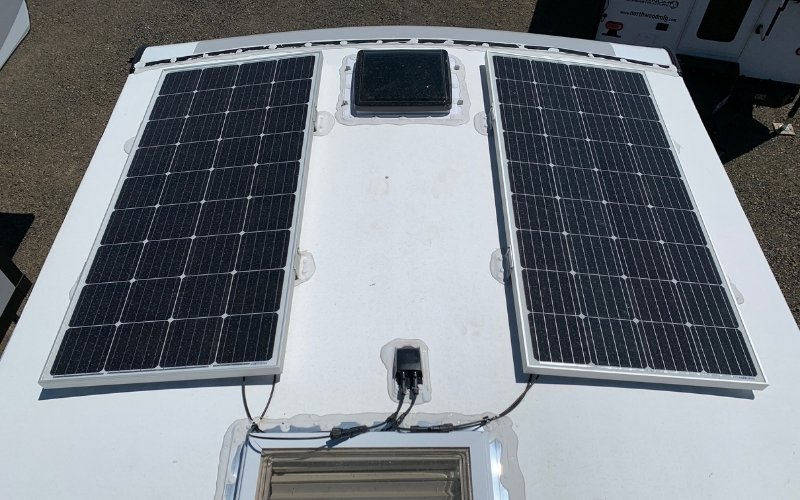
With most modern systems, you can easily monitor your solar input and output, estimate how long your batteries will last under the current load, and set eco-friendly modes on your appliances. After a little practice, managing your energy becomes second nature.
Some tips to stretch your power include taking advantage of DC-to-DC charging while driving. You can also tilt your panels towards the sun and deploy portable solar panels to maximize solar input. Just as importantly, take the time to understand what your system can handle and how much energy it requires to run your air conditioner.
For many truck campers, air conditioning is generally a situational tool. Use it when you need it, and rely on simpler strategies like fans and cross-ventilation the rest of the time.
An effective strategy for staying cool starts with how you park. Avoid asphalt when you can. It absorbs and radiates heat all day, turning the ground beneath your camper into a heat source.
In peak, direct sunlight, shade can drop surface temperatures by up to 100°F, so seek it out. No shade? Make your own. Awnings, portable canopies, and even a well-placed shade cloth will cut the heat.
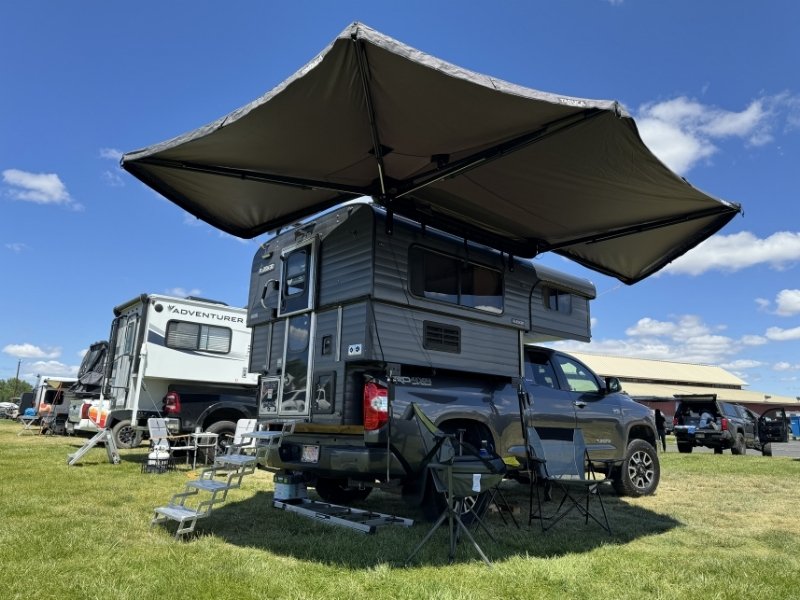
Alaskan truck camper with awning deployed
If your camper runs on solar, shade can be a tradeoff. Check your battery levels and consider your energy needs before committing to a shady spot.
Once you’ve picked a site, pay attention to how the sun will move across your camper. Position your largest windows away from harsh afternoon exposure, close blinds during peak sun, and use reflective window covers. Keep the refrigerator side out of direct sunlight when possible. Refrigerators work harder in the heat, and shading the exhaust helps prevent the refrigerator from emitting additional heat inside your camper.
In the mountains, park on the “morning side” of a slope. The eastern side gives you soft early sunlight and natural shade during peak afternoon heat.
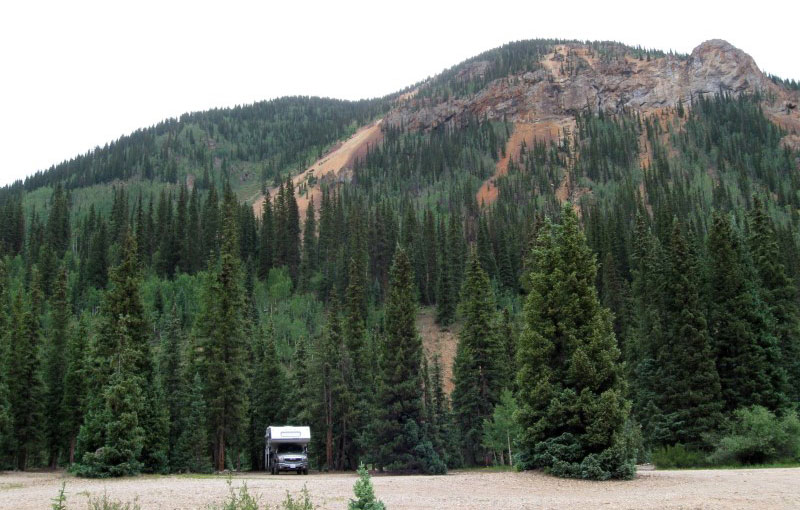
Photo submitted by Ralph Goff (aka Ramblin’ Ralph), 2006 GMC 2500HD, 2001 Lance 845
After you’ve minimized heat inside your rig, focus on keeping yourself cool. Cook outside to avoid raising both the camper’s interior temperature and your body temperature.
In dry climates, a mister system can provide quick relief. Try mounting one on the exterior of your camper or awning, set up your camp chair, and enjoy. An evaporative cooler is another low-cost option that works best below 60% humidity and offers a 12-volt alternative to air conditioning.
Don’t overlook the simple tricks. A damp bandana or towel on your neck, wrists, or behind your knees will help regulate body temperature. Keep ice packs or frozen water bottles handy, stay hydrated, and wear lightweight, breathable clothing.
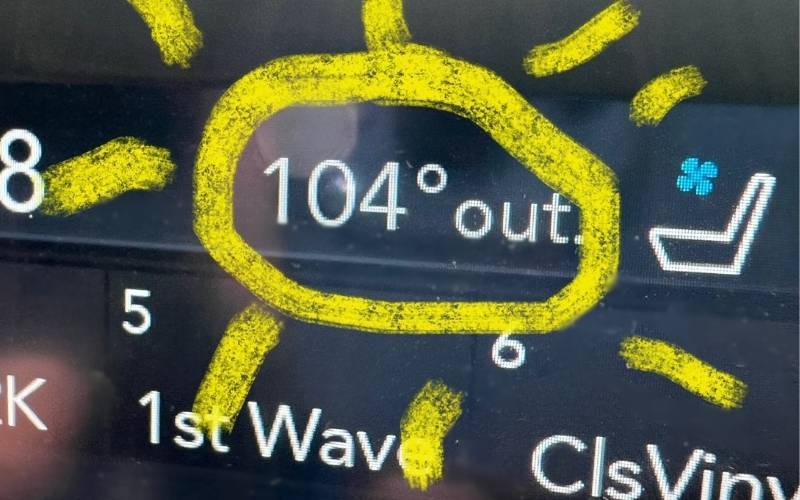
Adjusting your routine to work with the heat instead of against it also makes a big difference. Plan physical activities for the early morning or evening, and use the hottest part of the day to rest. If you need to cool off, take a drive with the air conditioner on. If you don’t have pets or can bring them along, head into town for a grocery run, ice cream break, or step indoors to catch a movie.
Now that you have some strategies to manage body heat and prevent heat buildup inside your camper, let’s zoom out. The secret to staying cool isn’t just how you camp—it’s where you go.
The biggest factor in staying cool is your location. Where you camp can mean the difference between chasing hookups and carefully managing your power or simply enjoying naturally cooler temperatures.
When planning months ahead of time, start by researching daytime highs and avoiding regions during their peak heat months. From a quick Google search, I can see that I would likely be comfortable visiting Death Valley National Park in April without air conditioning. However, if I were headed there in June, I’d want to make sure I had a functioning air conditioner and the resources to keep it running.
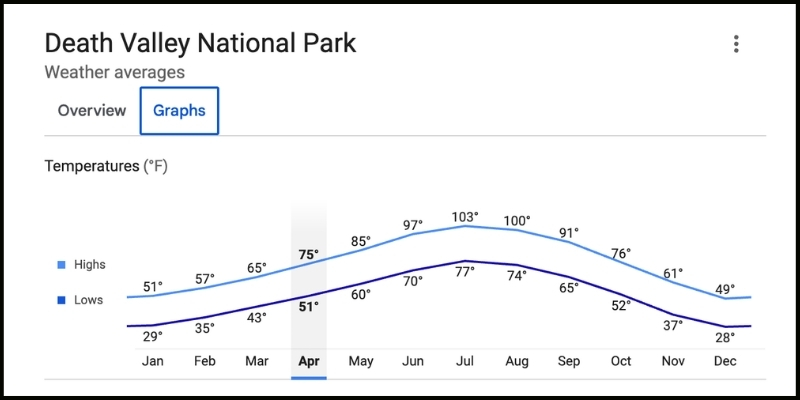
Average Temperatures in Death Valley National Park according to Google
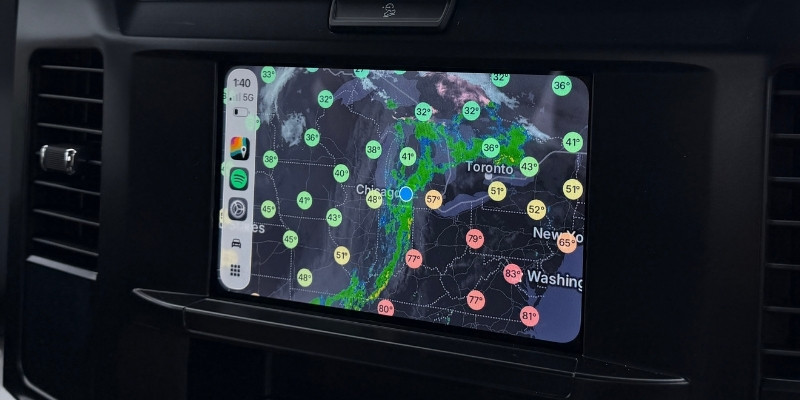
Flexibility is just as important as planning. Weather can change quickly, so be willing to adjust your route if needed. I recently downloaded an app called MyRadar, which overlays temperatures, winds, storms, and other weather data directly onto a map. It’s a great tool for viewing weather across an entire region and helps you make real-time decisions on the road. Staying flexible and willing to adjust your route mid-trip is a huge advantage.
If you want to cool down dramatically, head uphill. As a general rule, temperatures drop about 3.5°F for every 1,000 feet you climb. That means a campsite at 9,000 feet can be over 30°F cooler than one at sea level. It’s a reliable way to find consistently cooler conditions during the heat of summer.
I’ve always loved watching the ecology and landscape change quickly as you head into the mountains. Roll down a window and you’ll feel the humidity and temperature drop as you drive. It’s a reminder of how dynamic these environments are, and one of the simple joys of camping is getting to experience those transitions in real time.
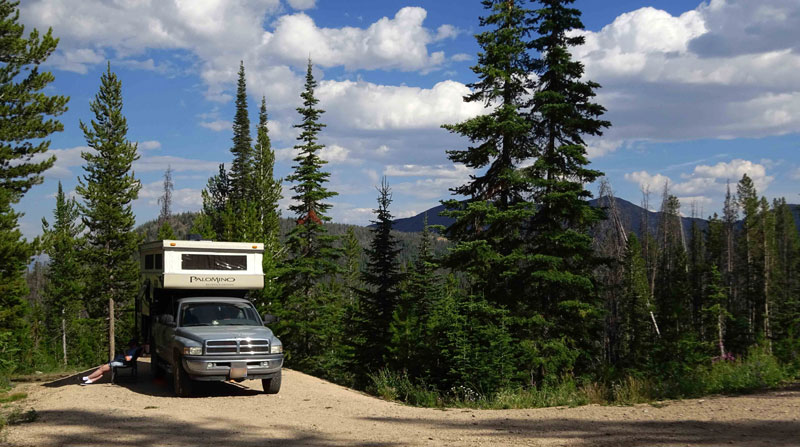
Photo submitted by Brian and Chris Hagen, 2004 Dodge Ram 2500, 2014 Palomino Backpack 1251S pop-up
There are a few trade-offs to keep in mind. Many high-elevation camping areas are boondocking or dry camping sites, often managed by the Bureau of Land Management or Forest Service. These locations tend to prioritize preservation over development, which means fewer amenities and limited access to hookups. They also tend to be more remote, sometimes requiring rougher roads or more planning to reach.
For many truck campers, that’s part of the appeal. Fewer crowds, cooler temperatures, and a stronger connection to the landscape often outweigh the lack of services. Below are tables featuring a compiled list of camping locations submitted by the Truck Camper Magazine community. To see photos and more details of each, check out Cool Camping Spots For Hot Weather. Let’s start with the high-elevation camping spots.
These high-elevation camping locations are ideal for staying cool in summer. The following list highlights campgrounds above 6,000 feet with average July temperatures, elevation, and reservation details.
| Location | State | Avg July Temp (High / Low °F) | Avg Elevation | Campground | Reservations / Website | Hookups |
|---|---|---|---|---|---|---|
| Bighorn Mountains | WY | 70°F / 40°F | 9,000 ft | Sitting Bull CG | Reserve / Info | No |
| Yellowstone NP | WY | 75°F / 45°F | 6,800 ft | Madison CG | Reserve / Info | No |
| San Juan Mountains | CO | 75°F / 45°F | 7,200 ft | Junction Creek CG | Reserve / Info | No |
| Mogollon Rim | AZ | 75°F / 50°F | 7,000 ft | Aspen CG | Reserve / Info | No |
| White Mountains | CA | 68°F / 35°F | 8,600 ft | Grandview CG | Reserve / Info | No |
| Georgia Pass | CO | 65°F / 35°F | 11,600 ft | Dispersed | Reserve / Info | No |
| Lake Tahoe | CA/NV | 75°F / 44°F | 6,200 ft | D.L. Bliss State Park | Reserve / Info | No |
| Red River | NM | 73°F / 45°F | 8,750 ft | Red River RV Park | Reserve / Info | Yes |
| Silverton | CO | 70°F / 40°F | 9,800 ft | South Mineral CG | Reserve / Info | No |
| Leadville | CO | 68°F / 38°F | 9,900 ft | May Queen CG | Reserve / Info | No |
| Beartooth Mountains | MT/WY | 68°F / 35°F | 9,500 ft | Limber Pine CG | Reserve / Info | No |
| Stanley | ID | 77°F / 40°F | 6,500 ft | Stanley Lake CG | Reserve / Info | No |
| High Uintas | UT | 70°F / 35°F | 10,500 ft | Mirror Lake CG | Reserve / Info | No |
| Telluride | CO | 72°F / 45°F | 8,750 ft | Town Park CG | Reserve / Info | No |
If you can’t drive uphill, drive north. While the temperature shift isn’t as immediate as gaining elevation, heading north can still make a meaningful difference. As a general guideline, temperatures drop gradually with latitude, about 1.8 to 3.6°F for every five to ten degrees you travel north. Since five degrees of latitude is roughly 300 to 350 miles, this strategy works best when you’re planning a longer trip rather than a quick weekend escape.
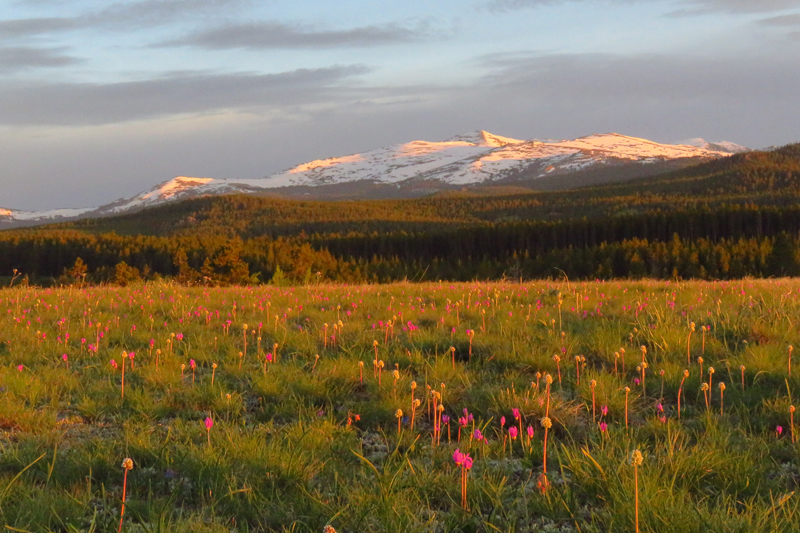
Photo submitted by Pat Eastes, 2005 Chevy, 2013 Lance 865
Some go-to summer locations include Nova Scotia and the Yukon in Canada. In the United States, Northern Michigan, Minnesota’s North Shore along Lake Superior, the Pacific Northwest, and much of New England are great spots too. If you have the time to make the drive, heading north can open up an entirely different kind of summer camping experience. Below are some of the northern go-to destinations shared by Truck Camper Magazine readers.
These northern camping locations are ideal for staying cool in summer. The following list highlights destinations at higher latitudes with average July temperatures, regional details, and campground reservation information.
| Location | State/Region | Avg July Temp (High / Low °F) | Latitude | Campground | Reservations / Website | Hookups |
|---|---|---|---|---|---|---|
| Anchorage | AK | 65°F / 52°F | 61.2181 | Centennial Campground | Reserve / Info | Yes |
| Yukon | Canada | 68°F / 50°F | 60.7223 | Hi Country RV Park | Reserve / Info | Yes |
| Newfoundland | Canada | 63°F / 50°F | 47.5627 | Pippy Park CG | Reserve / Info | Yes |
| Nova Scotia | Canada | 70°F / 55°F | 44.6820 | Shubie Park CG | Reserve / Info | Yes |
| Acadia National Park | ME | 68°F / 55°F | 44.3876 | Blackwoods CG | Reserve / Info | No |
| Upper Peninsula | MI | 72°F / 55°F | 46.5436 | Tahquamenon Falls SP | Reserve / Info | Yes |
| Northern Michigan | MI | 75°F / 55°F | 45.7540 | Wilderness State Park | Reserve / Info | Yes |
| Northern Minnesota | MN | 78°F / 57°F | 47.7500 | Fall Lake CG | Reserve / Info | No |
| Northern Wisconsin | WI | 76°F / 56°F | 46.3744 | Copper Falls SP | Reserve / Info | Yes |
| British Columbia | Canada | 72°F / 50°F | 49.7831 | Alice Lake CG | Reserve / Info | Mixed |
| Olympic Peninsula | WA | 66°F / 52°F | 47.6130 | Kalaloch CG | Reserve / Info | No |
Campground rules, conditions, and availability may change. Please research before traveling.
If you’ve ever jumped into a lake after a long, hot day, you already know the relief it brings. Water is one of the most effective ways to beat the heat. Growing up in Michigan’s Great Lakes region, heading to the water has always been my first instinct.
Beyond comfort, water also plays a measurable role in cooling the surrounding environment. Large bodies of water can lower nearby land temperatures by roughly 5°F to 9°F, thanks to natural air circulation and water’s ability to absorb and hold heat. I experienced this while living in Southern California, where coastal areas stayed consistently comfortable all summer long. It’s exactly where Eric and I kept gravitating to camp when the summer heated up.
The tradeoff is that waterfront campsites fill up fast during peak summer months and can be tough to secure without planning. Mountain lakes are a great alternative, combining elevation with cold water for serious cooling power.
Some of our favorite water-based destinations include the Lake Superior shoreline, the Oregon and Washington coasts, alpine lakes throughout the Rockies, and Maine’s rugged coastline. The Truck Camper Magazine community weighed in with their favorites, listed below.
Camping near lakes, rivers, and oceans is one of the most effective ways to stay cool in summer. The following list highlights water-based destinations with average July temperatures, water types, and campground reservation details.
| Location | State/Region | Water Type | Avg July Temp (High / Low °F) | Campground | Reservations / Website | Hookups |
|---|---|---|---|---|---|---|
| Half Moon Bay | CA | Ocean | 62°F / 52°F | Half Moon Bay State Beach CG | Reserve / Info | Yes |
| Yosemite (Merced River) | CA | River | 89°F / 57°F | Upper Pines CG | Reserve / Info | No |
| Lake Superior (Washburn) | WI | Lake | 70°F / 55°F | Memorial Park CG | Reserve / Info | Yes |
| Suzanne Lake | BC | Lake | 70°F / 45°F | Suzanne Lake Rec Site | Reserve / Info | No |
| Tally Lake | MT | Lake | 80°F / 45°F | Tally Lake CG | Reserve / Info | No |
| Bayhorse Lake | ID | Lake | 70°F / 45°F | Bayhorse Lake Rec Site | Reserve / Info | No |
| Deadwood River | ID | River | 80°F / 40°F | Deadwood CG | Reserve / Info | No |
| Barnes Park | MI | Lake | 75°F / 55°F | Barnes Park CG | Reserve / Info | Yes |
| Harrisville SP | MI | Lake | 74°F / 56°F | Harrisville State Park | Reserve / Info | Yes |
| Puget Sound | WA | Ocean | 70°F / 52°F | Kitsap Memorial SP | Reserve / Info | Yes |
| Myrtle Beach | SC | Ocean | 89°F / 75°F | Myrtle Beach SP | Reserve / Info | Yes |
Campground rules, conditions, and availability may change. Please research before traveling.
Ultimately, staying cool in a truck camper is about using what you have wisely and choosing the right places to camp.
Start with airflow and simple upgrades. Use air conditioning when your setup allows, and lean on low-tech strategies when it doesn’t. Most importantly, let your destination do the heavy lifting. Where you camp and how you park make a bigger difference than you might expect.
The reader-submitted locations tell an interesting story. Water-based destinations tend to have hookups and developed campgrounds. Higher elevations are often more remote and off-grid, but reward you with noticeably cooler temperatures. Northern destinations strike a balance of both, offering milder summer weather alongside amenities. If there’s a sweet spot, it’s somewhere between 6,000 and 9,000 feet with a lake or river nearby.
When your setup and your surroundings work together, even the hottest months can become some of the best times to be on the road. Don’t wait for perfect conditions. Load up, pick a direction, and go find your version of cool. We’ll see you out there.