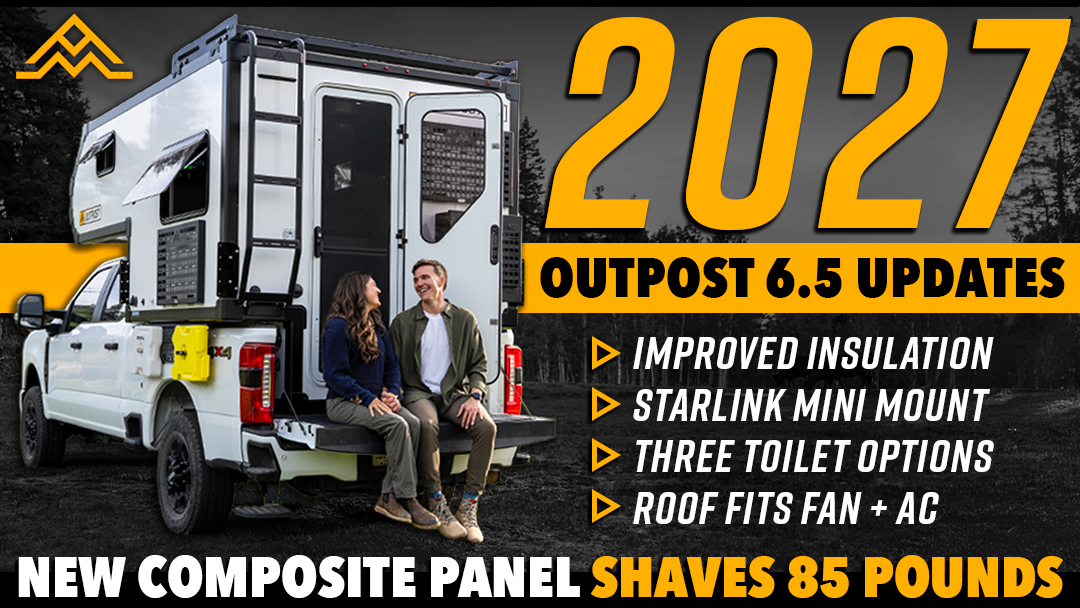
For 2027, the Outpost 6.5 short bed sheds eighty-five pounds while gaining insulation and storage. Up top, a redesigned roof makes room for an air conditioner and a MaxxAir fan. And the options list? That grew, too.
For its first two years, Outpost produced one camper, the 6.5, with one floor plan moving down a single production line. For this growing company out of Bayfield, Colorado, launching the larger Outpost 8.0 model required much more than designing a camper and spreading the word. What happens when the orders come in? They need materials on hand, processes in place, room to work, and people ready to turn those orders into campers.
We saw the beginning of this preparation at Outpost Campers during our factory visit in June. The first-ever 8.0 prototype was coming together on the production floor. An expansion was planned for a building the company had occupied for less than a year. Outpost was thinking ahead, making room for a second production line months before the 8.0 had even been announced.
After two years of requests for a larger Outpost, customers welcomed the 8.0’s enclosed wet bath, built-in cassette toilet, and north-south bed with enthusiasm. When we learned the Outpost 8.0’s XPS composite panels offered better insulation at a lower weight, we had one question: when does the 6.5 get them?
For 2027, the XPS panels are here, shaving eighty-five pounds off the Outpost 6.5. For a hard side camper with a 5 kWh battery and 3,600-watt inverter already on board, getting below a 1,500-pound base weight without jacks is worth a pause.
Inside, the updated 6.5 now has cabover cabinetry inspired by the 8.0, while optional removable shelves give owners another way to organize the closet. Up top, a redesigned roof accommodates both an air conditioner and a MaxxAir Deluxe fan with room for 500 watts of solar. Buyers can also choose composting or dry-flush toilets, an indoor Starlink Mini mount, a 180-degree awning, and factory-installed electric jacks.
All of this is happening as Outpost gets two production lines running and prepares a new showroom near Denver. And right on schedule, the first Outpost 8.0 campers are heading out the door as you’re reading this.
For more information about updates to the Outpost 6.5 short bed composite panel camper, we talked to Taylor Ripp, CEO of Outpost Campers.
Request a free Outpost Campers brochure
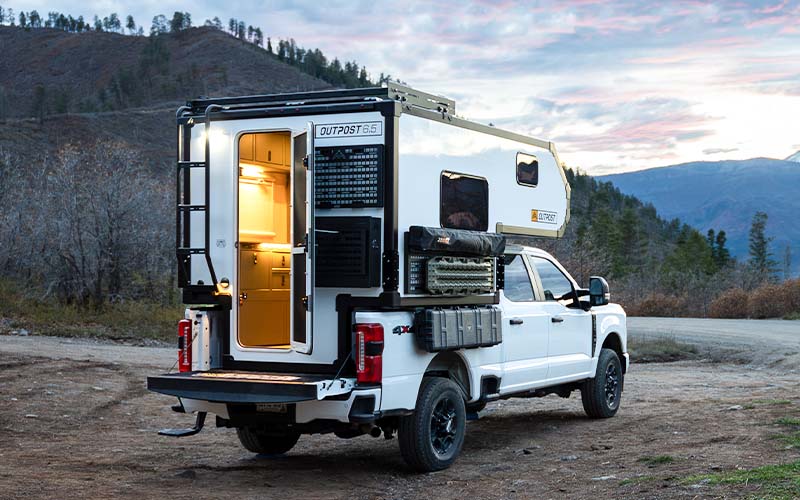
2027 Outpost 6.5
What’s new at Outpost since our factory visit in June?
We expanded the north end of our building by about 3,000 square feet to make more room for warehousing, staging, and subassembly. That freed up space on the main shop floor for two separate assembly lines.
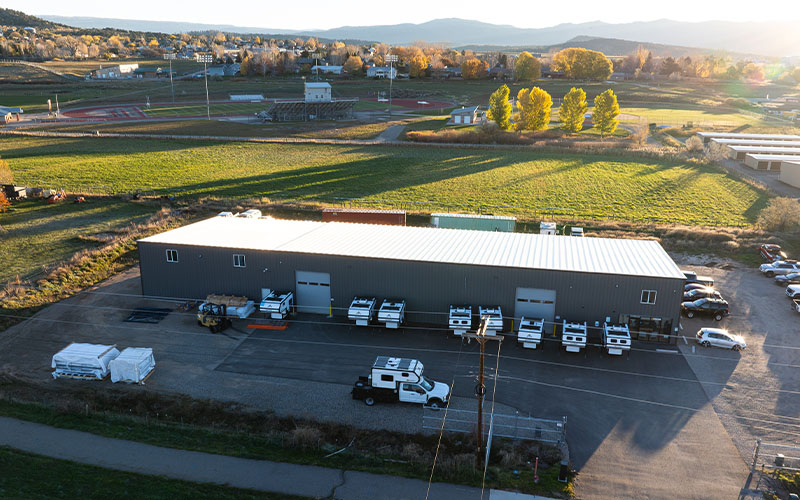
Outpost Campers factory with new expansion (left of the second bay door)
For the past two and a half years, Outpost has been focused on the 6.5. Now we’re a two-production-line company building two camper models. Bringing the 8.0 into the mix has meant developing a lot of new processes.
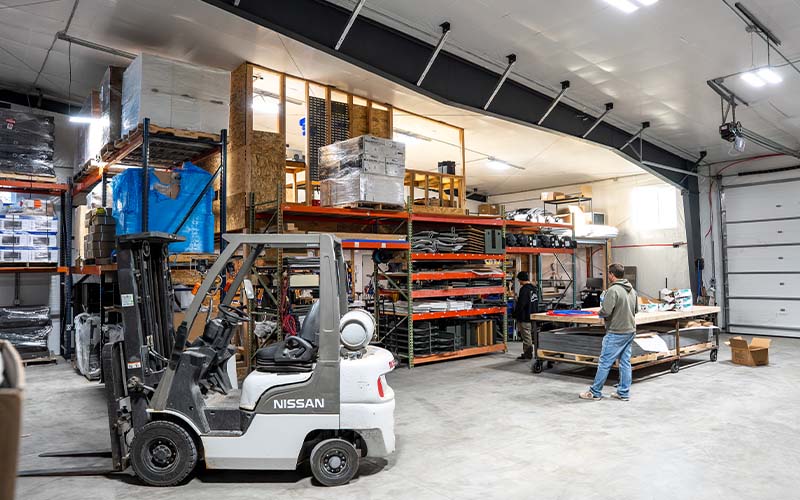
The new warehousing, staging, and subassembly space
How has the response been to the Outpost 8.0?
We’ve been kind of blown away by it. There were clearly people waiting for a long-bed Outpost camper with a wet bath. We have a healthy backlog of orders, and the first Outpost 8.0 deliveries are going out this week.
At the same time, we didn’t forget about the 6.5, our tried-and-true model. While we were working to get the 8.0 into production, we were also refining the Outpost 6.5.
It will be exciting to see Outpost 8.0 campers on the road. What did you learn from developing the 8.0 that’s carrying over to the 6.5?
When developing the 8.0, we were focused on building a camper for an eight-foot truck bed that maintains the lightweight Outpost DNA. We worked closely with our composite panel manufacturing partner on a lighter panel with better insulation that still provides excellent structural rigidity.
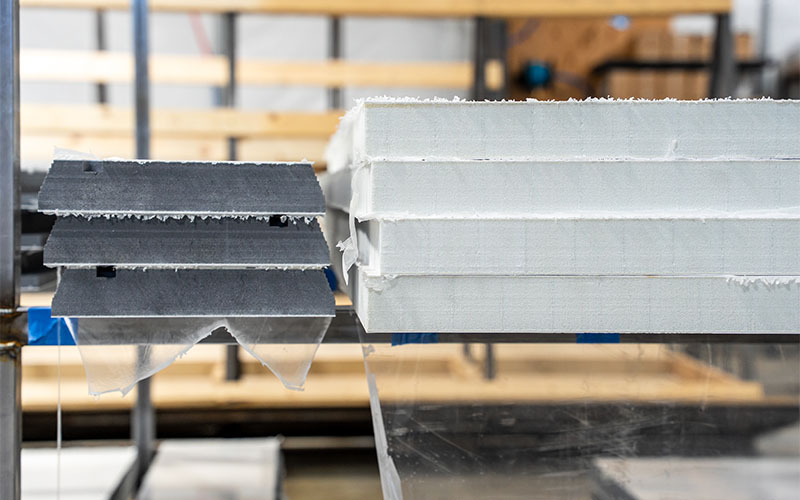
Composite panels showing the XPS foam core (left) and PET foam core (right)
Like the Outpost 8.0, the 6.5 now has a hybrid composite-panel system using two types of foam core. Most of the structure has changed from a 1⅝-inch PET foam core to a two-inch, graphite-infused XPS foam core. The graphite-infused XPS foam has been used in Australian campers and extreme climates for over a decade.
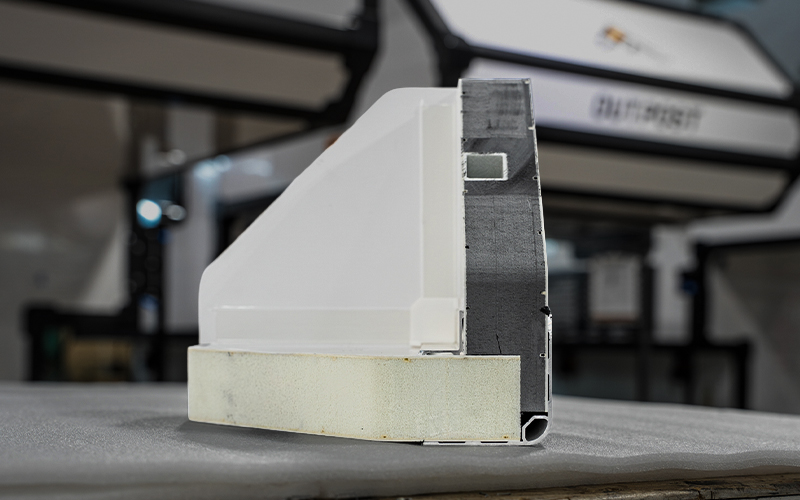
A cross-section of Outpost’s composite side wall and floor connection
We’re keeping the PET foam in the floor and in the vertical wing panels to utilize its compressive strength. The side walls, nose caps, and roof now use the XPS foam core composite panels. The result is an Outpost 6.5 that’s about eighty-five pounds lighter and is even more insulated.
“The result is an Outpost 6.5 that’s about eighty-five pounds lighter and is even more insulated.”
How does the insulation compare to the previous panels, and do they have an R-value?
The previous PET-core panels had an estimated R-value of approximately R-8 to R-9. The new XPS panel has an R-value between R-11 and R-12. Those specifications come from our composite panel manufacturer and are panel estimates rather than tested R-values for the complete camper.
We were already seeing great insulation performance with the PET-core panels. But after we built and tested an Outpost 8.0 with the XPS panels, we noticed significant insulation benefits.
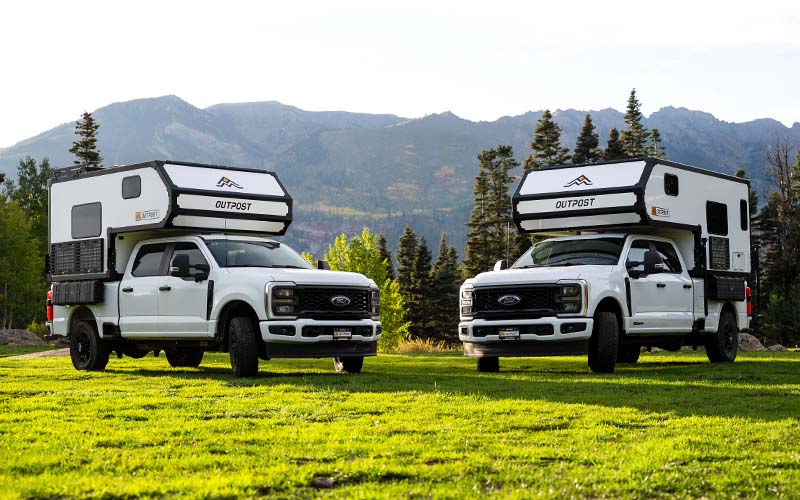
Outpost 6.5 (left) and long bed Outpost 8.0 (right)
Our team went out on a ninety-degree summer day with an Outpost 8.0 and an Outpost 6.5 with the previous PET-core panels. Both campers were running the same 48-volt air conditioner and EcoFlow power system. Even with more interior space to cool, the 8.0 noticeably outperformed the 6.5, reaching sixty-four degrees while parked in the sun on a ninety-degree day.
Sometimes it’s hard to notice a difference in insulation in a small space, but this was undeniable. That helped convince us to bring the thicker panels into the 6.5.
During our factory visit, we saw how much attention went into the panel joints and thermal breaks. Did that process change with the new composite panels?
No. It’s the same construction, just with a thicker panel and a different foam core.
As you saw during your visit, we use separate internal and external aluminum extrusions at the composite-panel joints. Those two sets of extrusions don’t touch, which creates a thermal break between the outside and inside of the camper.
That thermal break is a key part of our insulation performance. Without aluminum framing, we’re getting that R-value across essentially the entire structure of the camper, rather than having heat or cold transfer through the framing.
How did the thicker panels affect the camper’s dimensions and interior layout?
We made the exterior one inch wider and preserved the interior width. The exterior width is now eighty-three inches.
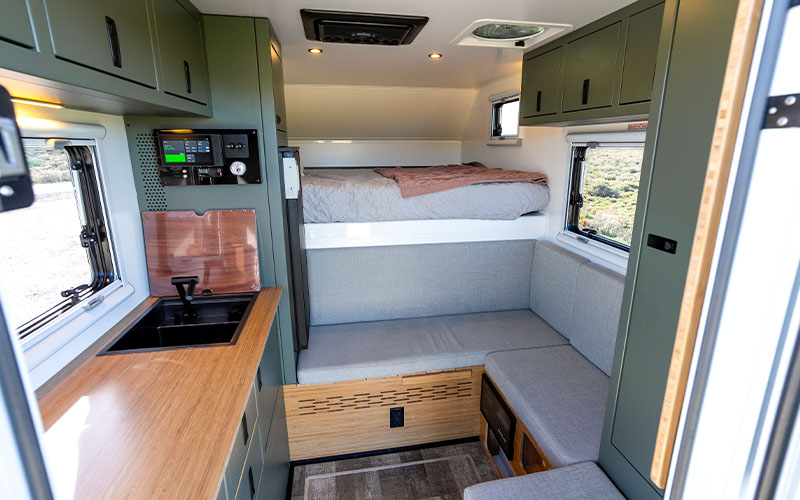
2027 Outpost 6.5 interior
We already have one of the narrower hard-side truck campers on the market, and we felt that adding an inch of width wouldn’t compromise its performance. We did lose one inch of interior length to maintain the ability to close the tailgate. The cabover’s interior dimensions stayed the same.
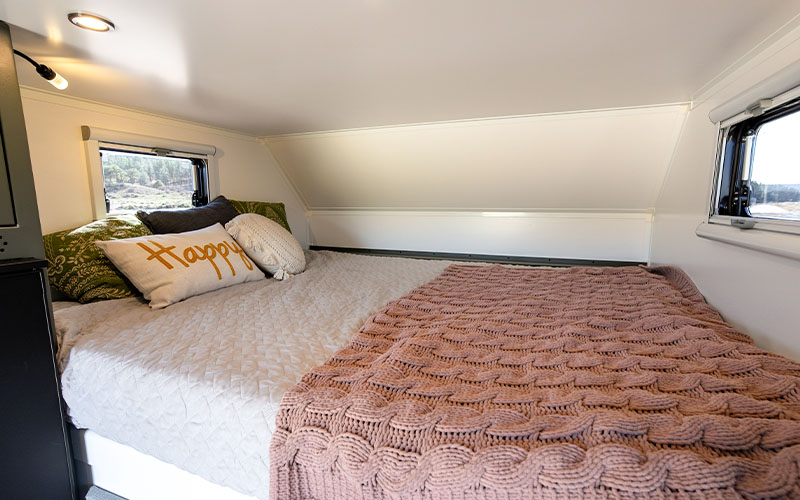
Outpost 6.5’s east-west cabover
What is the new base dry weight of the Outpost 6.5?
The Outpost 6.5 now has a 1,550-pound base dry weight. Without the standard Rieco-Titan manual jacks, it weighs 1,485 pounds dry.
What did you want to accomplish with the 2027 Outpost 6.5 roof redesign?
On the previous 6.5, choosing an air conditioner meant giving up the MaxxAir Deluxe fan for the smaller MaxxAir Dome fan. Outpost Campers are well insulated and airtight, so ventilation is key. Figuring out how to keep the MaxxAir Deluxe fan when ordering the air conditioner became a priority.
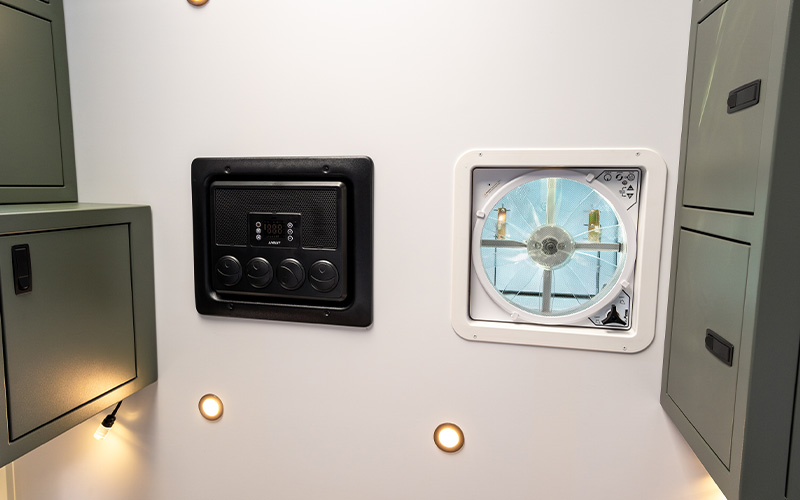
Redesigned Outpost 6.5 ceiling with both the air conditioner (left) and MaxxAir Deluxe fan (right)
For 2027, we reengineered the roof so the 48-volt air conditioner and MaxxAir Deluxe fan fit side by side. We can still fit 500 watts of solar on the roof with the air conditioner and MaxxAir fan. It seems like a simple challenge, but a lot goes into fitting everything on a relatively small roof.
Are you still offering the Velit 48-volt air conditioner?
Yes. We’ve had very good feedback from customers and good results with that unit in the field. It runs directly from the battery pack in the EcoFlow 48-volt system included in every camper.
Here’s a loaded question: how long can owners realistically run the air conditioner off-grid?
That’s certainly a loaded question, but it’s a good one. In Eco mode, the air conditioner draws about 500 watts. With a full five-kilowatt-hour battery and no recharging, that gives you a theoretical runtime of about ten hours without any solar or DC-to-DC charging.
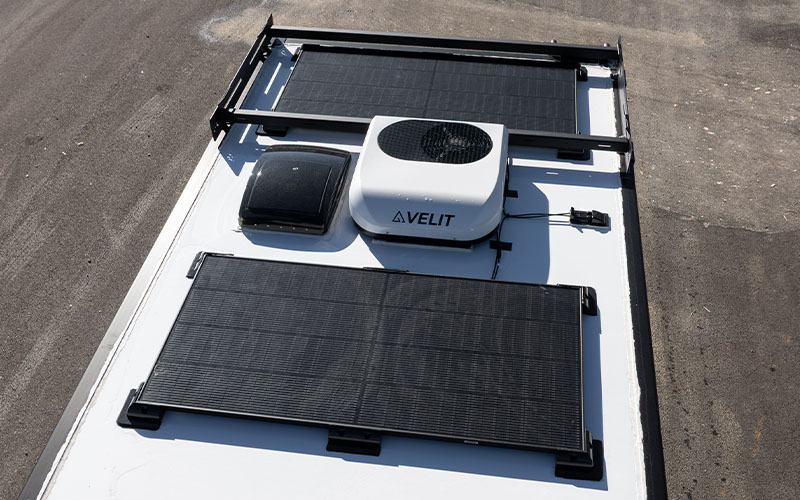
500 watts of solar, roof racks, MaxxAir Deluxe fan, and Velit air conditioner
In optimal solar conditions, especially with an additional portable panel, we’ve been able to run the air conditioner largely or entirely from solar. Real-world use depends on the outside temperature, how many people are in the camper, and how much the compressor needs to run to maintain the temperature.
What do you recommend for getting the most out of your power system when running the air conditioner?
I recommend turning on the air conditioner while you drive if it’s hot and you’re heading to camp. The DC-to-DC charger draws power from the truck’s battery to cover the air conditioner’s load, so you can arrive at camp with a cool camper and a full battery.
“The DC-to-DC charger draws power from the truck’s battery, so you can arrive at camp with a cool camper and a full camper battery.”
The camper’s insulation also lets you use the sun to your advantage. You can park in direct sun to generate solar power for the air conditioner without heat penetrating the camper’s structure. Even on a 90-degree day, the camper’s interior walls stay cool to the touch.
Parking in the sun to keep your camper cooler is a funny concept. With the air conditioner, fan, and maximum solar installed, is there still room for roof racks?
Yes. The roof racks are still compatible with that configuration.
Did developing the Outpost 8.0 give you any ideas for improving storage in the 6.5?
It did. We developed an aluminum cabinet to fit alongside the north-south bed in the 8.0, and adjusted the design to fit the 6.5’s cabover.
The Outpost 6.5 now features a one-piece laser-cut aluminum cabinet that fits at the front of the cabover along the east-west bed. The doors use friction hinges, so they stay where you leave them without needing struts.
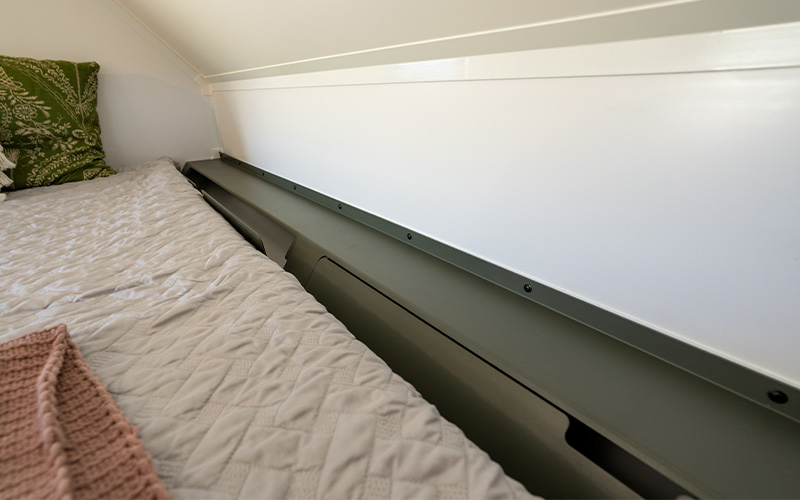
New aluminum cabover cabinet with side-opening doors and a flat top
We intentionally designed the angled doors to open from the side, keeping the top flat and stationary. That way, owners can store things on top without having to move everything out of the way each time they want to access the cabinet.
That’s a clever design. Has Outpost made any other changes or additions to the 6.5’s storage for 2027?
We have. For 2027, the tall cabinet will have optional removable bamboo shelves. You can pop them in or take them out, depending on how you want to use the space.
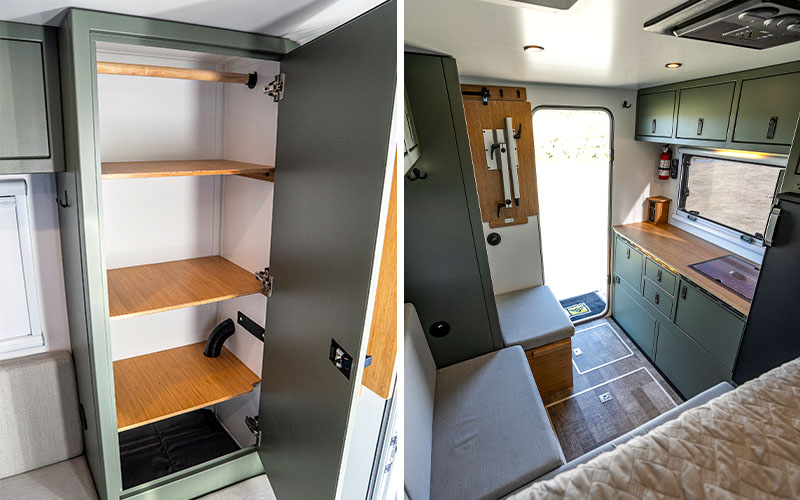
Tall closet with optional removable bamboo shelves (left) and Outpost 6.5 interior (right)
Existing Outpost 6.5 can get the shelves installed here at our factory in Bayfield, Colorado.
How are you expanding toilet choices in the Outpost 6.5 for 2027?
There are a lot of toilet styles available now, and we were seeing customers replace the portable cassette-style toilet in the Outpost 6.5 with other toilet options. For 2027, we partnered with CompoCloset to offer a composting toilet and their new S1 dry-flush toilet. Both fit the existing toilet compartment with very little redesign, and they’re now factory options for the Outpost 6.5.
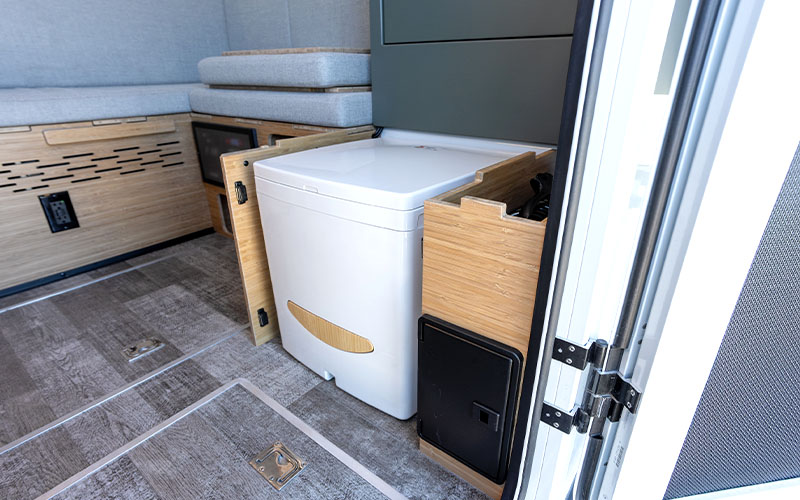
Optional CompoCloset Cuddy in the Outpost 6.5’s toilet compartment
What are the practical differences between the different toilet options?
The composting toilet is essentially a separating toilet. It keeps liquids and solids apart, which helps significantly with odors.
The dry-flush model uses a bagging system to isolate and seal the solid waste. It’s an electronic system with more moving parts, so it’s more expensive than the composting option and uses refill bags.
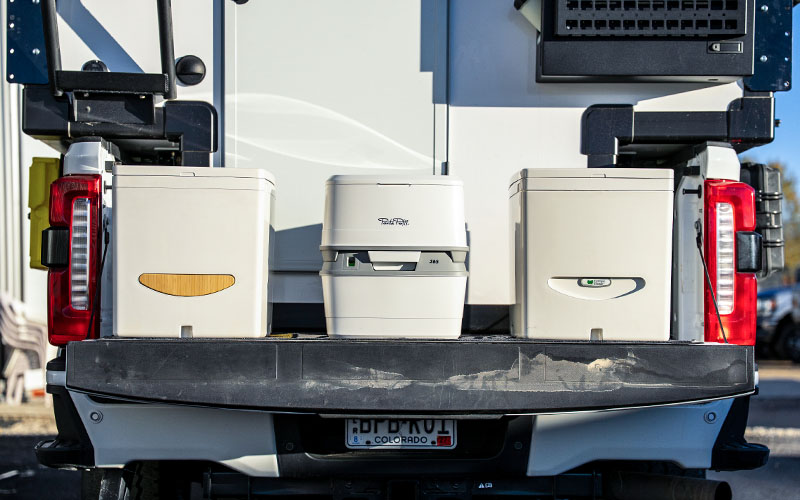
CompoCloset Cuddy composting toilet (left), Thetford Porta Potti (center), and CompoCloset S1 dry-flush toilet (right)
For our customers, these toilet options allow them to stay off-grid without needing a dump station for a black tank. You still have to dispose of the waste properly, but it gives people more options.
Have you made updates to accommodate Outpost Camper owners who use Starlink?
We’ve had a lot of requests for a way to integrate Starlink into the camper. The Starlink Mini simplified that because the dish and router are combined into one unit.
Through our testing and some creative solutions from customers, we discovered that the Starlink Mini can receive a signal through our composite panels. That opened up the possibility of mounting it inside the camper instead of outside, without having to drill a hole through the camper roof.
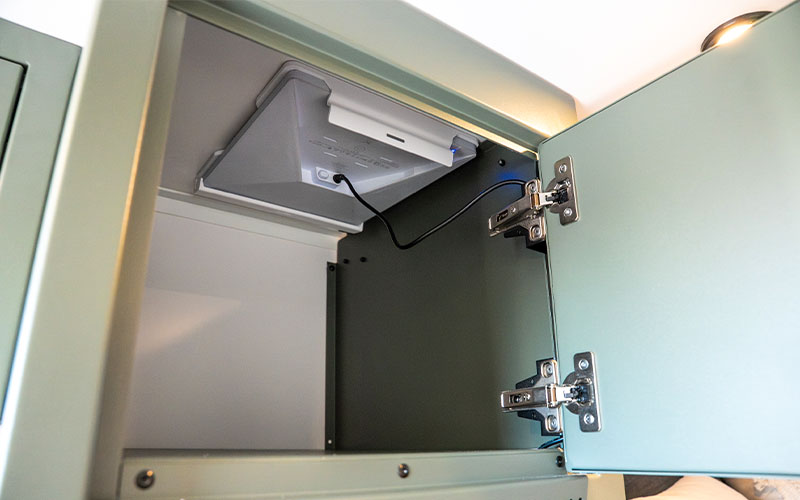
Outpost’s patent-pending Starlink Mini mount
We designed a patent-pending mount that fits inside the cabinet above the refrigerator. The Mini stays inside, out of the weather, and owners don’t have to set it up every time they make camp. The internet connection also works great in the cab while driving.
“The Mini stays inside, out of the weather, and owners don’t have to set it up every time they make camp.”
Can customers easily move the Starlink Mini outside?
Yes. If you’re parked under trees or another obstruction, you can remove the Starlink Mini without tools and position it outside where it has a better view of the sky.
How is the Starlink Mini powered inside the camper?
We experimented with several DC power solutions, and most worked well. However, we did encounter some overheating issues with the Starlink Mini that we weren’t seeing when using the included 120-volt power supply.
We also looked into Starlink’s own guidance, which states, “Starlink only guarantees performance with the included Starlink power supply and cable.”
Until Starlink provides clearer guidance on DC power, we’ve decided to stick with their included 120-volt power supply. The 48-volt EcoFlow system has a built-in 3,600-watt inverter, so powering the Starlink Mini through the camper’s electrical system is no problem.
Are there any new exterior options for the Outpost 6.5?
We’ve been working on adding an awning for quite a while, and are excited to offer a 180-degree awning by 23Zero. We’ve developed our own mounting system that attaches directly to the optional MOLLE panel. It mounts below the passenger-side window to preserve the view from inside the camper.
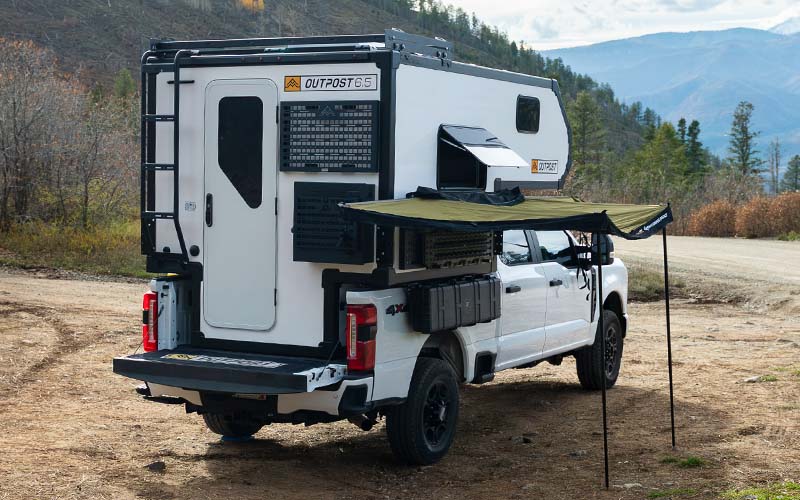
Optional 23Zero 180-degree awning deployed on the passenger side
How much does the awning weigh, and what is involved in setting it up?
It’s about twenty-nine pounds and very easy to deploy and stow. You can use it completely freestanding. If it’s windy, the manufacturer recommends deploying the included legs. It also has straps that tension to the truck mirror and the camper’s heater box.
We tested several awnings, and this was our favorite. It’s lightweight, uses durable material, and gives us a lot of coverage for the space it occupies on the side of the camper.
Are there any other new options we haven’t covered?
Electric Rieco-Titan jacks are now an option on both the Outpost 6.5 and 8.0. That was another request we heard from customers. Electric jacks will make loading and unloading an Outpost camper quicker than ever before.
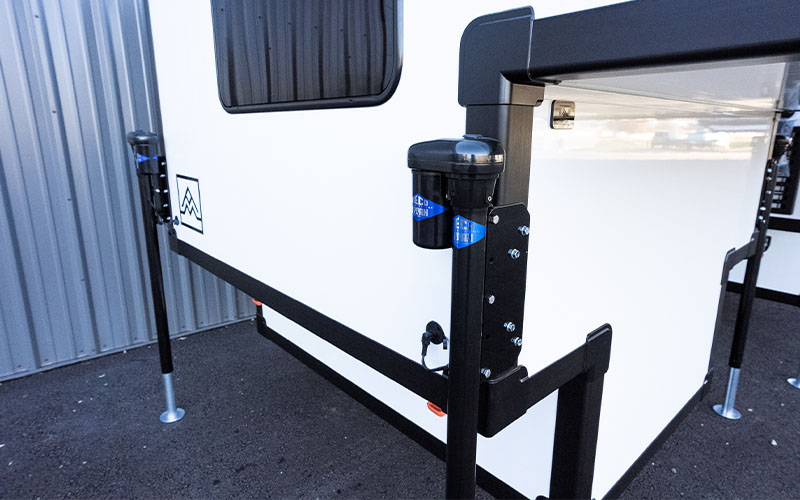
Optional electric Rieco-Titan jacks on the Outpost 6.5
The standard manual Rieco-Titan jacks are convertible, so they can be upgraded to electric operation later.
What are the base MSRPs for the 2027 Outpost 6.5 and 8.0?
The base MSRP for the Outpost 6.5 is $45,995 USD, and the base MSRP for the Outpost 8.0 is $57,995 USD.
When will the 2027 Outpost 6.5 updates be available, and what are your current lead times?
As of today, new Outpost 6.5 orders will be 2027 models. Our estimated lead time for both the 6.5 and 8.0 is about three to four months. Customers who order now can expect to have their campers in time for the spring and summer 2027 camping season.
What else is in the works at Outpost for 2027?
We’re focused on getting Outpost campers in front of more people and making it easier to see both models in person. Our three dealer partners, Groupe Alliance in Canada, PAD Overland in Oregon, and Truck Camper Warehouse in New Hampshire, are a big part of that.
We’re also working on opening a showroom in Longmont, Colorado, near Denver. Customers will be able to see our campers in person, meet our team, and take delivery. We’re hoping to open in December, with a grand opening in the spring.
At the factory, we’re focused on getting the 8.0 production line primed to meet demand. With two models and more places to see them, we’re excited to welcome more people into the Outpost community.
For more information about Outpost Campers, visit their website at outpost-campers.com. To request more information from Outpost Campers, click here.