Truck Camper Magazine visits Outpost Campers in Bayfield, Colorado, to discover how their composite-panel truck campers are built. Who needs hundreds of screws when chemistry can do the heavy lifting? Stick around.
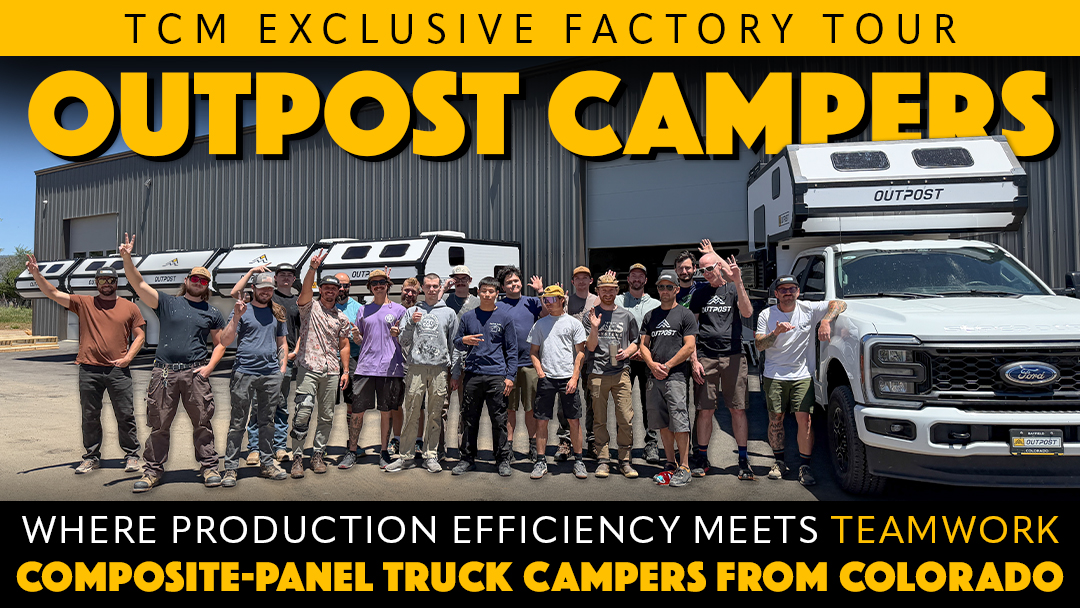
In July of 2024, Outpost Campers launched in Truck Camper Magazine with a lightweight composite-panel truck camper. Combining composite-panel construction, modern design, integrated 48-volt power, and a deliberate focus on weight reduction, the Outpost 6.5 quickly established its own identity within the truck camper market. Since then, Outpost has expanded its team, increased production capacity, and moved into a much larger facility in Bayfield, Colorado.
Since Outpost’s debut, we’ve covered every model announcement and product update. With each article, our curiosity grew. We wanted to know how these composite-panel campers were built, who the people behind them were, and how a company could grow this quickly without losing its identity. There’s only one way to get those answers. You show up, walk the production floor, ask way too many questions, and see what’s really happening behind the curtain.
In typical TCM fashion, we rolled into Bayfield, made ourselves at home in the Outpost parking lot, and declared ourselves temporary residents. Grab a cup of coffee and get ready to head up the mountain. Let’s see how Outpost Campers turns a stack of composite panels into an off-grid-focused truck camper.
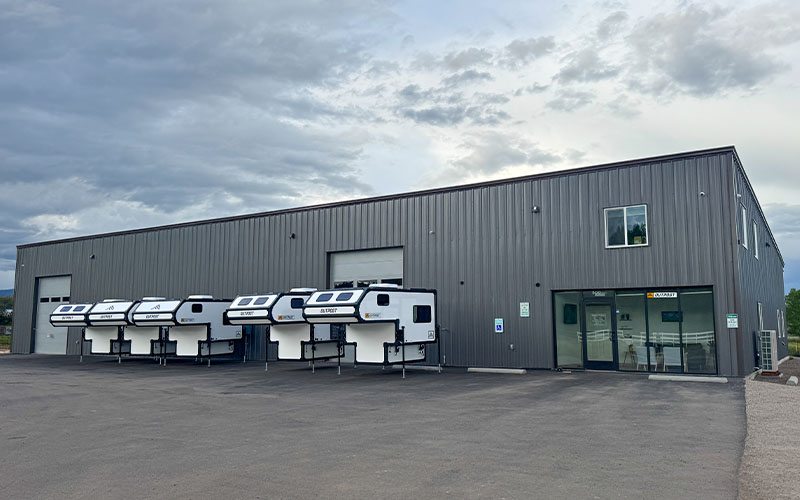
Outpost’s new facility in Bayfield, Colorado
Outpost Campers has officially settled into their new building, nearly 7,000 feet above sea level. Between the crisp air, mountain views, and steady stream of truck campers, it’s not a bad place to spend a workday.
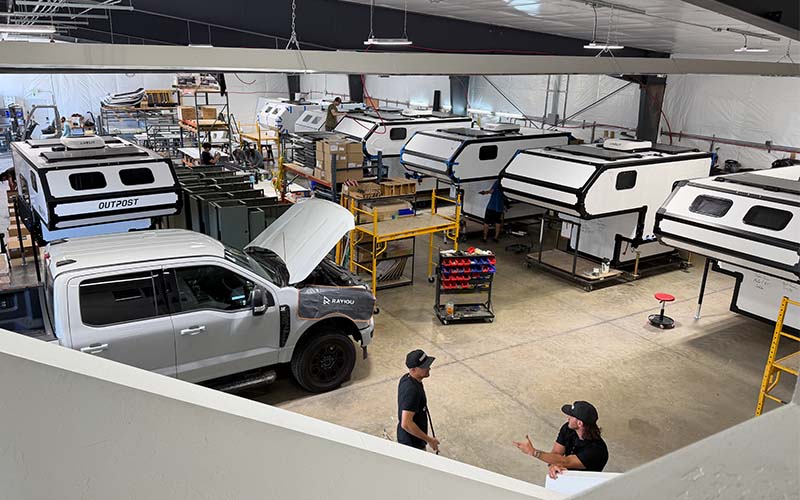
Customer install in progress (left), Outpost 6.5 production line (right)
Temperature, preparation, and timing are critical when you’re building campers with structural adhesives. Outpost’s production line is divided into five stages designed around curing times and quality control checkpoints.
To support the curing process, the new facility maintains temperatures above sixty-five degrees year-round with radiant heat. The adhesives appreciate the consistent temperature, and after talking with several employees about their first winter at the new shop, so does the team.
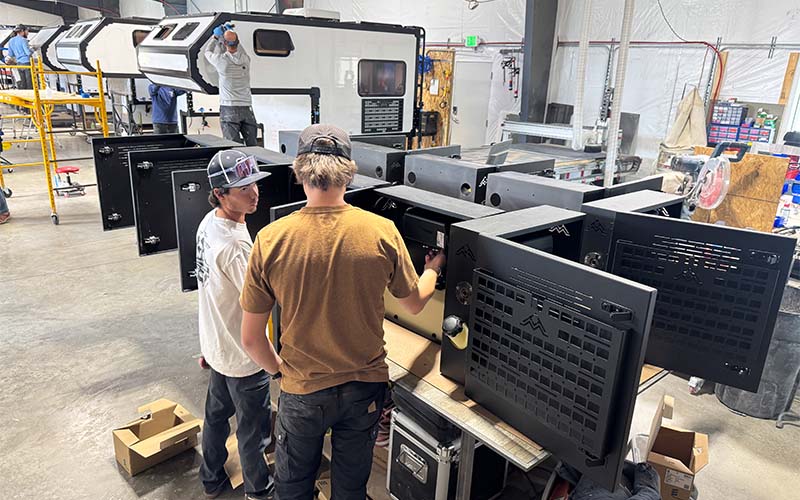
Away from the main production line is the subassembly team. Their mission? Make life easier for everyone else in the building. Here, Orion Botsford (left) and Brock Ferrier (right) are assembling diesel heaters in batches before they’re stacked on shelves and staged for installation. We’ll be checking in on this crew throughout the day.
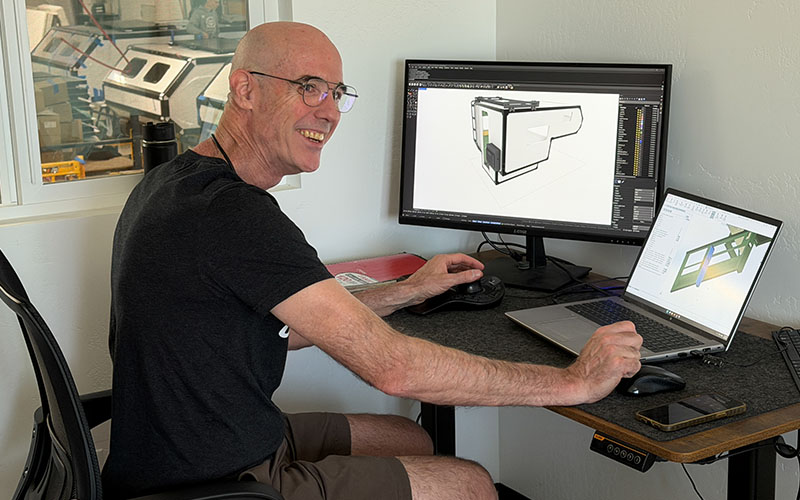
At Outpost, production starts on the computer with CAD Designer, Jason Cross. The composite panels, aluminum extrusions, and aluminum cabinetry are designed in CAD and manufactured in Texas and Indiana before being shipped to Bayfield for assembly.
Jason’s design starts with the owner experience and ends with production efficiency. Drawing from his experience as an architect, he finds creative ways to accomplish both. Most owners will never notice the countless decisions behind a floor plan, cabinet, or storage compartment, but they’ll appreciate the results every time they use their camper.
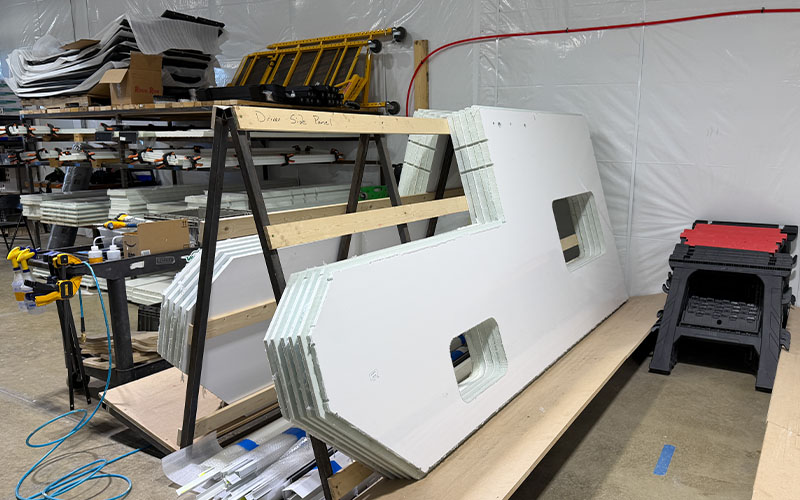
At the far north end of the building is where every Outpost camper begins. The composite panels and aluminum extrusions arrive from Texas ready for assembly, complete with pre-cut openings, registration marks, and channels for wiring. By designing these details into the panels from the outset, Outpost eliminates hand cuts wherever possible, improving quality and streamlining production.
The Outpost 6.5 is built using 1-5/8-inch PET closed-cell composite panels. After a very scientific poke test, we noticed a variety of foam densities.
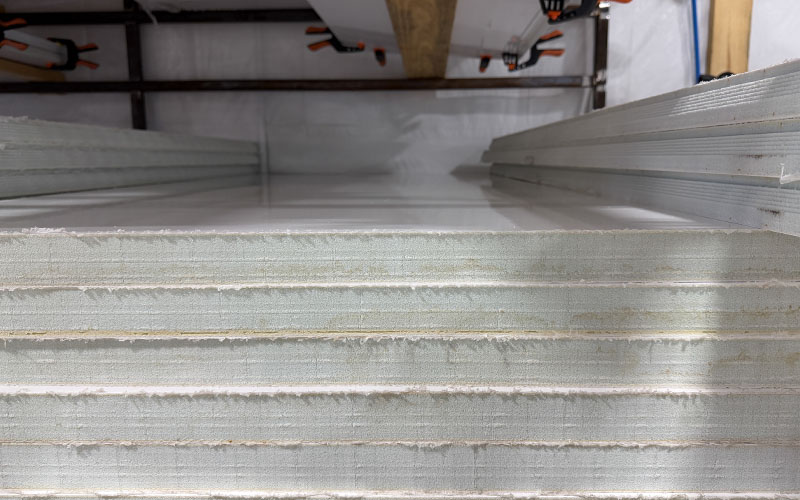
The floor panel is made using a denser foam that provides more rigidity and structural support. The wall and ceiling panels are less dense to save weight and improve insulation.
One of the key details in Outpost’s construction is how they address thermal transfer. Rather than using a single aluminum extrusion, Outpost uses two completely separate extrusion frames—internal and external—to create a thermal break between the outside and inside of the camper.
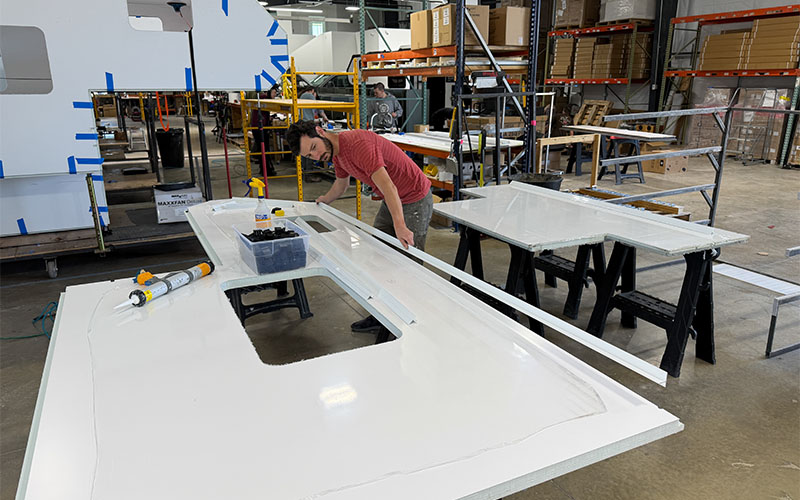
At Stage 1, Steve Padron installs the internal extrusions around the perimeter of each composite panel. Every panel must be finished before the end of the day so the adhesive can cure overnight. If he falls behind, the next day’s production schedule falls behind with him. No pressure, Steve.
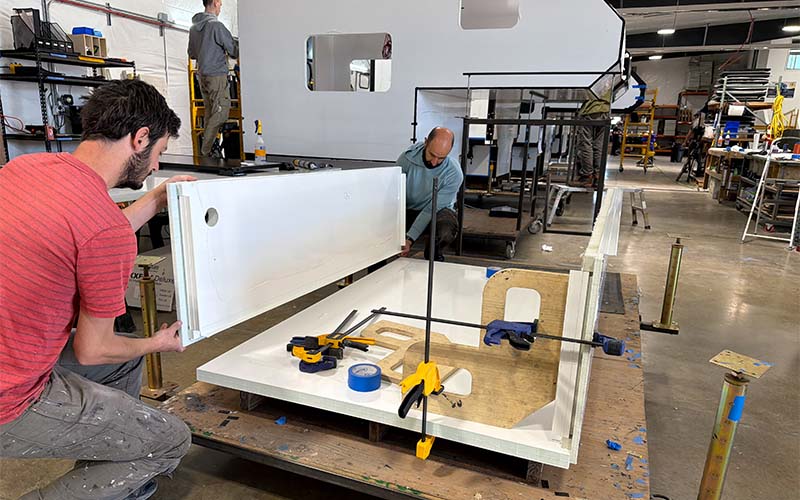
Production Manager Dan Bruce and Steve Padron begin constructing the camper shell at Stage 2. The base is secured with 90-degree custom jigs to ensure everything is straight before the rest of the shell is assembled.
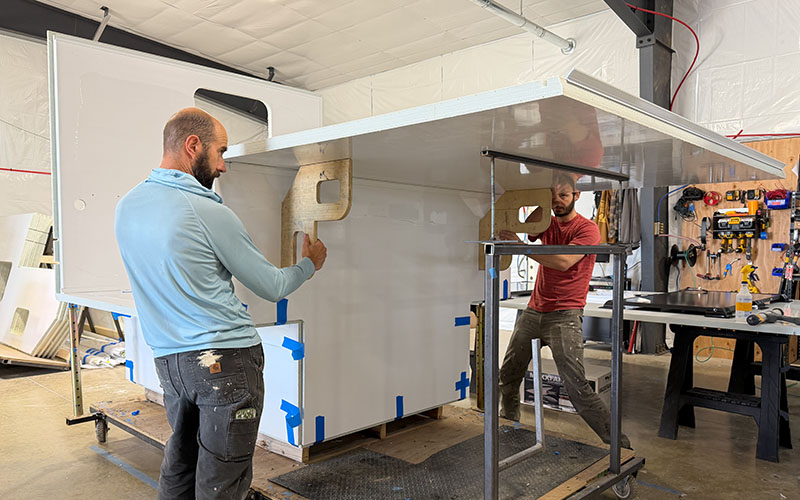
With the front and rear walls in place, Dan and Steve turn their attention to the cabover. Using a custom rolling base, they adjust the height of the composite panel before securing it with more 90-degree custom jigs.
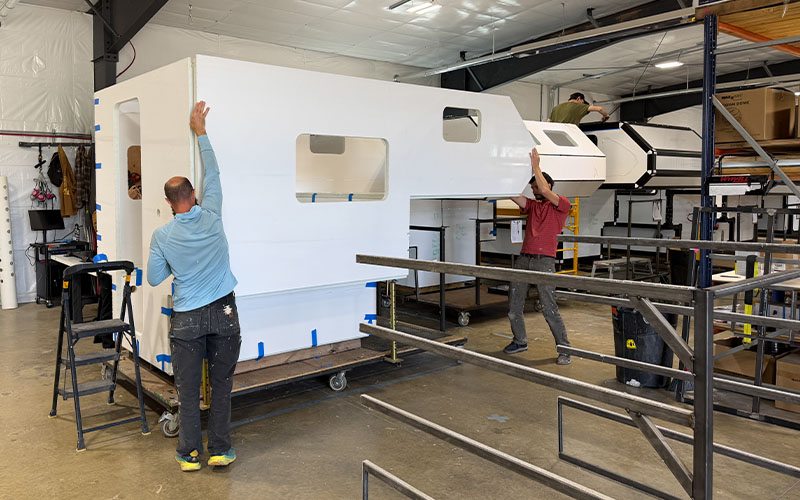
Dan and Steve remove the final side panel from the drying rack and carefully guide it into position. With the shell complete, they call in reinforcements for the most anticipated step in the process—installing the roof.
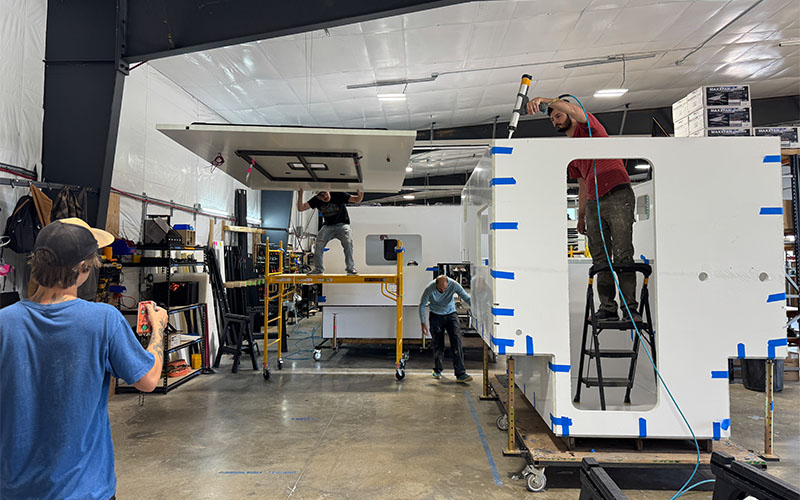
The Outpost team hoisting a roof onto an Outpost 6.5 shell
After threading a winch line through the roof fan opening and attaching it to a custom bracket, Isaiah Vander Rooy (left) raises the roof with the push of a button while Hadrian Devader guides it from scaffolding. Meanwhile, Steve (right) applies adhesive around the perimeter of the shell as Dan releases the caster brakes. Once the adhesive is down, the clock is ticking.
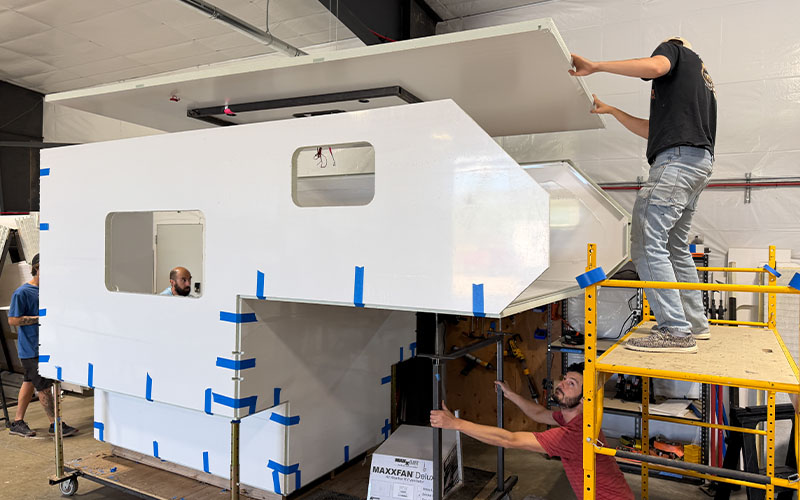
The concentration on the team’s faces matches the moment. With the adhesive applied, Steve and Dan carefully roll the camper beneath the suspended roof while Hadrian guides everything into position from above. Once the adhesive is laid, the team has less than twenty minutes to get the roof aligned, seated, and secured.
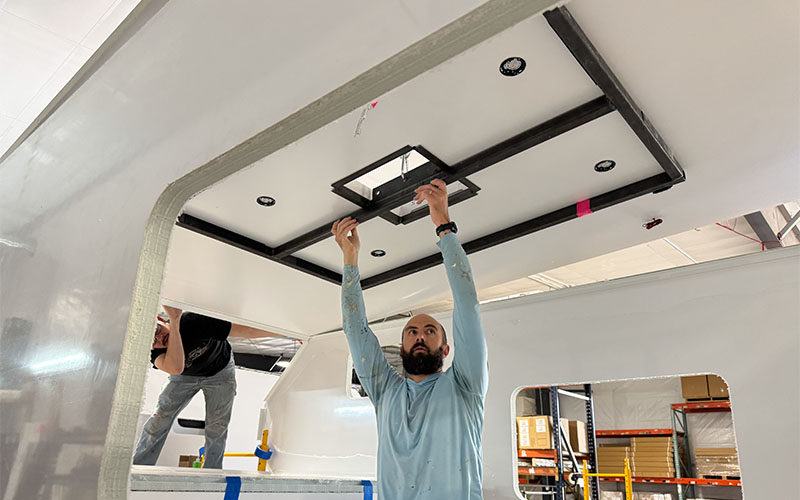
You can learn a lot about a production team by listening to them work. “Down. Left a little. Right there. Slow. Stop. Dan, you good? Yep. Okay. Down.” Nobody was talking over each other. Nobody was having a side conversation. A few minutes later, they stuck the landing.
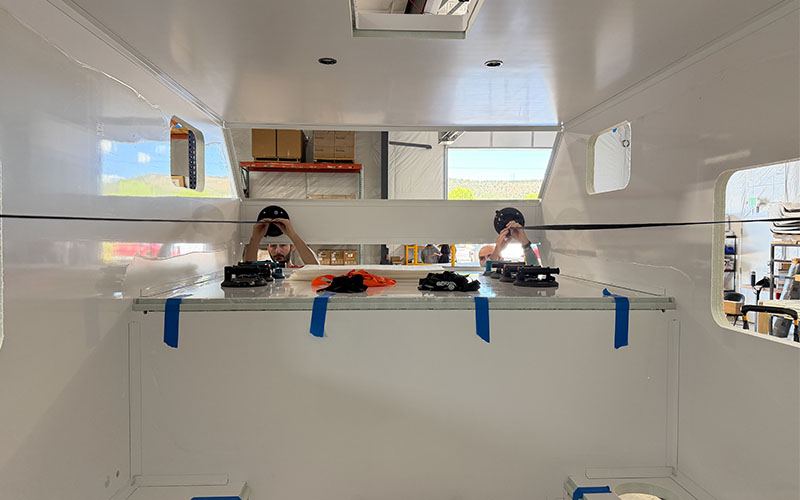
Dan and Steve secure the final nose panels using ratchet straps and construction-grade suction cups, completing the shell.
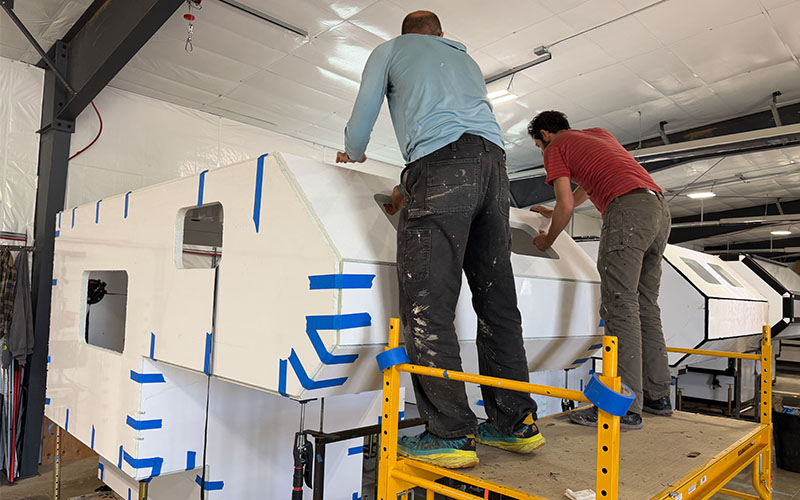
At this point, there’s nothing left to do but let chemistry take over. The camper will now sit untouched for the next twenty hours while the adhesive cures.
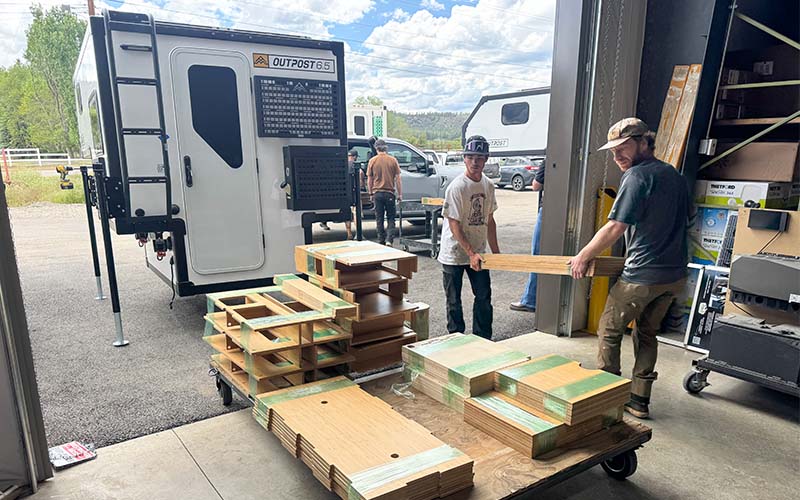
While the composite-panel shell sits untouched to cure, the subassembly team receives a shipment of CNC-cut bamboo cabinets and countertops. The bamboo components are produced by a local father-son business and arrive ready for assembly. This will be the only wood used in the entire camper.
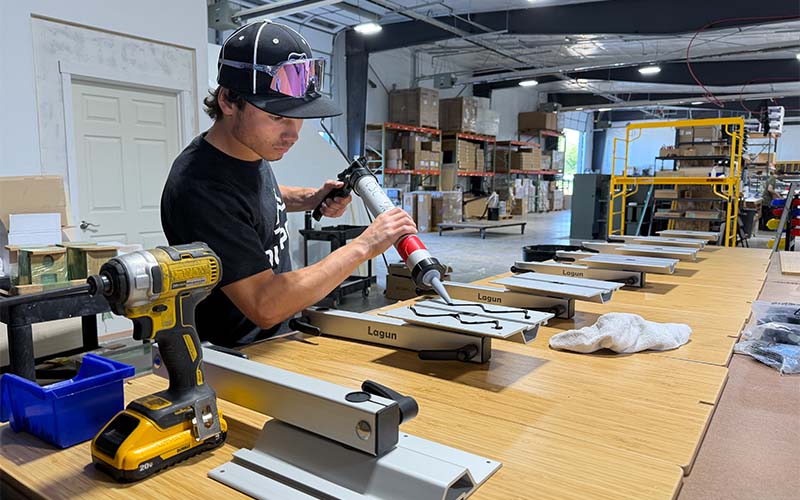
Orion wastes no time prepping a batch of Lagun swivel tables for future campers. Like several members of the Outpost team, he came through the company’s internship program with neighboring Bayfield High School. The partnership provides students with hands-on experience while creating a pipeline of future talent for the growing manufacturer.
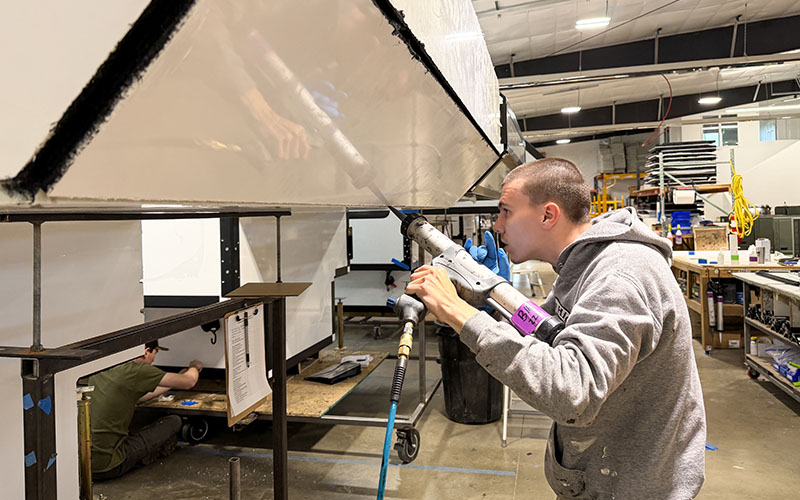
Back on the production line, Jack Grob kicks off Stage 3 by applying adhesive around the entire perimeter of the camper. Before the day is over, these adhesive lines will be hidden behind extrusions, corner caps, and sealants, but they’re a critical part of what keeps the camper sealed.
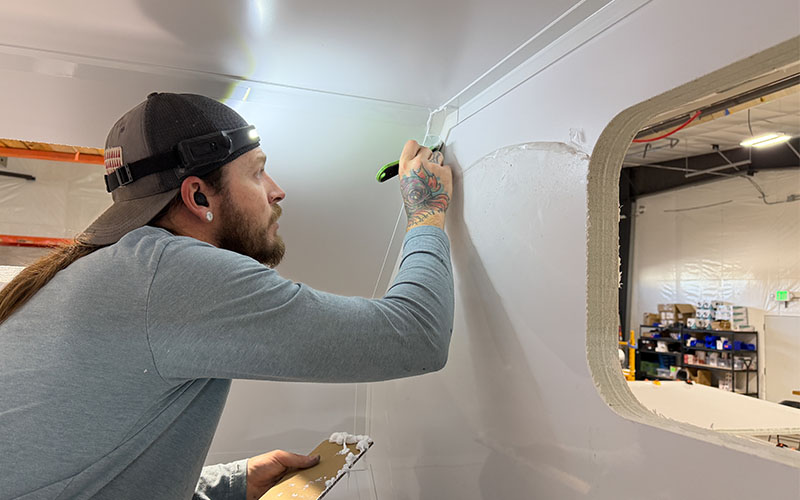
As Jack seals the exterior, Kevin McNeil follows close behind, applying adhesive to the internal extrusions and installing the corner caps. Once this process is complete, the camper is officially watertight. That’s worth noting because the external extrusions—the pieces many people assume provide the weather seal—haven’t even been installed yet.
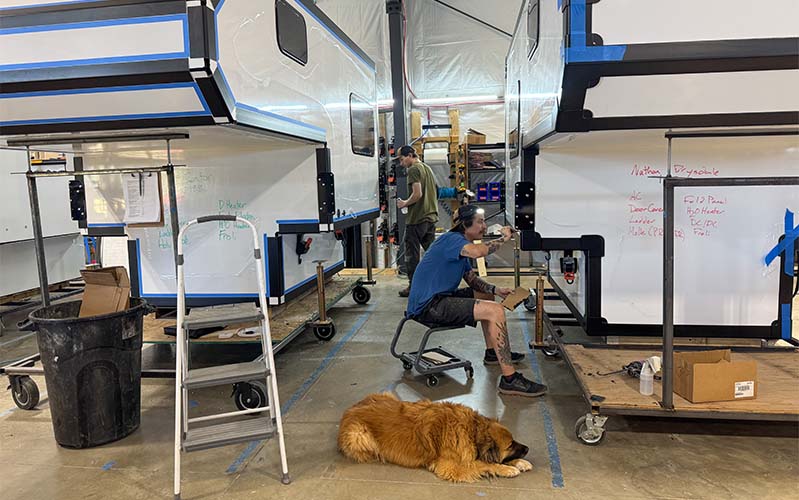
Joey, the team’s four-legged companion, taking a nap between Stage 3 and Stage 4
Now it’s time for the black external extrusions. What this photo doesn’t show is the amount of preparation required before they can be installed. Every surface must be cleaned, wiped with alcohol, lined with adhesive, and misted with water before assembly can begin. It’s meticulous work that rewards patience and attention to detail.
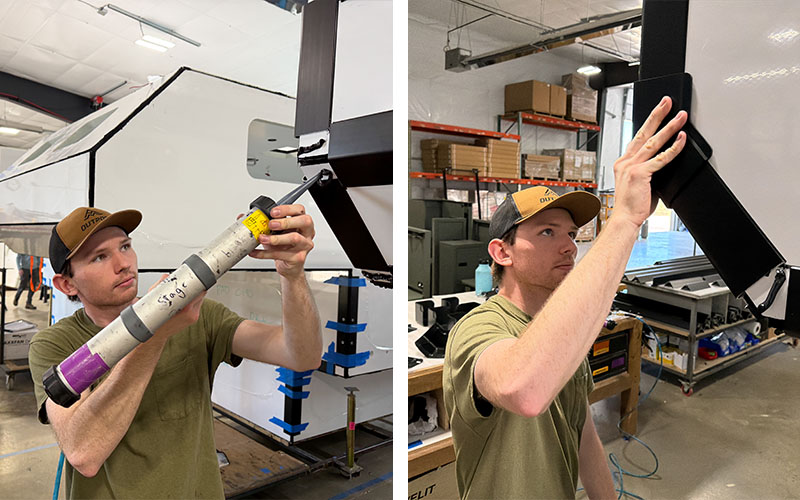
Asher Rehman kicks off Stage 4 by applying Sikaflex-252 and installing the end caps for the external aluminum extrusions. This is one of the final steps in transforming the shell from a functional structure into a finished camper, adding protection and a clean, finished appearance.
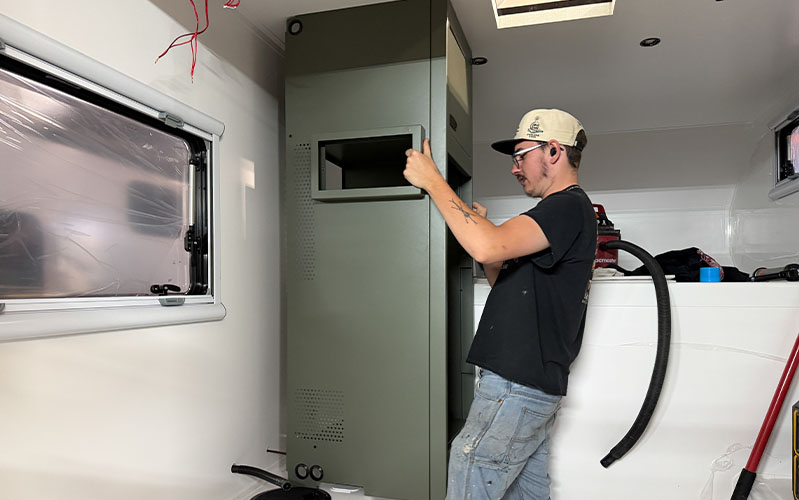
With the camper shell nearing completion, it’s time for the outfit team to join the party. Hadrian sets the first aluminum cabinet into place, which will eventually house the Vitrifrigo 12-volt refrigerator and Outpost’s custom power panel.
The stark white interior won’t last much longer as cabinets, bamboo finishes, upholstery, and appliances begin transforming this composite shell into something that looks and feels like an Outpost camper.
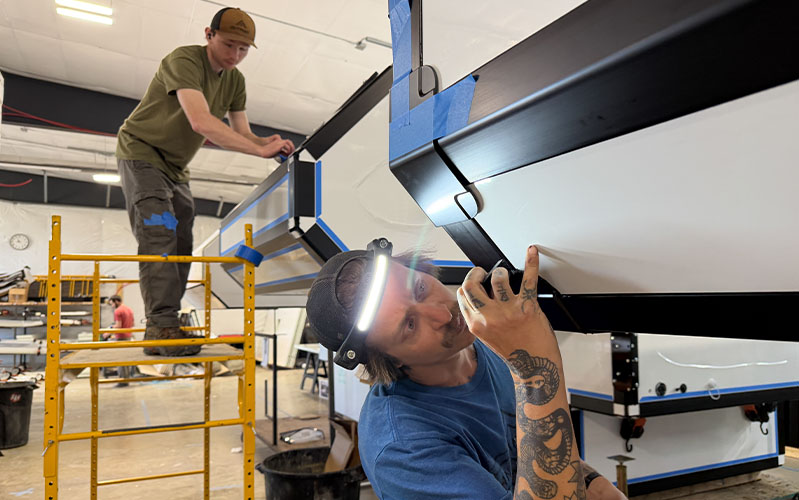
Stage 4 marks the finish line for the shell construction team. Before sending the camper on to outfitting, Isaiah cleans up the seals for the external extrusions and performs a thorough quality control inspection. Once he signs off, the shell is officially complete and ready for its final stage.
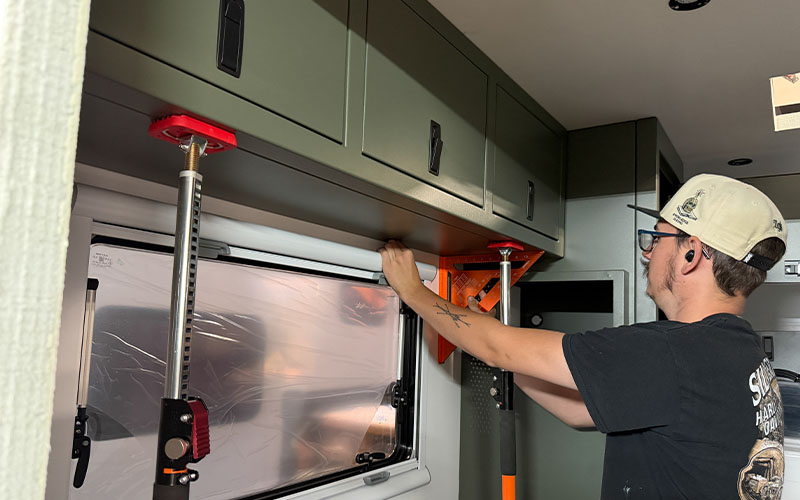
Inside the camper, Hadrian uses third-hand support poles to position the overhead cabinets—no measuring or trimming required. Made in Indiana, the powder-coated aluminum cabinets are an example of Outpost’s outsourcing philosophy, allowing them to focus internal efforts on assembly and quality control.
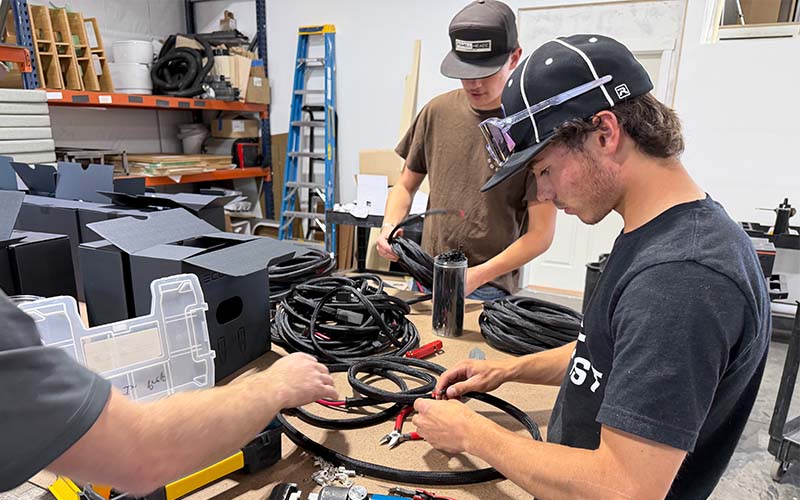
If you think the subassembly team has been slacking, think again. These guys are on to their third, fourth, maybe even fifth project of the day. I’ve lost track.
This time, they’ve unboxed a shipment of EcoFlow components, trimmed the wires, added connections, and repackaged everything into installation-ready kits. When the outfitting team needs an electrical system, they’ll grab a kit that’s organized and ready to go.
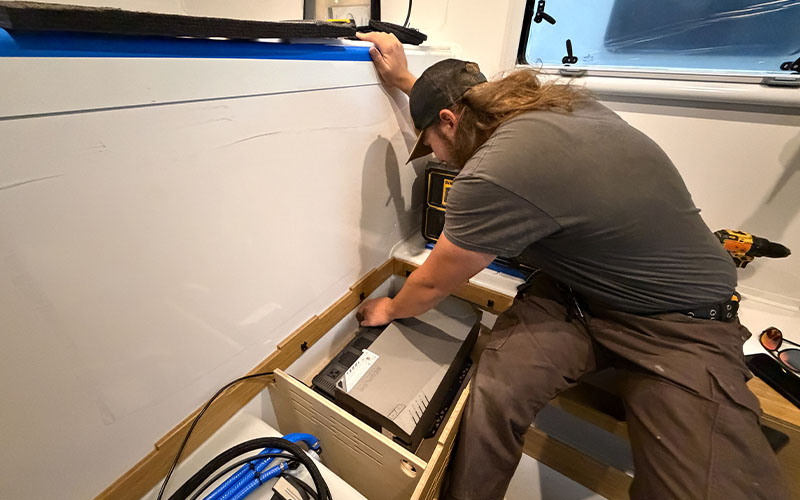
With the aluminum cabinets in place, Connor Smith jumps in to assemble the bamboo cabinetry, water tank, and 48-volt EcoFlow power system. Connor’s movements were swift, practiced, and precise. This is when I really noticed what having one model with one floor plan means for a production line—efficiency.
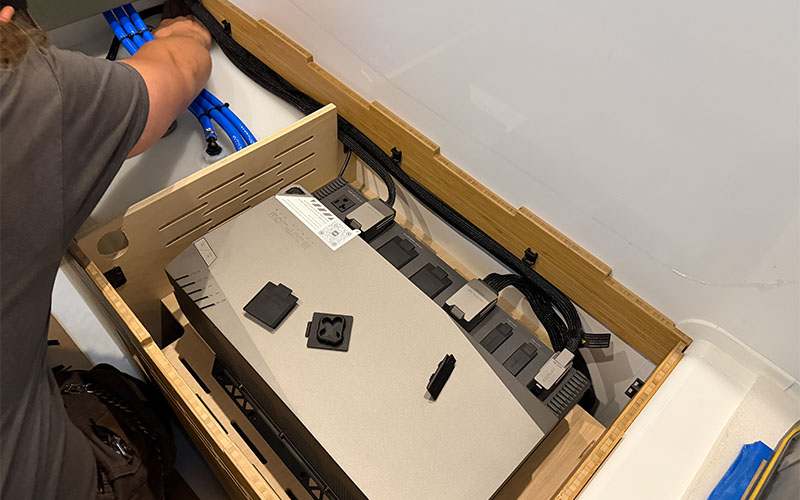
EcoFlow power system being wired underneath the front bench seat
Connor’s familiarity with the system and attention to detail keep everything tidy, but so does the power system itself. Rather than assembling a complicated collection of individual electrical components made by different companies, Outpost uses a plug-and-play EcoFlow system consisting of a battery, control module, fuse block, and touchscreen display designed to seamlessly integrate together.
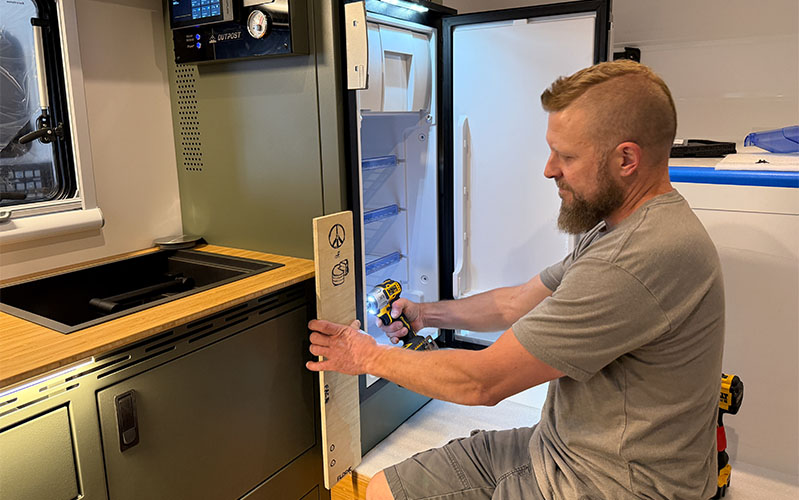
Kevin Pearson plugs the Vitrifrigo 12-volt refrigerator into the aluminum cabinet like a match made in SketchUp. According to the artwork on his custom template, pictured above, it’s a piece of cake.
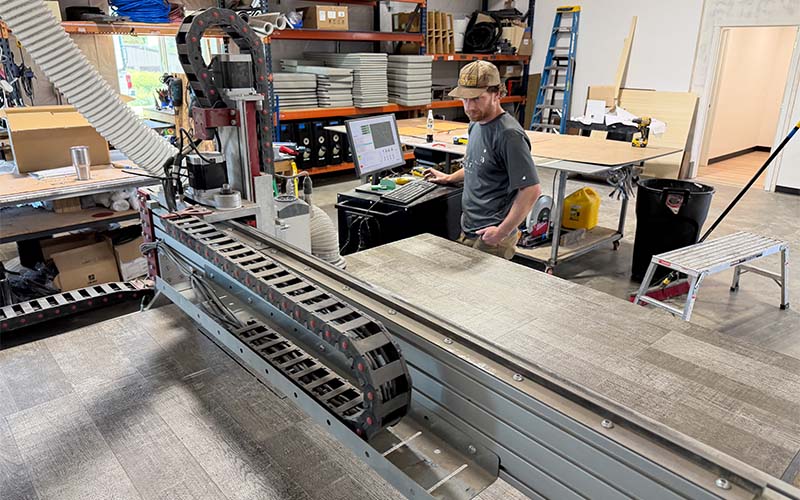
When Subassembly Manager Spencer Woodard fired up the CNC machine, I realized how quiet the factory had been all day. Even for the loudest machine in the shop, I could still hear Shania Twain playing in the background.
Nearly ten years ago, Outpost Co-Founder Kurt Pattinson built this CNC machine by hand using aluminum extrusion. Today, Outpost uses it to cut the subfloor out of Coosa Board. This is a lightweight, rot-proof composite material that’s becoming increasingly common in modern truck campers.
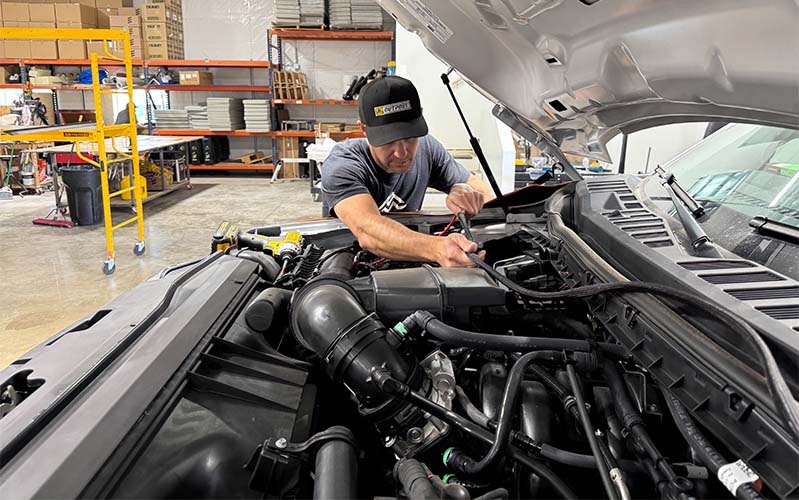
Speaking of Kurt, a customer from Idaho arrives to pick up an Outpost 6.5. Rather than watching from the sidelines, Kurt is already underneath the hood and wiring the truck for DC-to-DC charging.
That’s one of the advantages of a smaller manufacturer. The company’s Co-Founder might also be the guy helping install your camper. At Outpost, titles are a lot less important than getting the job done.
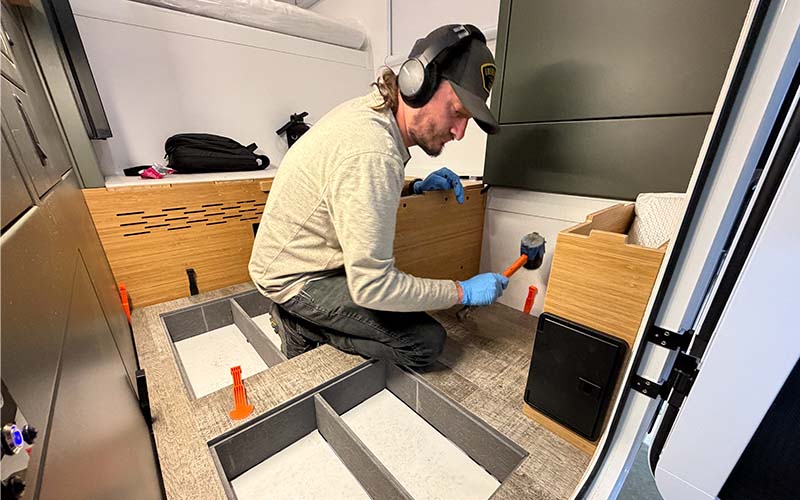
Upfitting Manager Dave Arnold spends most of his day at the end of the production line in Stage 5, where campers receive their final components and finishing touches. Here, Dave installs the CNC cut Coosa subfloor using spacers and a mallet to ensure the topsheet seats evenly across the floor.
Dave displayed unwavering confidence working with Sikaflex-252 inches away from finished cabinetry, fabric cushions, and freshly completed surfaces. By this point in the build, one careless move could create a lot of extra work. Dave never seemed remotely concerned. After watching him work for a while, neither were we.
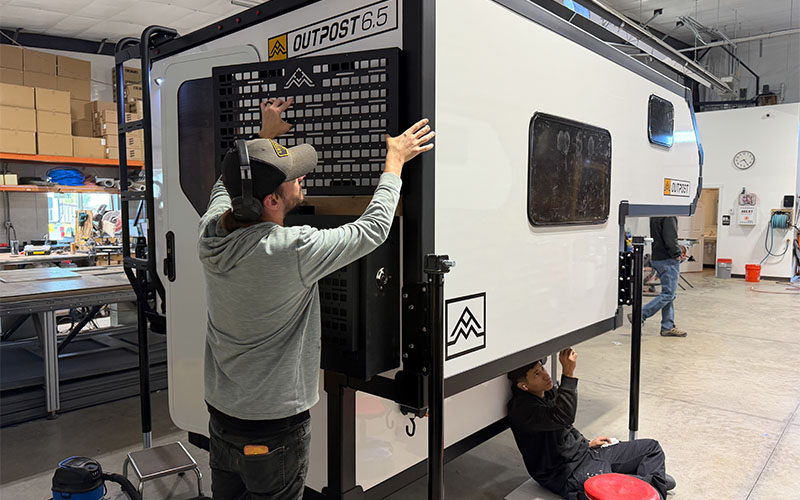
Back outside the camper, Dave joins Aiden Martinez for a final cleanup and quality control inspection. Watching Dave and Aiden was a reminder that finishing work requires a different kind of focus. Judging by the headphones and facial expressions, these two were locked in.
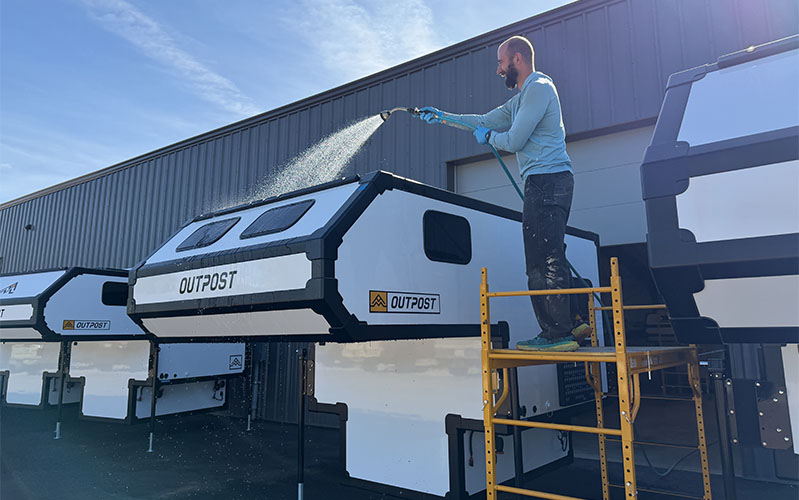
Every Outpost gets a thorough spray-down water test from all angles, followed by a detailed leak inspection of the interior and exterior. After spending the day watching the team obsess over sealants, extrusions, adhesives, and corner caps, this felt like the final exam.
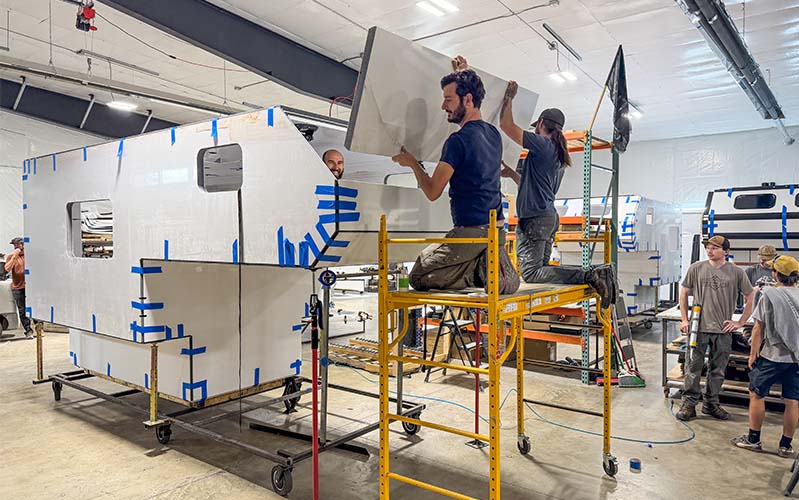
The Outpost team was nearing the end of their four-day, forty-hour workweek when I noticed a migration begin. One by one, people started drifting toward the north end of the building. Then a few more. Then a few more after that.
Nobody made an announcement. Nobody called a meeting. Nobody said, “Hey, we need help over here.” The team knew that internal extrusions still needed to be bonded, and a shell had yet to be constructed. If those stages weren’t completed before the weekend, Monday morning would start one step behind.
Before long, it was all hands on deck, like the Outpost team was answering a silent 4:30 p.m. dinner bell. It may not have been their station, but it was their camper.
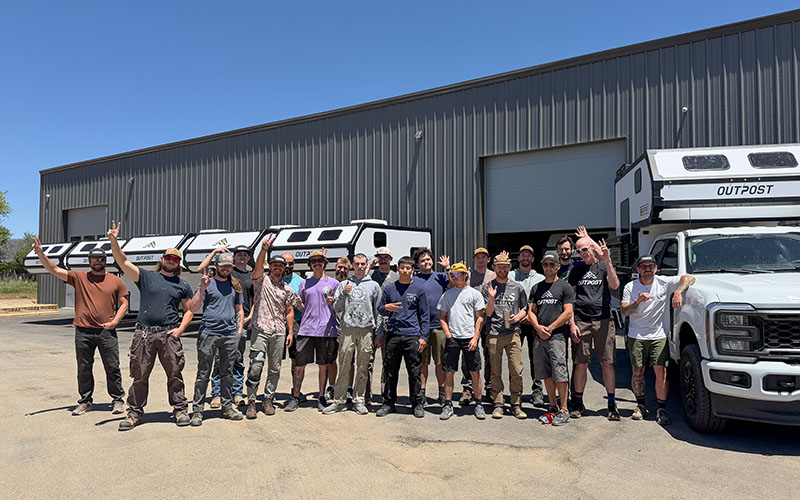
That team mindset showed up repeatedly in our conversations with Outpost Co-Founder, Taylor Ripp. Ask him about a new process, and he’ll talk about the people who developed it. Ask about production growth, and he’ll point to the team that made it possible. By the end of our visit, we started noticing that success was rarely described as an individual achievement, but rather as a group effort.
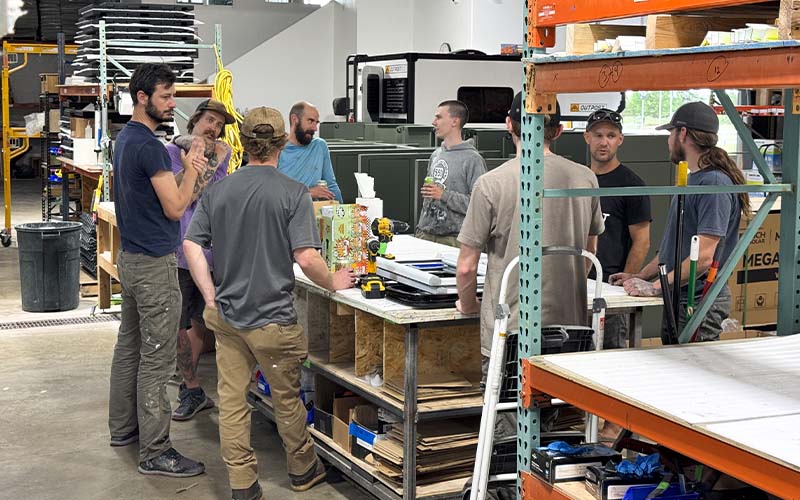
The Outpost team hanging out after hours before their three-day weekend
Outpost 8 Coming Soon
Sometimes you just get lucky, and boy, did we hit the jackpot. It just so happened that the Thursday afternoon shell was the final production prototype of Outpost’s upcoming long bed camper—the Outpost 8.
The Outpost 8 will feature the company’s first wet bath, along with an extended cabover for north-south sleeping. That’s all I can share for now; you’ll have to wait for the full announcement when it’s ready.
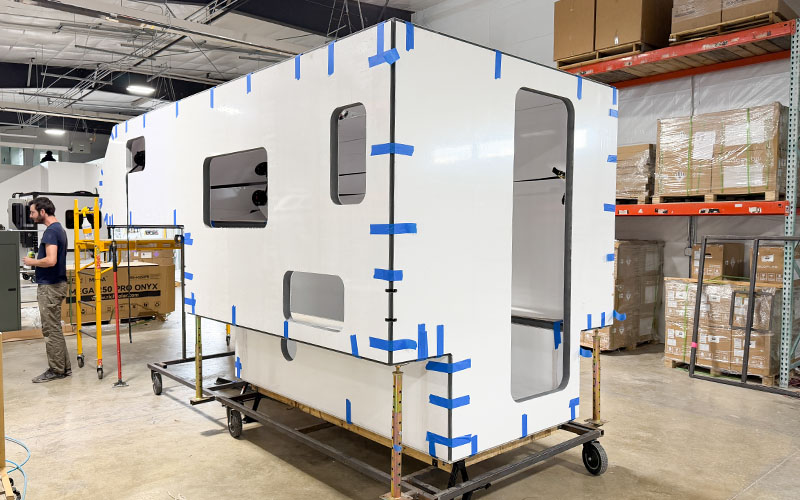
Outpost 8 production prototype shell
Less than a year after moving into their current facility, Outpost is already planning a significant expansion. The north end of the building is being extended, and a second production line for a new model is already taking shape. Judging by what appeared over the facility during our visit, the future of Outpost might literally be waiting at the end of the rainbow.
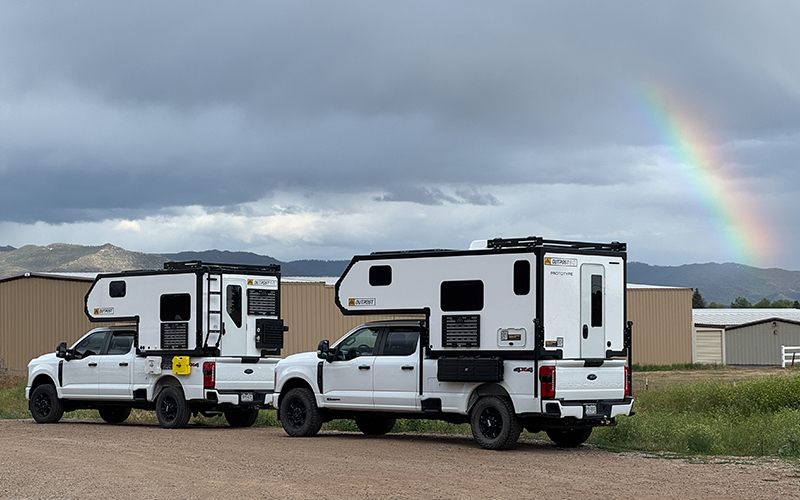
Outpost 6.5 (left) and Outpost 8 Prototype (right)
We’ll continue to keep tabs on this fast-moving company out of Bayfield, Colorado, and you better believe we’ll be the first to give you an in-depth look at the production debut of the Outpost 8.
For more information about Outpost Campers, visit their website at outpost-campers.com. Click here for an Outpost Camper brochure.