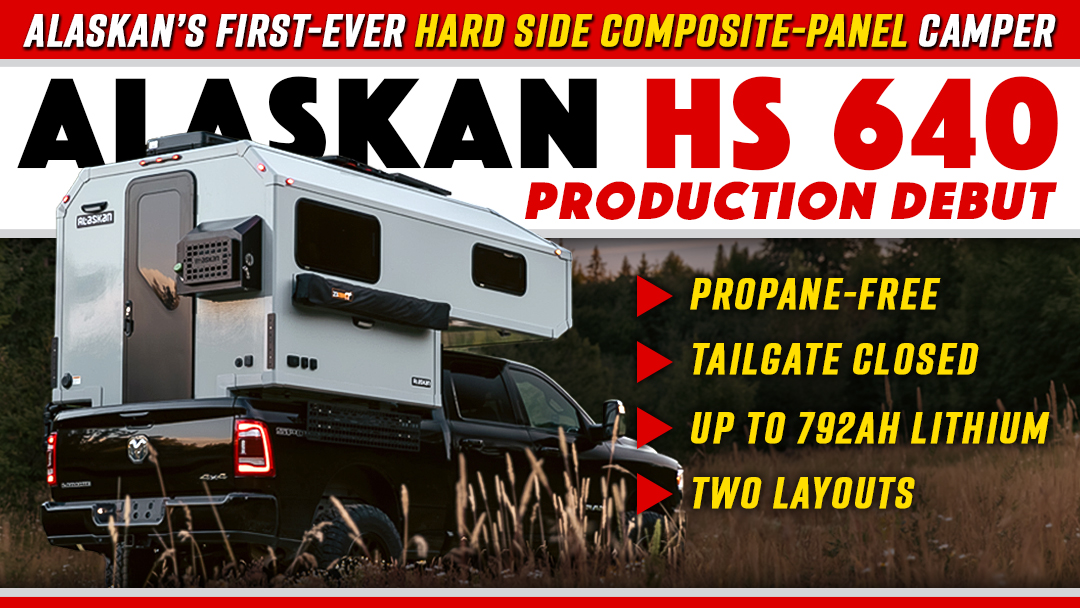
Since the HS 640 renderings were released this spring, anticipation has been building for Alaskan Campers’ first composite-panel hard side truck camper. From CAD to reality, the production HS 640 has officially arrived. The Alaskan HS era is here.
For nearly seventy years, Alaskan’s hard-sided pop-up campers have been recognized for their low-profile design, four-season capability, and unmistakable aesthetic. While the camper has continuously progressed over the decades, its core identity has remained remarkably consistent.
That changed when Alaskan revealed renderings of the HS 640 earlier this year. The HS 640 is not only Alaskan’s first hard side truck camper in decades, but also the company’s first composite-panel camper, the first propane-free design, and the first step toward an entirely new camper made to complement—not replace—the traditional Alaskan pop-up lineup.
Perhaps the most compelling part of the HS 640 story is how much it was shaped by consumer feedback. Requests for a diesel heater, tankless water heater, acrylic windows, and internal tie-downs all found their way into the final design. Even the final floor plans reflected that same customer-first approach.
Alaskan started with four floor plan concepts, but after seeing how people responded to the HS 640 renderings, they simplified the production lineup to two choices. Layout 1 emphasizes seating, while Layout 2 includes a full-height cabinet for increased storage.
For Alaskan, the HS 640 marks the beginning of an entirely new product category and manufacturing process. For future owners, it opens the door to a new kind of Alaskan that combines nearly seventy years of truck camper experience with composite-panel construction and customer-driven innovations.
To learn how this ambitious project came together, we talked to Nick Coursolle, Vice President of Alaskan Campers.
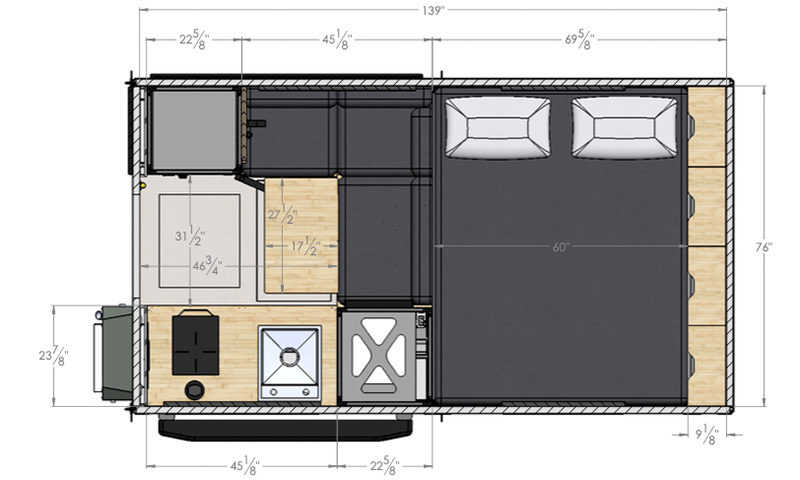
Alaskan HS 640 Layout 2 floor plan
The Alaskan Campers HS 640 is a hard side, non-slide truck camper made for short bed trucks. The interior floor length of the HS 640 is 5′ 8’’, the interior height is 6’5’’, and the center of gravity is approximately 24″ behind the front wall.
The HS 640 has a 15 gallon fresh tank, an optional portable toilet, on-demand water heater, and diesel heater.
Alaskan Camper is reporting the loaded weight of the HS 640 with Layout 2 at 1,976 pounds. The MSRP for the HS 640 with Layout 2 is $48,995 USD.
Click here for more information on the Alaskan HS 640.
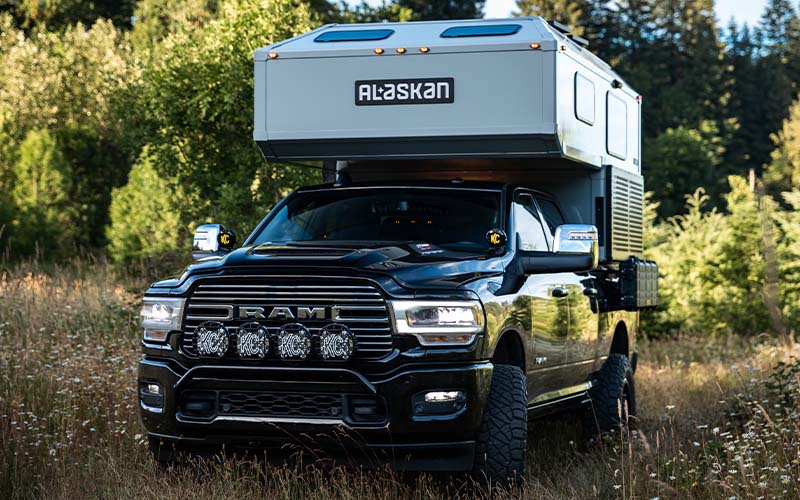
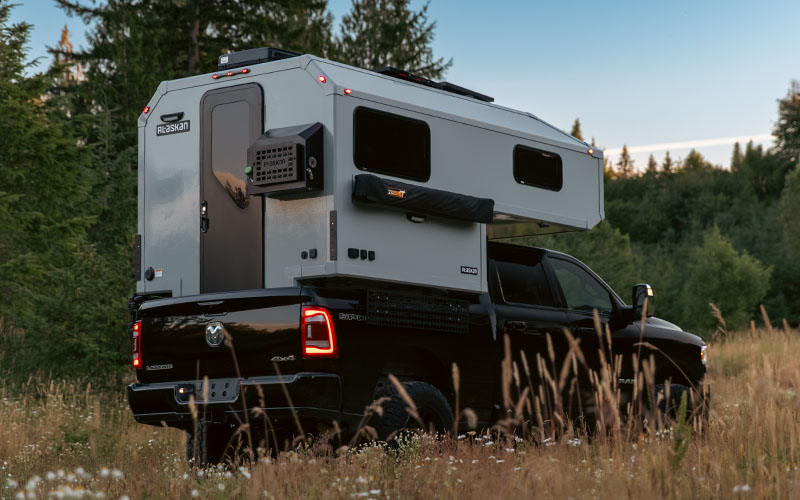
All photos in this article are of Layout 2 of the HS 640, and all images were provided by Alaskan Campers.
The HS 640 is not only Alaskan’s first hard side camper in decades, but also the brand’s first composite-panel camper. What set Alaskan Campers down this path?
Our original goal was to make a lighter camper. When you compare Alaskan Campers to most of the hard side campers on the market, they’re considered lightweight. But within the pop-up truck camper segment, they’re on the heavier end of the spectrum.
We were getting so many calls from half-ton truck owners who loved the idea of an Alaskan, but we had to steer them away due to payload limitations. That became the driving force behind the project.
Our engineering team experimented with aluminum framing and even built a complete aluminum-frame camper. We expected major weight savings, but in reality, we only shaved a few hundred pounds. That wasn’t enough to reach the customers we were trying to serve.
That’s what led us to experiment with composites. Composite-panel technology has come a long way over the past several years, and once we dove into the research, we realized it was the best path to building the lighter camper we envisioned.
We appreciate your transparency with half-ton truck owners. What convinced Alaskan to pursue a hard side design?
Alaskan owners use their campers everywhere and in every season. We wanted to build the most weather-tight camper possible, and a fully enclosed hard side design gave us the best opportunity to do that.
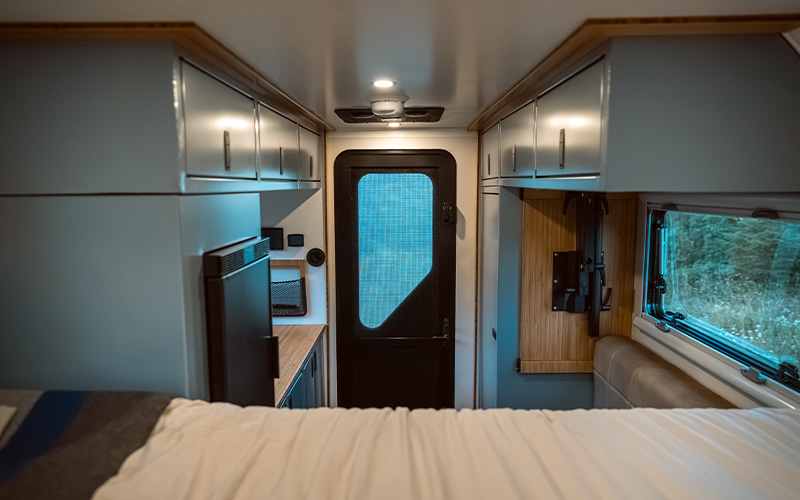
At the same time, the HS 640 allowed us to reach an entirely new group of truck camper owners who may never have considered a traditional Alaskan pop-up. It gives us two very different campers, each designed for a different type of customer.
The HS 640 is being built in Alaskan’s new 15,000-square-foot production facility. What does that expansion mean for the company?
We wanted to grow, but we reached the limits of our original facility. When a 15,000-square-foot building became available across the street, we jumped at the opportunity to expand our production capacity and create space for an entirely new product line.
Today we have two dedicated production facilities. Our original building continues to build our wood-framed hard side pop-up campers, while the new facility is dedicated exclusively to composite-panel construction. That separation gives us the flexibility to continue innovating without interrupting production of the traditional Alaskan lineup.
What was it like learning an entirely new construction technique?
Learning composite-panel construction forced us to rethink every step of our manufacturing process. It challenged our team to look beyond the way we’d always done things and discover new ways to design and build a camper.
Seven team members have been focused exclusively on the HS 640 project. They spent the better part of a year learning, testing, and refining the new construction methods. Some parts of the process turned out to be simpler than we expected, while others presented entirely new challenges.
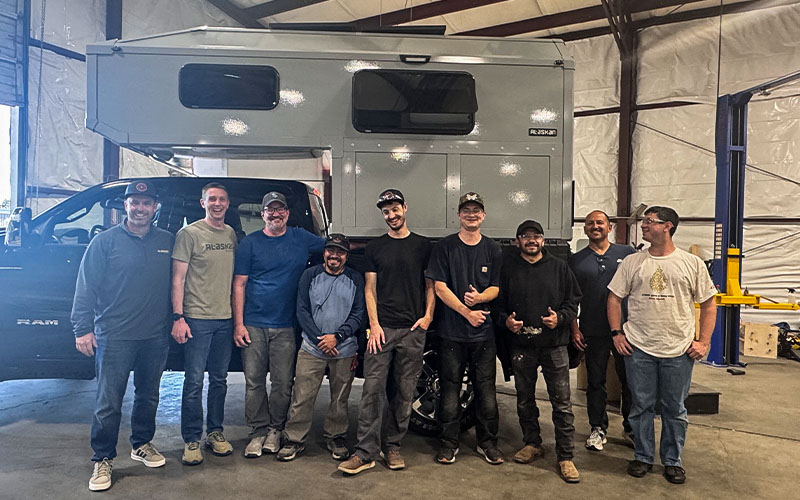
Left to right: Nick Coursolle, Vice President, Rob Scheele, CEO, and Alaskan’s HS 640 team next to the first production HS 640
We’ve learned a lot along the way, and those lessons are not limited to the HS 640. We are already applying what we’ve learned to improve our traditional Alaskan campers.
The HS 640 looks very different from a traditional Alaskan. Was there discussion about maintaining the classic Alaskan appearance?
There absolutely was. After going back and forth, the team decided that Alaskan should create something completely different. The goal of the HS 640 was to create a modern, clean, and functional camper.
The HS 640 is a different product for a completely different customer, and that’s what makes this new direction so exciting.
Did the HS 640 begin with CAD, a physical prototype, or both?
The HS 640 began with months of engineering work and CAD modeling. Countless hours were spent evaluating materials, refining designs, and exploring different concepts before a single panel was assembled.
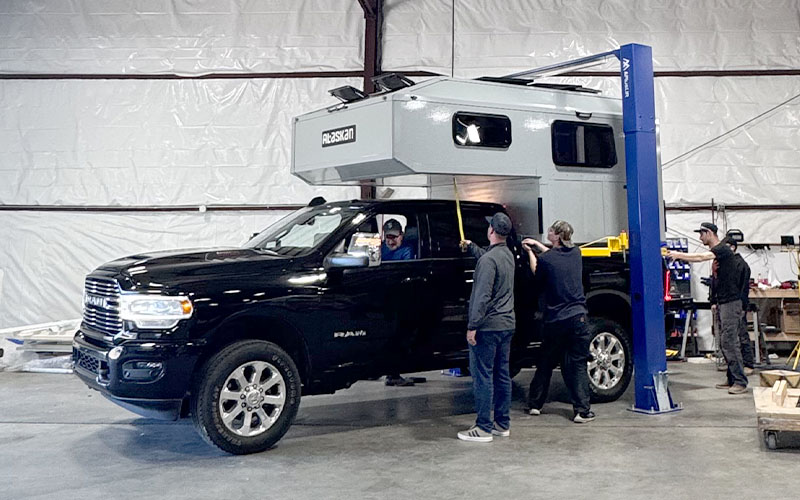
The HS 640 digital models eventually became full-size composite-panel shells, and then fully built prototypes.
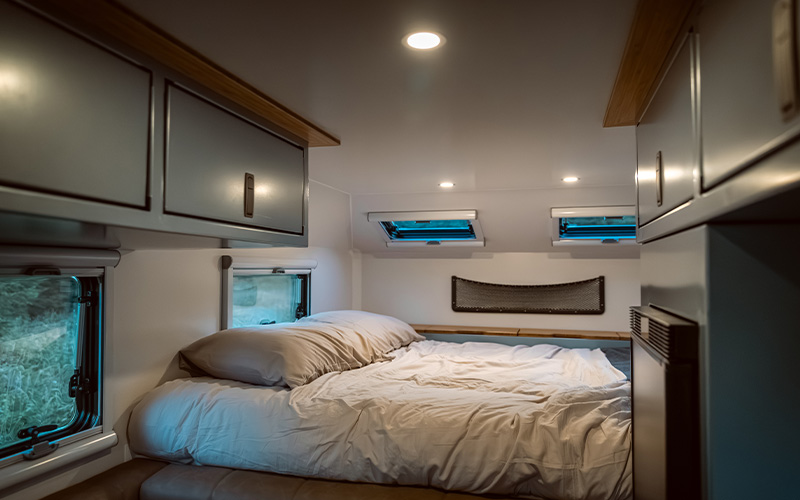
From there, it became a process of testing, refining, and making incremental improvements until we arrived at the production-ready HS 640.
“The HS 640 is a different product for a completely different customer, and that’s what makes this new direction so exciting.”
You’re not revealing your panel source at this time, but can you tell us about where they were sourced geographically?
Our composite-panel system is made in the USA.
Walk us through the HS 640’s composite-panel construction.
The HS 640 walls are built from 1.5-inch-thick composite panels with PIR foam insulation and fiberglass skin. The materials are completely rot-proof and have an R11 insulation rating, giving the HS 640 excellent four-season performance.
The HS 640 also uses a patent-pending aluminum and PVC framing system designed to reduce thermal bridging. The combination of aluminum and PVC helps limit temperature transfer through the frame, reducing condensation and improving thermal performance.
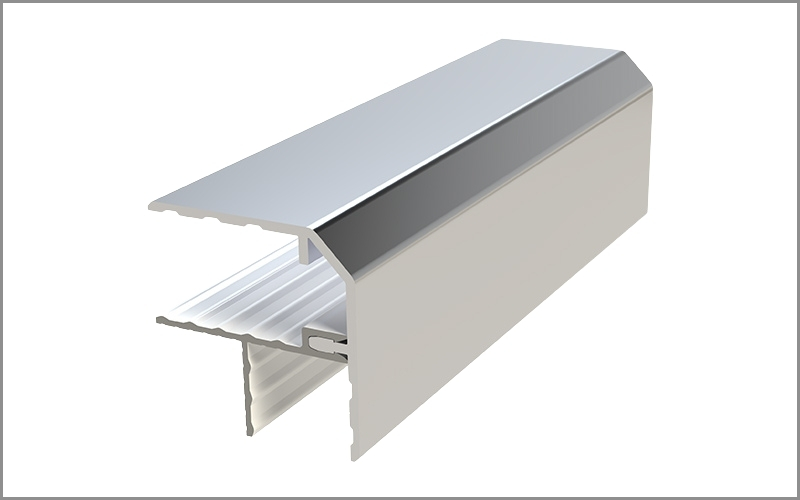
Alaskan HS 640 patent-pending aluminum and PVC frame
Building a composite-panel camper is all about trusting the bond between the panels and the frame, so we wanted an adhesive with a proven track record. That’s why we chose the same type of structural adhesives trusted throughout the marine industry.
How did the renderings influence the final Alaskan HS 640 floor plan options?
We originally explored four floor plans, but after sharing the renderings and gathering feedback, we noticed that people consistently gravitated toward two of them.
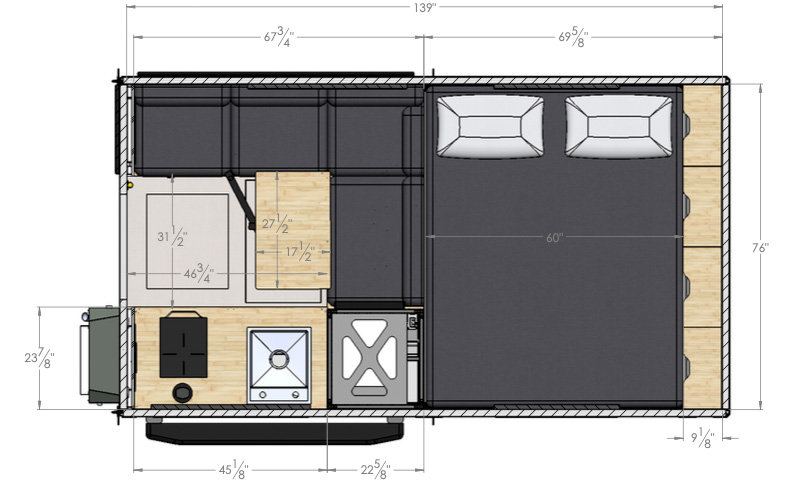
HS 640 Layout 1 (left) and Layout 2 (right)
HS 640 buyers can choose between two floor plans. Layout 1 prioritizes seating, while Layout 2 incorporates a large floor-to-ceiling cabinet for additional storage. Everything else in the camper remains the same.
The Alaskan HS 640 is designed to fit within the truck’s footprint with the tailgate closed. Why was that a priority?
We kept hearing from customers that they wanted to retain their factory backup camera, integrated step system, and everything else that comes with the tailgate. That’s what led us to develop the Alaskan 630 SI.
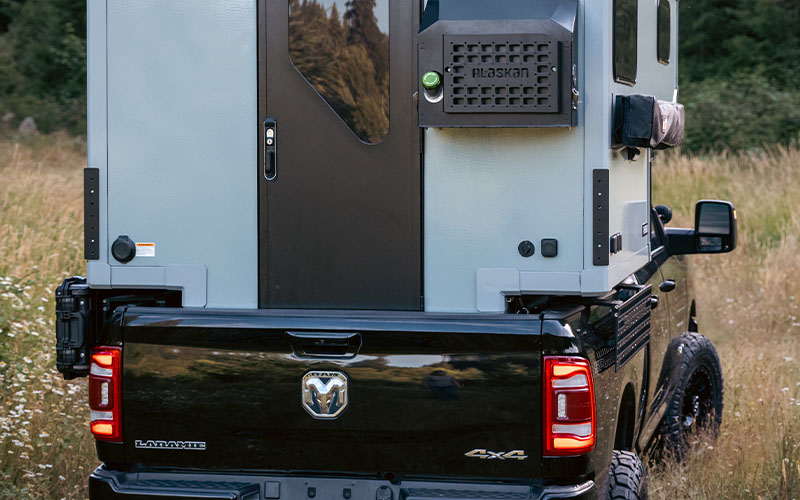
Just as importantly, designing the HS 640 to stay within the truck’s footprint reduces the overall weight.
Where is the center of gravity located in the HS 640?
The center of gravity is two feet behind the front wall, depending on which layout and options are chosen.
Does the Alaskan HS 640 have a basement?
Yes. We located the major systems inside the cabinetry and seating, so the entire five-inch basement is dedicated to storage.
Why did you choose dual-pane acrylic windows?
Dual-pane acrylic windows are significantly lighter than glass windows while also providing excellent insulation. Alaskan customers have asked for acrylic windows for years, and designing the HS 640 from the ground up allowed us to incorporate them.
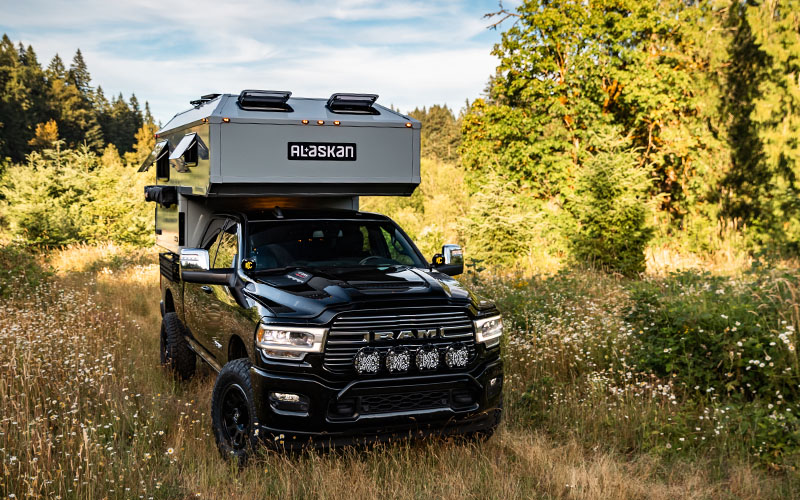
How extensive are the paint-match options for customers who want the camper color matched to their truck?
Any factory truck color can be paint-matched on the HS 640. We’ve partnered with a local automotive paint shop that specializes in matching OEM finishes.
Does this camper use internal or external tie-down and turnbuckle systems?
The HS 640 is Alaskan’s first camper to feature an internal tie-down system. It’s another thing that customers have requested, but the tight tolerances of the traditional Alaskan pop-up made it difficult to incorporate.
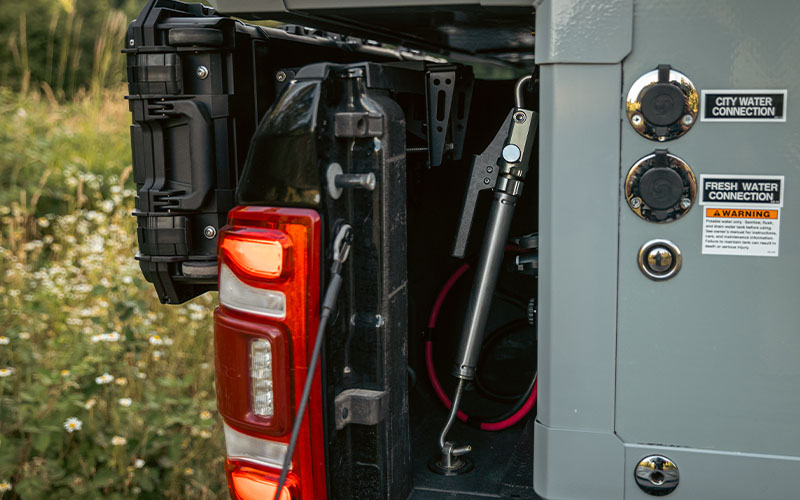
Alaskan HS 640 with Torklift Apex internal tie-down and turnbuckle system
We’re outfitting the HS 640 with Torklift Apex internal turnbuckles. Our engineers are exploring ways to bring internal tie-downs to the traditional Alaskan lineup in the future as well.
Why did Alaskan choose aluminum cabinets for the HS 640?
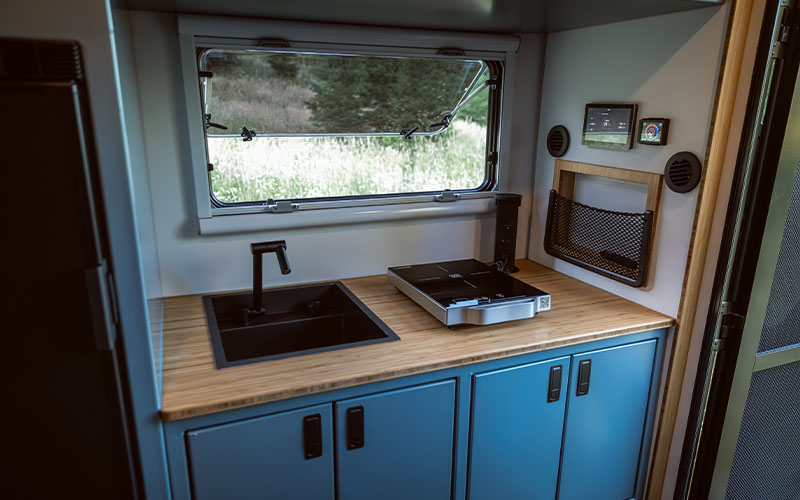
Aluminum cabinets fit the modern direction of the HS 640 while reducing weight. They also give owners the opportunity to personalize the interior with blue, gray, green, or beige powder-coated finishes.
How did customer feedback influence the heating and hot water systems in the HS 640?
Two of the most requested features from Alaskan customers have been a diesel heater and an on-demand tankless water heater. This was the driving force to design our first propane-free camper.
For diesel truck owners, a diesel heater means one less fuel source to manage. According to the manufacturer, the diesel heater operates at elevations up to 14,000 feet and can run continuously for more than two weeks on its two-gallon fuel tank.
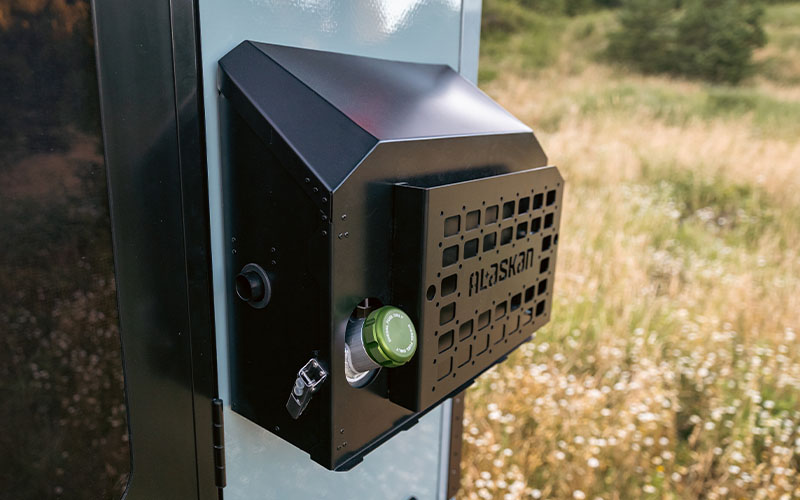
Diesel heater mounted to the rear wall of the HS 640
The electric tankless water heater provides instant hot water for the sink and shower while saving weight. The HS 640 can also be optioned with a Guzzle multi-stage water filtration system that allows owners to filter water from natural sources while camping off-grid.
To stay propane-free, the HS 640 will have an optional induction cooktop.
What air conditioner is available in the HS 640?
The HS 640 features a Nomadic 12-volt rooftop air conditioner designed to operate from shore power or the camper’s Victron electrical system and lithium battery bank.
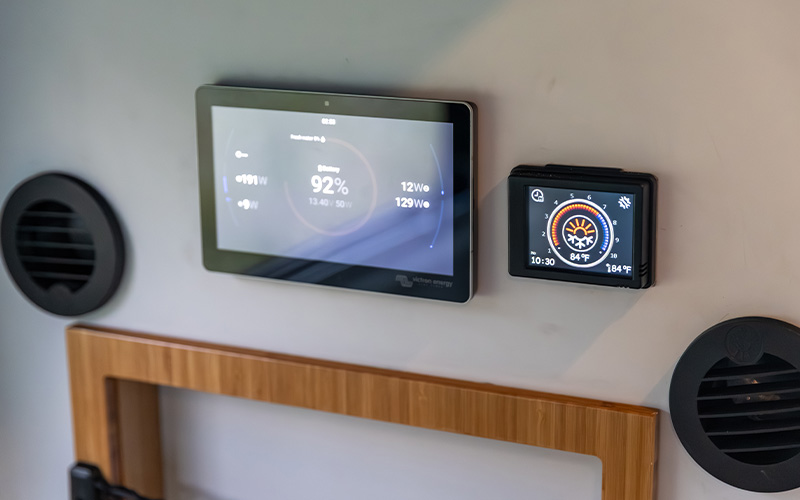
Victron GX Touch display (left) and thermostat (right)
What refrigerator comes standard in the HS 640?
We chose a 90-liter Isotherm refrigerator with a dedicated freezer compartment.
With so many electrically powered systems, how does the HS 640 support extended off-grid camping?
It comes down to selecting the right battery capacity for the options you choose.
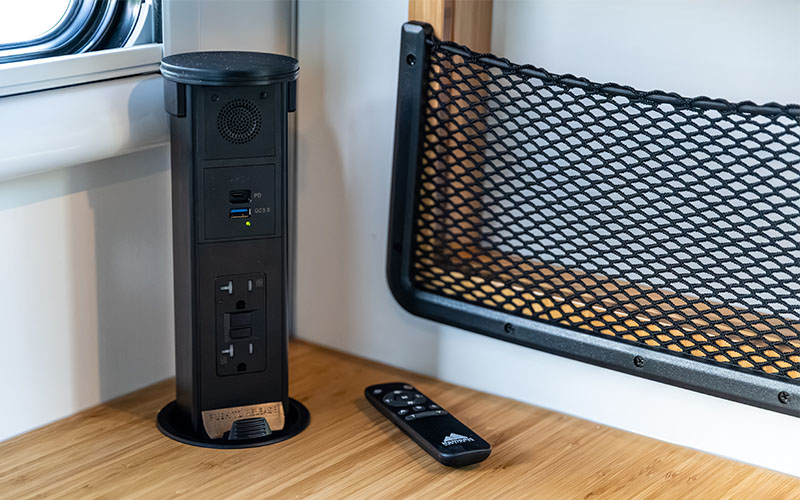
Pop-up outlet tower with USB-C, USB-A, and two AC outlets
The standard system includes two 162Ah Expion360 lithium batteries, a 3,000-watt Victron inverter, and a 200-watt roof-mounted solar panel. Included as standard is a 50-amp DC-to-DC charger and a Victron GX Touch display for monitoring and managing the camper’s electrical systems.
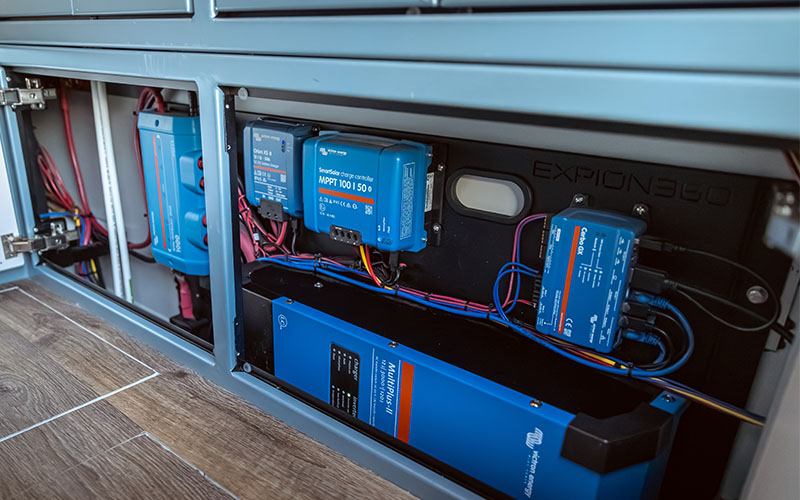
HS 640 power system with Victron components
Owners can expand the system with four additional 162Ah batteries, a second 200-watt roof-mounted solar panel, and a 600-watt portable solar panel for a maximum of 792Ah of lithium battery capacity and 1,000 watts of solar.
What shower and toilet options are available in the HS 640?
The HS 640 does not have a built-in shower or toilet. It features a portable indoor-outdoor shower system.
For inside showers, a handheld shower wand connects to a quick-connect fitting inside the entry cabinet and can be used with the portable shower pan and removable curtain. The same fitting is on the exterior of the camper for outside showers or rinsing off gear, dogs, or kids at camp.
The optional toilet in the HS 640 is a Trelino Evo S composting toilet. It stores inside its own dedicated cabinet and slides out when needed, keeping it tucked away when not in use. The cabinet is fairly universal and can accommodate a variety of portable toilets.
What are the fresh, grey, and black tank capacities?
The HS 640 is equipped with a 15-gallon fresh water tank. It does not have grey or black holding tanks.
What is the dry base weight of the Alaskan HS 640?
We haven’t yet built a true base model HS 640, so the final figure hasn’t been verified on a production camper. Based on our shell prototypes, our fully equipped HS 640 production campers, and CAD data, we estimate the dry base weight to be approximately 1,500 pounds.
What is the dry weight of a loaded Alaskan HS 640?
The camper pictured in this article—a loaded HS 640 with Layout 2—is 1,976 pounds.
What is the base MSRP?
The HS 640 with the Layout 1 floor plan starts at $47,950 USD. The Layout 2 floor plan starts at $48,995 USD.
When will the first HS 640 deliveries be taking place?
We are taking orders now, with the first customer deliveries scheduled for September.
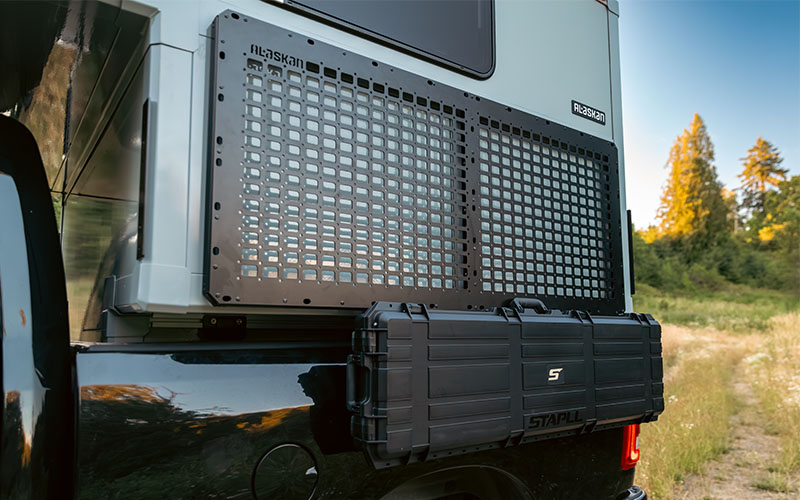
HS 640 Molle panel with STAPLL 56L hard case
What warranty does Alaskan offer on the HS 640?
The HS 640 comes with Alaskan’s one-year structural warranty.
You mentioned that the HS 640 is the first of several new products planned over the next eighteen months. How active is product development at Alaskan right now?
We now have five full-time engineers. Product development is more active than it’s ever been.
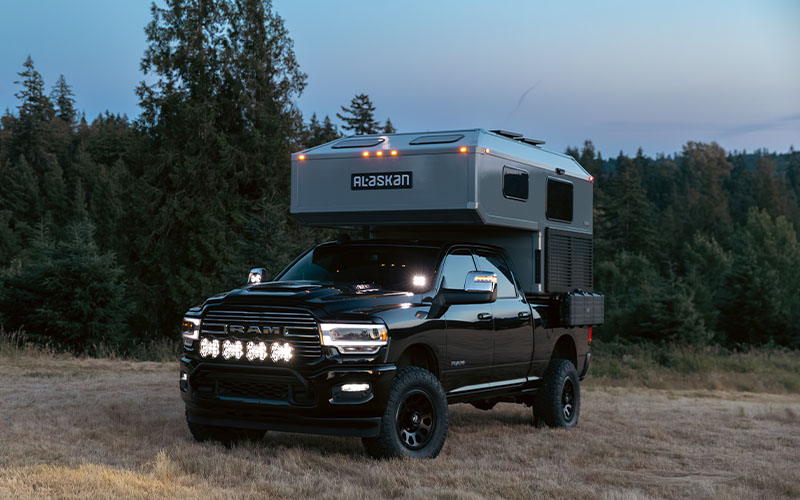
There’s definitely more to come from our composite-panel production facility, but right now our priority is getting the HS 640 into customers’ hands while continuing to improve our traditional camper lineup. The Alaskan HS 640 is just the first step. We’re excited about what’s possible with composite-panel construction, and we’re already working on what’s next.
“Our priority is getting the HS 640 into customers’ hands while continuing to improve our original camper lineup.”
For more information on Alaskan Campers, visit their website at alaskancampers.com. Click here to request more information.