From the lecture halls of Stanford law and economics to the rolling mountain-wave lifts of the Sierra Nevada, Mitch Polinsky is a man of two very different worlds. From his Supertramp Flagship LT, he waits each morning. Will he be a professor or a pilot? Only the weather can tell.
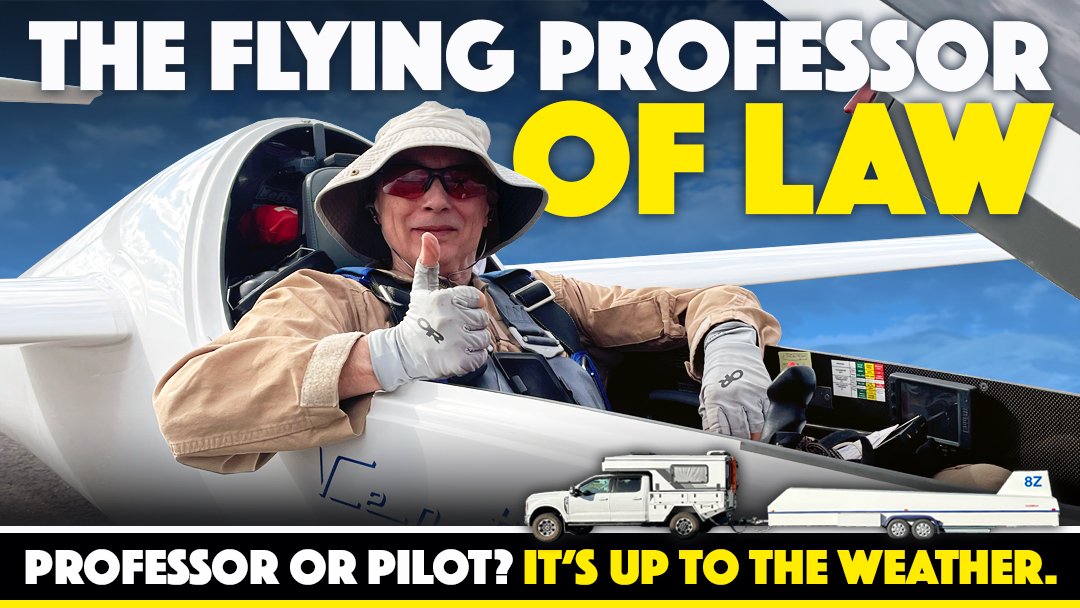
In summer’s dog days of June, July, and August, the high desert heat of Ely, Nevada, can easily push temperatures into the 90s day after day. Most of us would avoid driving our rigs into sweltering conditions like this—much less staying in them—but not Mitch Polinsky. Year after year, he takes his truck, camper, and glider trailer to Ely and lives at the airport.
This might lead some to question Mitch’s decision-making abilities, but Mitch also happens to be a graduate of Harvard, MIT, and Yale, and an economics and law professor at Stanford University. Mitch is among the most cited law and economics professors in the world, with over 80 academic articles and two books to his name. So what is the distinguished professor doing all summer, baking in the Nevada heat? Getting high. Really, really high.
No, not that kind of high. You see, Mitch is an avid—no, completely obsessed—glider pilot set on achieving as many gliding records as humanly possible. That means being in the right place—Ely—at the right time. The right time means the right weather, and that happens—when it happens—in the dog days of summer. By staying on site in his Supertramp Flagship LT, with his glider ready to fly, Mitch is guaranteed to be the early bird that goes for the record.
Now you might be wondering what Mitch does on all the other days. You know, when it rains, storms, or there’s low visibility. That’s when Mitch stays grounded and goes into full research professor mode.
When he’s not soaring, Mitch is in his camper working on papers and books focused on deterrence and optimal punishment, criminal law economics, and how to design legal rules that deter harmful behavior at the lowest social cost. In other words, when Mitch isn’t trying to get as high as possible over Nevada, he’s in his camper figuring out how to make the world behave better. And we thought publishing Truck Camper Magazine from our camper was impressive.
What follows is Mitch’s remarkable dual life—one at the highest levels of law and economics, the other with gravity, thermals, and mountain waves thousands of feet above the earth. We talked with the man between these two worlds, and landed his story.
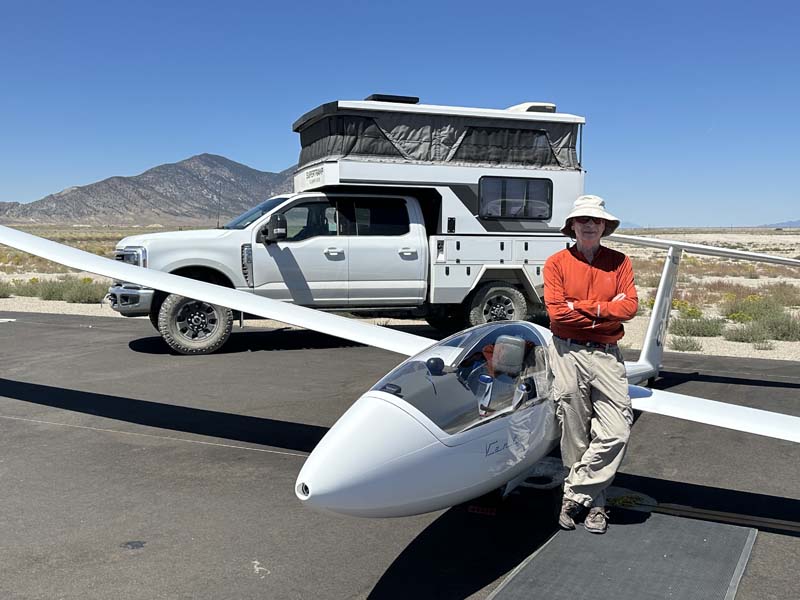
Mitch Polinsky with his glider, Supertramp Flagship LT and Ford F350 with a custom Bowen bed
How has your truck and camper rig changed since we interviewed you in 2010?
In 2010, I had a Ford F-150 with a Four Wheel Campers Hawk. I liked that setup and had it for twelve years, but I needed a more powerful air conditioner.
Getting adequate cooling is critical for me. I spend my summers living in my camper at the Ely, Nevada airport, splitting my time between academic research and flying my glider when conditions allow. I’m cool at 16,000 feet, but often uncomfortable on the ground in the high desert temperatures. The heat makes it difficult to work.
The F-150 was also underpowered when towing my 3,800-pound glider trailer, particularly during long-distance straight-out soaring flights. During these runs, I would hire someone to follow me in the truck pulling the empty trailer and meet me wherever I landed. My longest engine-less one-way flight was 685 miles. When my driver caught up, the two of us, the camper, and the trailer put the truck over the F-150’s maximum capacity. I could have solved the truck problem with an F-250 or F-350, but I loved the F-150 and was reluctant to take a large depreciation hit after just one year.
Beyond the air conditioner, the manual roof lift was becoming a concern after a prior back injury. Four Wheel Campers has since introduced a roof air conditioner and battery-powered roof assist, but those options came after I had decided to make a change.
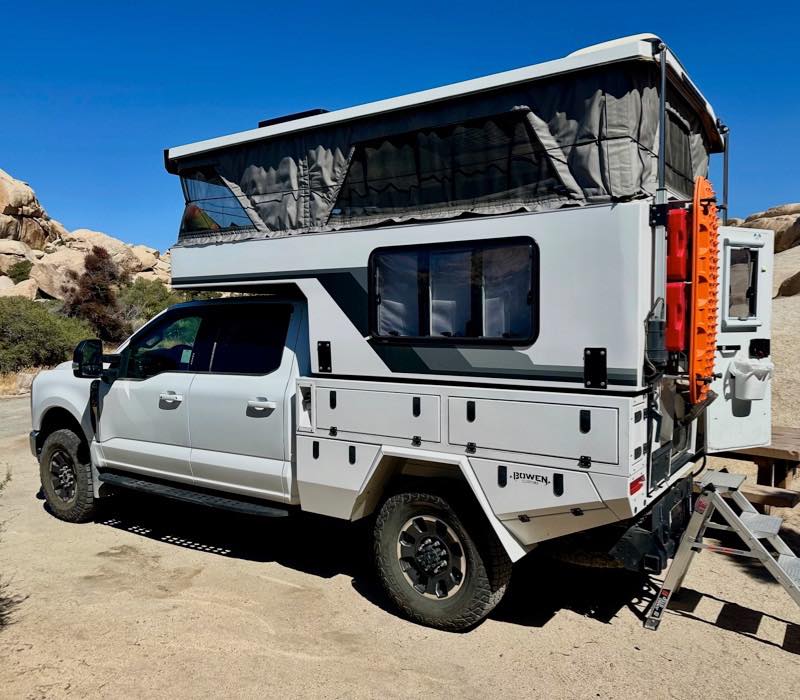
Hanging out in Joshua Tree National Park, California
Was that when you discovered Supertramp?
Yes, and no. Around that time, I read about a new company called Supertramp Campers and began an extended dialogue with co-founder, Kelsey Panich. When I noticed they didn’t offer air conditioning, Kelsey explained they didn’t yet have the bandwidth for that option during their startup phase. Given my needs, I told her I would have to look elsewhere.
Soon after, I learned about a chassis-mount camper built on a Ford F-350. It appeared to solve my payload and towing challenges, offered a powered pop-up roof, and featured a more powerful air conditioner. Based on the BTU-to-space ratio, I placed a non-refundable deposit. In hindsight, this was a mistake. The air conditioning performed worse than the Hawk and the additional four feet of length created parking challenges almost everywhere I traveled.
After that, I was in a funk. Then I called Kelsey and asked how well the then-new air conditioner option worked in the Flagship LT. She offered to connect me with Supertramp owners. I spoke with three—one in Texas living full-time, one in Florida using it in summer, and one in Colorado. All reported excellent performance. I immediately sent a deposit for a Flagship LT and arranged to sell the chassis-mount.
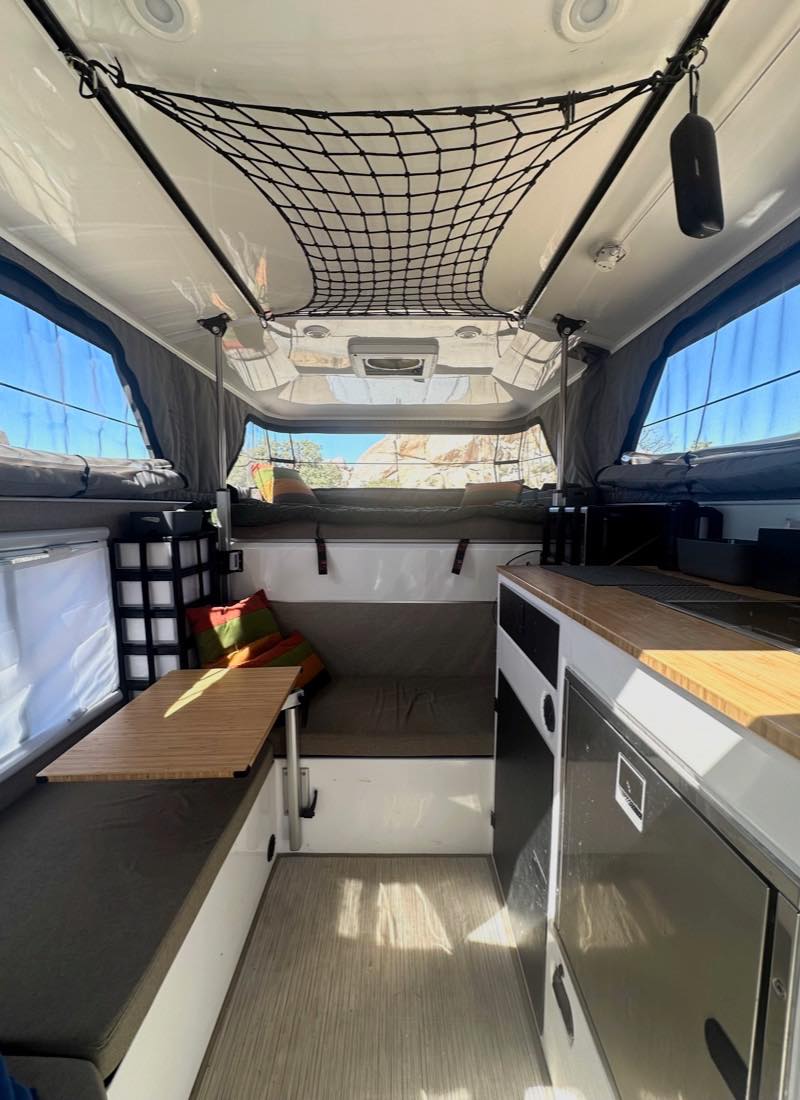
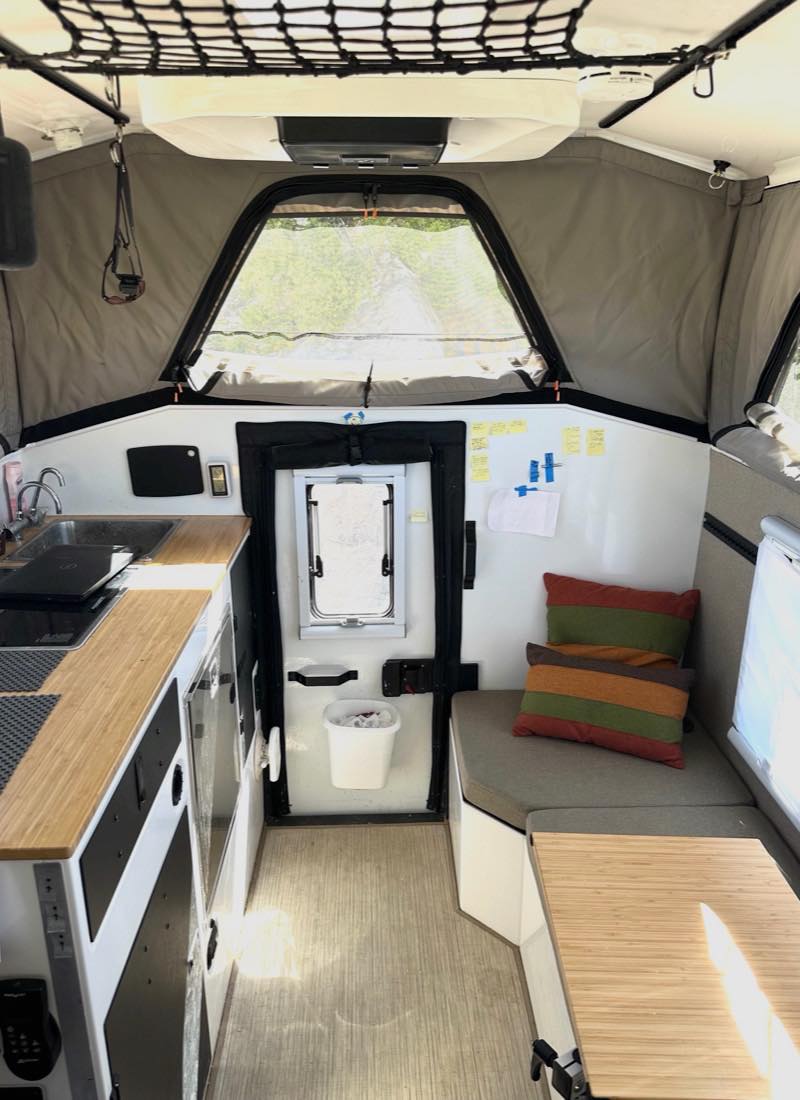
We know a lot of fellow truck campers who bought a motorhome or towable only to come back home to a truck camper. Did the Supertramp Flagship LT achieve your objectives?
Yes. I’ve been ecstatic with the Flagship LT. After fourteen years of struggling with heat, the air conditioning has been fantastic. I’ve even had to turn it down. I sleep better, my research productivity has improved, and my wife says that I am a nicer person!
That’s a win.
Beyond cooling, the Flagship LT solved my payload and towing concerns, eliminated roof lifting with an electric system, and fixed the parking challenges. Mounted on a standard-bed F-350—just seven inches longer than my original F-150 and Hawk—it’s remarkably manageable.
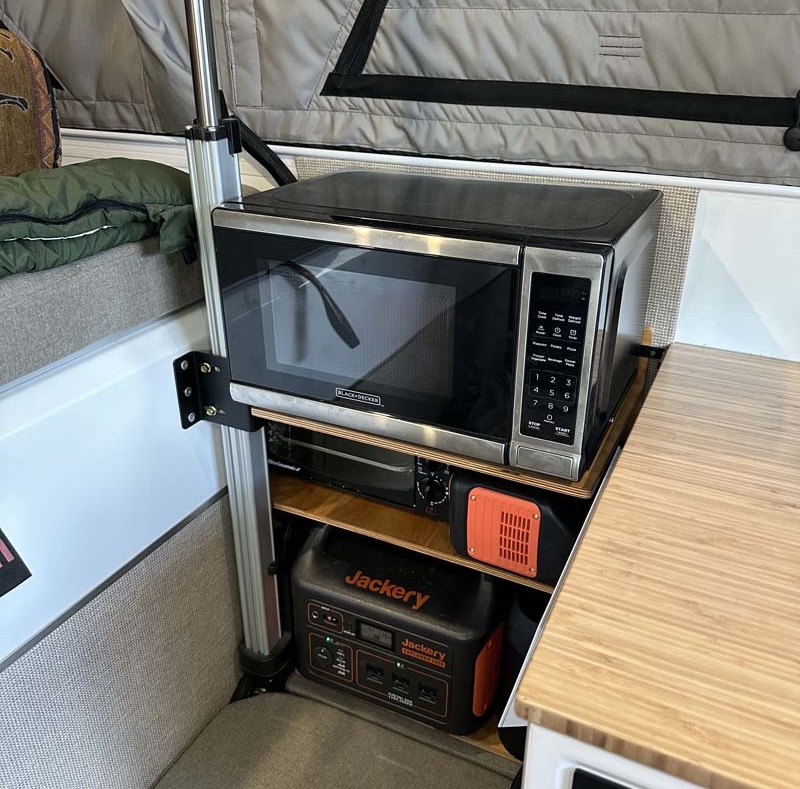
The microwave stand is an option in the Flagship LT
Supertramp also had the essentials: heat, stove, hot and cold water, refrigerator and freezer, a comfortable mattress, toilet, and ideally an indoor shower. The Flagship LT checked all those boxes, though the built-in refrigerator and freezer were smaller than my previous rigs. I addressed that by adding two Dometic CFX3 25-liter portable coolers—one as a refrigerator and one as a freezer—placed in the truck’s rear seat area and powered by a Jackery Explorer 1000 charged through the Flagship LT’s 110-volt outlet.
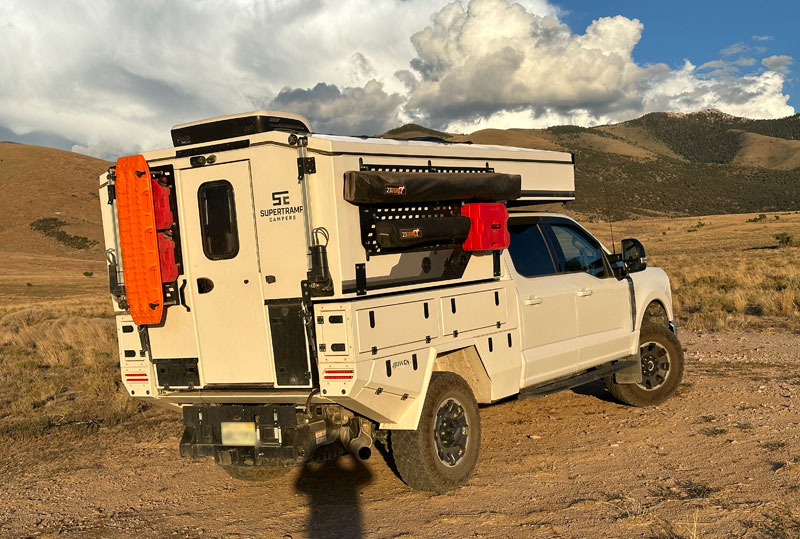
In the hills east of the Ely, Nevada airport
You also have a Bowen Customs bed. Was that something you needed for soaring?
When I first visited Supertramp, I saw a Bowen Customs bed on Kelsey’s personal F-250 and Flagship LT rig. I fell in love with it at first sight.
Bowen Customs removes the sides of the truck bed and replaces them with weather-tight, lockable storage boxes while retaining a standard slide-in configuration. This isn’t a flatbed or chassis-mount. The Flagship LT still slides in like a traditional truck camper, but with far more flexible exterior storage.
Another key advantage is that the camper remains at normal truck bed height. I specifically wanted to avoid a flatbed setup that would raise the camper significantly. I wear a parachute when flying my glider and didn’t want to feel like I needed one just to exit the camper!
“Another key advantage is that the camper remains at normal truck bed height. I specifically wanted to avoid a flatbed setup that would raise the camper significantly.”
That’s funny. How did you decide on a Bowen configuration?
I had a couple of conversations with Brent Bowen and with his assistant, Stu Turner. Both were extraordinarily nice and helpful. I don’t think it hurt that Brent has a pilot’s license and used to fly powered planes for fun.
They advised me on a couple of useful options, like having a storage door that opens at the rear of each row of boxes so that one can put fishing rods or skis or (in my case) hiking poles lengthwise in the row of boxes. I also wanted the color of the boxes to match the white color of my F-350, which they succeeded in doing. Bowen Customs and Supertramp Campers are perfectionists.
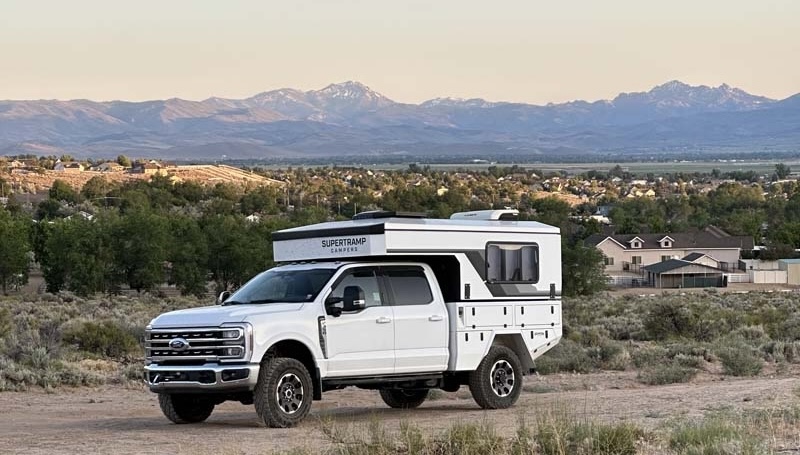
In Minden, Nevada, Carson Valley in the background
I mainly use the passenger’s side boxes for dry food and other related items; plates, utensils, extra cups, plus tools and spare parts. The driver’s side boxes are used mainly for recovery gear, boxes of tissues and paper towels, wood chips for the composting toilet inside the camper, small propane containers for the portable stove I use outside the camper, and collapsible chairs.
With the Bowen Customs boxes and the generous storage inside the Flagship LT, I have more usable storage in my 21-foot-long F-350 than I had in the 24-foot-long chassis-mount.
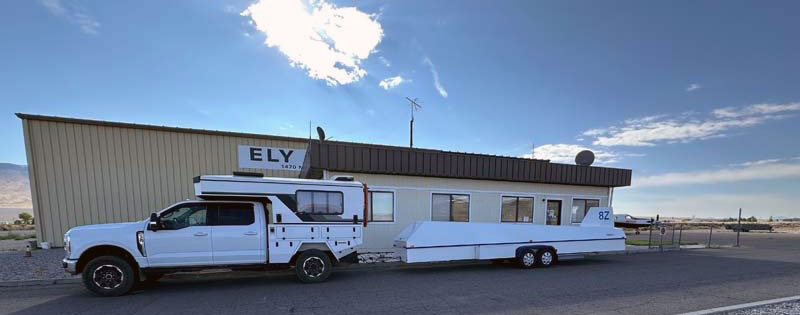
Packed up, ready to leave the Ely, Nevada airport for home
You stay in your Supertramp in Ely, Nevada every summer to go soaring. What is it about Ely that makes it ideal for soaring?
Ely is my happy place. For the triangle speed records I’ve focused on in recent years, it’s one of the best places in the world. Ely sits in the Great Basin, with row after row of north-south mountain ranges.
During the summer, the best soaring is along these crests. The challenge is to travel long distances above one range while staying high enough to glide across the valley and reach the next. I don’t know of another place that offers this type of soaring across such a large expanse.
On my first trip to Ely prior to 2010, when I was staying in hotels, I stayed about ten days. Each visit afterward grew longer as I became more comfortable flying over unfriendly terrain and gained an appreciation for the exceptional soaring conditions.
After I acquired a truck and camper, I stayed even longer because living at the airport was so enjoyable. I’d describe it as “summer camp for adults.”
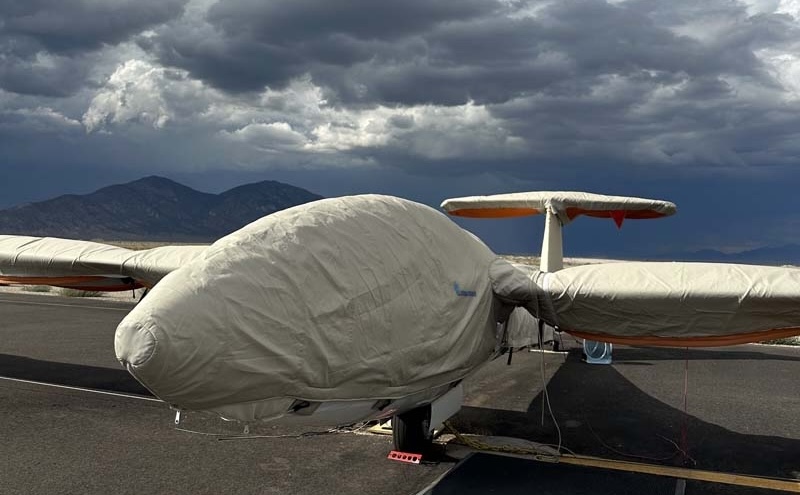
Ely, Nevada airport, hunkered down for the storm
Are there other pilots staying at the airport?
Yes. About one-third of the other glider pilots also live at the airport in RVs. Camping there gives us time to socialize before and after flying, walk a few hundred feet to check on our planes during adverse weather, and access hangar tools for tinkering and fixes.
With a truck camper, my trips grew from several days to a few weeks, and eventually I began thinking in terms of months. For several years now, I’ve arrived in Ely during the first half of June and left in the second half of August. My personal best is eleven consecutive weeks living there in a truck camper.
“With a truck camper, my trips grew from several days to a few weeks, and eventually I began thinking in terms of months.”
How has your soaring evolved since we first interviewed you in 2010? Any new goals or flight records you’re chasing?
My soaring has really taken off since 2010 (pun intended). Before then, I flew mostly free flights—choosing directions after takeoff based on developing weather conditions. Like many glider pilots, I also competed in the OLC (Online Contest), which ranks pilots based on their six best flights each year. It gave me a useful measure of improvement.
On a spectacular day in the summer of 2012, flying from Ely, Nevada, I attempted a large triangle. After several hours, my flight computer indicated that if I stretched to a final turn point in weaker lift, I might set a national free triangle distance record. I reached the turn point and landed, having flown 673 miles (1,083 kilometers)—longer than any previous triangle flight in my glider category in the United States.
But I didn’t hold the record for long. A close friend flying the same type of glider from Ely that day landed thirty-five minutes later. His triangle measured 703 miles (1,131 kilometers). When two pilots break a record on the same day, the larger margin wins. Congratulations, Uwe!
That experience ignited my interest in records. I spent the rest of 2012 trying to beat Uwe’s mark, improving my weather analysis and in-flight decision-making along the way. Then, on June 29, 2013, our anniversary, I called my wife and said, “Guess what I got you for our anniversary today? A national soaring record.” That day I flew a 719-mile (1,157-kilometer) free triangle. It was especially satisfying—and, as it happened, Uwe wasn’t flying. Thank you, Uwe.
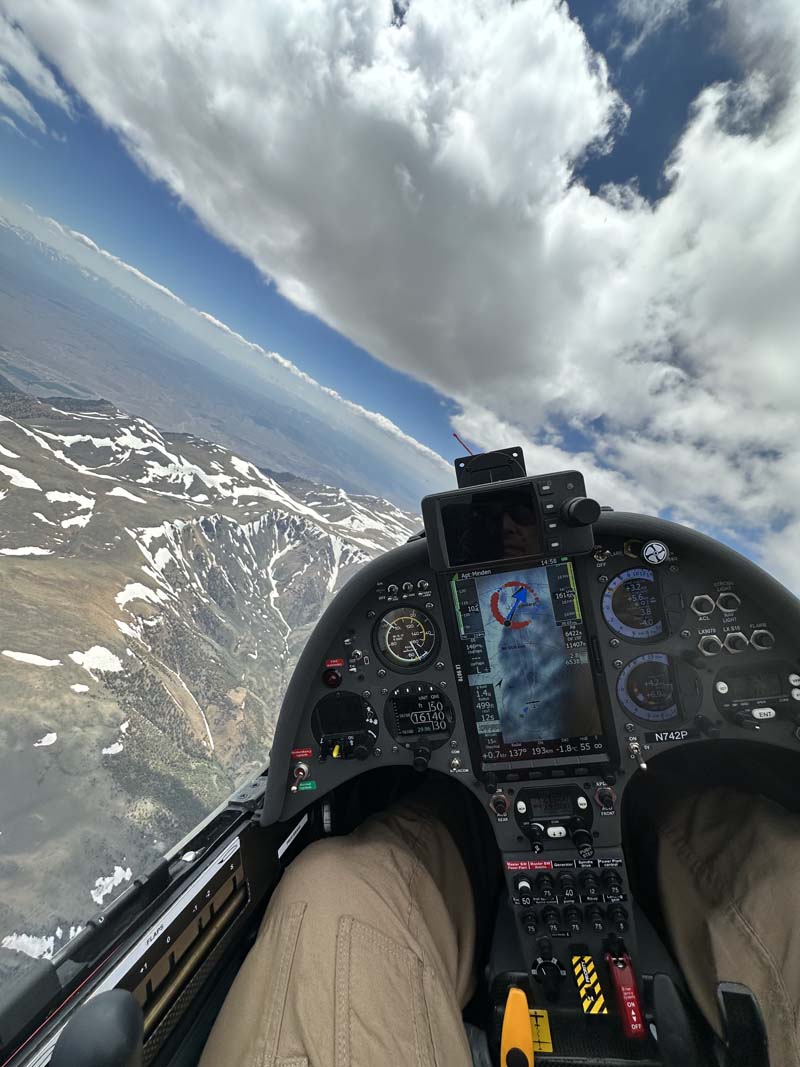
You beat Uwe! Have you set any more records since then?
Yes. Soon afterward, I explored other record categories and began chasing them. Record flying became a passion bordering on an addiction. Since then, I’ve broken twenty-nine U.S. National Soaring records and nine North American Continental records.
When you interviewed me in 2010, my personal best was a 606-mile eight-hour flight. My current personal best is a 935-mile (1,505-kilometer) twelve-and-a-half-hour flight. It wasn’t a record, but it remains my longest and most memorable.
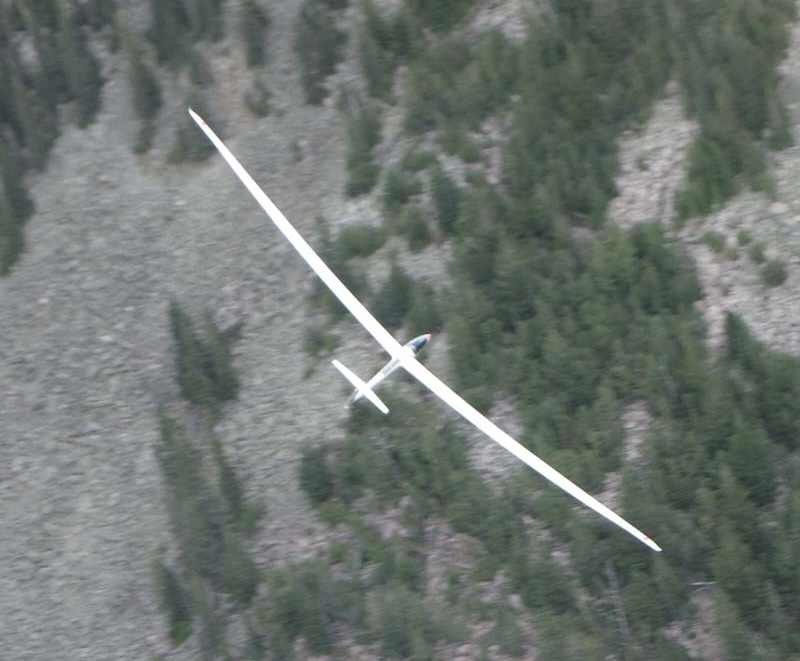
One of the gliders Mitch used to fly, near Santa Fe, New Mexico
That’s incredible, especially considering it was an unpowered flight. You’re a professor during the school year, and soaring over Nevada during the summer. Do those worlds balance or energize each other?
I more or less remain a professor during the summer. Although I don’t teach classes, I continue academic research and writing.
With my wife at home and fewer daily distractions, I split my time between flying and work. The weather determines each day. Over breakfast in the truck camper, I check soaring forecasts and quickly decide whether it’s a flying day or a work day.
In my early years at Ely, the split was roughly even. But favorable soaring weather seems to have declined over the past five to seven years. Now, I consider three flying days a week a good summer, though I haven’t reached that recently. Last summer, I averaged just two flying days per week and accomplished a great deal of research.
Being a professor has actually helped my record attempts. Most other Ely pilots are retired or using limited vacation time, so when adverse weather moves in, often for a week or two, they leave. I stay and work from my truck camper until conditions improve.
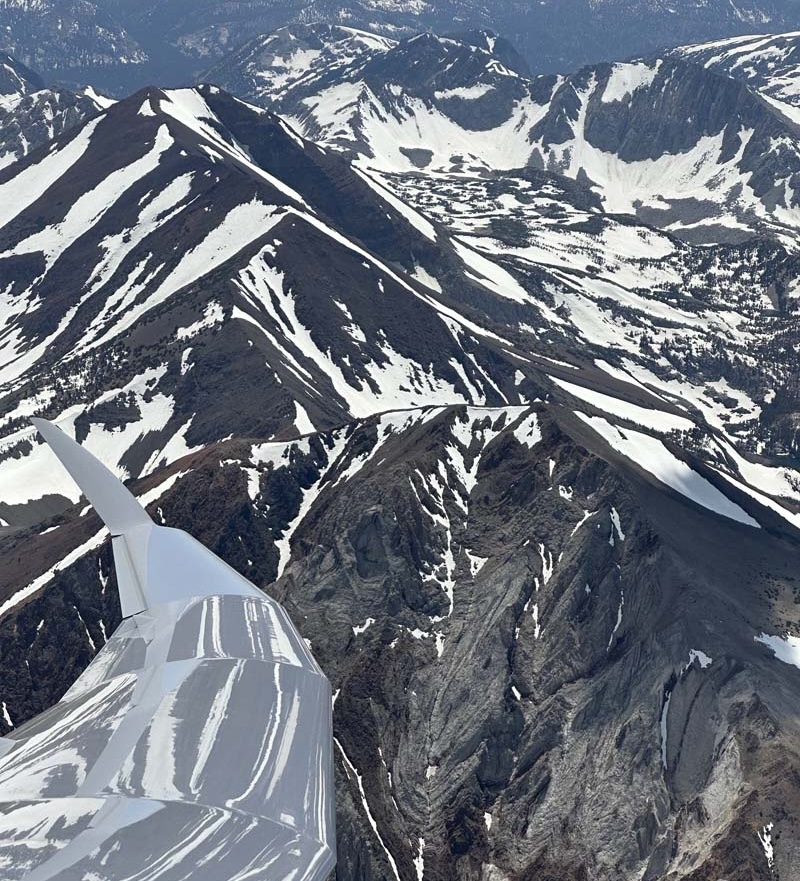
High Sierra mountains south of Lake Tahoe, California
During peak season, there may be twenty pilots at Ely. After extended poor weather, there may be only two or three left—sometimes just me. Several of my records came after others had departed. If I had retired, I likely would have left too and missed those special days.
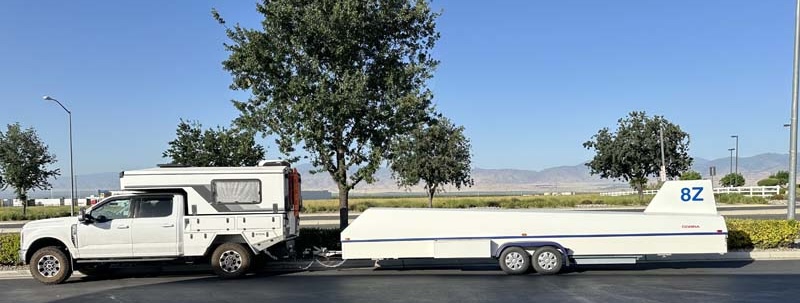
Rest stop in the California Central Valley on the way home
In that sense, being a professor and a glider pilot balance and energize each other. Does your wife visit you in Ely during the summer?
Not very often. My wife, Joan, has flown in a glider a couple of times with friends who own two-seat gliders. I decided early on not to take her up myself because we have two children, and I didn’t want to risk both of us perishing at the same time.
On one flight several years ago, she had the remarkable experience of flying 456 miles (734 kilometers) from Lake Tahoe along the crest of the High Sierra to Mt. Whitney and back. When I asked how it was, she said she immensely enjoyed the scenery between sessions of throwing up from air sickness. She hasn’t been in a glider since.
Joan visits me occasionally in Ely during the summer, but getting there from our home near Stanford is not easy—drive to San Francisco, fly to Salt Lake City, rent a car, and then drive three and a half hours to Ely. She understands that if the soaring weather is good while she’s visiting, I’m going flying.
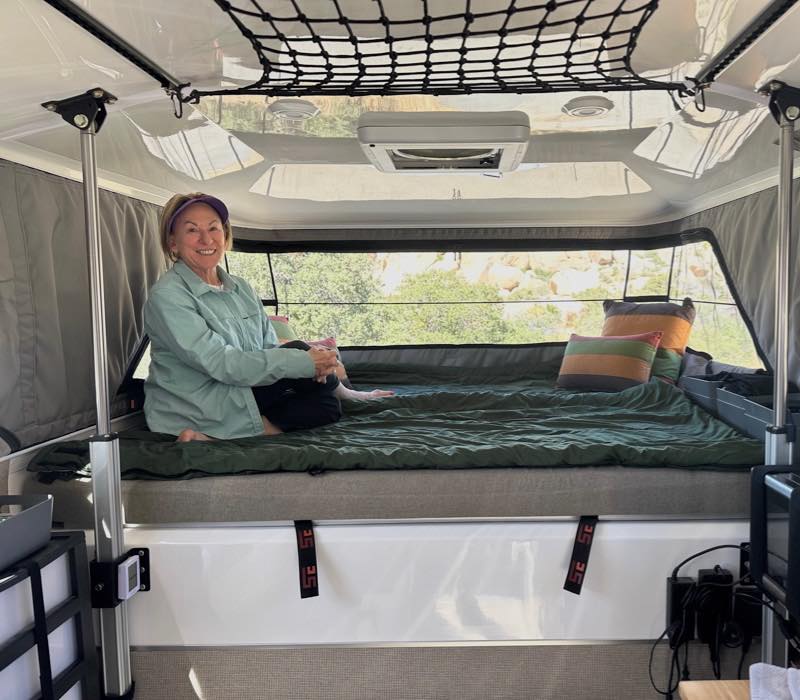
Mitch’s wife, Joan, luxuriating in the Flagship LT
When she returns to Palo Alto and friends ask about her trip, she half-jokingly says, “Yes, Mitch let me clean his wings every morning while he prepared the cockpit—making sure I got every bug off.” Her parting words are always, “Never again.” Fortunately, she’s been wrong about once every other year.
I like to say that our differences are part of what makes us work so well together. Joan loves opera and art. I’m drawn to dramatic performances like Great Basin thunderstorms and natural sculpture like the Northwest face of Half Dome. Joan enjoys traveling to Europe, Africa, and the Far East. I enjoy exploring Nevada, Utah, and Colorado. Fortunately, we both love truck camping.
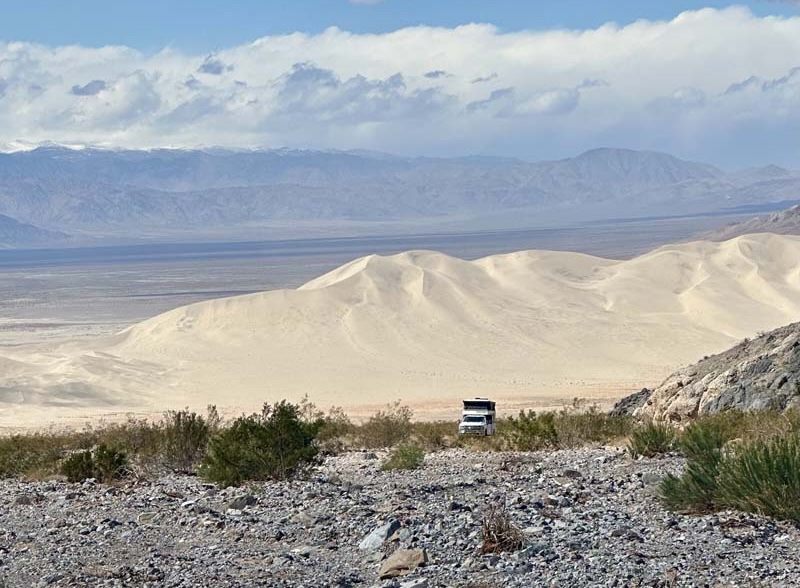
Truck camping in Death Valley National Park, Eureka Dunes in the background
Where do the two of you go truck camping together?
One of our favorite destinations is Death Valley National Park, where we dry camp at Furnace Creek. Since travel takes most of a day each way, that leaves fewer full days for hiking. We typically spend one day hiking the Golden Canyon–Gower Gulch loop to Zabriskie Point, another along the ridge north of Dante’s View, and a third hiking to the top of Eureka Dunes.
Another favorite is Lee Vining, California, near the eastern entrance to Yosemite and Mono Lake. From there, we do day hikes in Yosemite and on the east side of the High Sierra in the Ansel Adams and John Muir Wilderness areas.
When we have more time, we head to Moab, Utah. We stay in an RV park on the outskirts of town and do day hikes, including the Devil’s Garden loop in Arches National Park and the hike from Fisher Towers to the ridge overlooking the towers and the Colorado River.
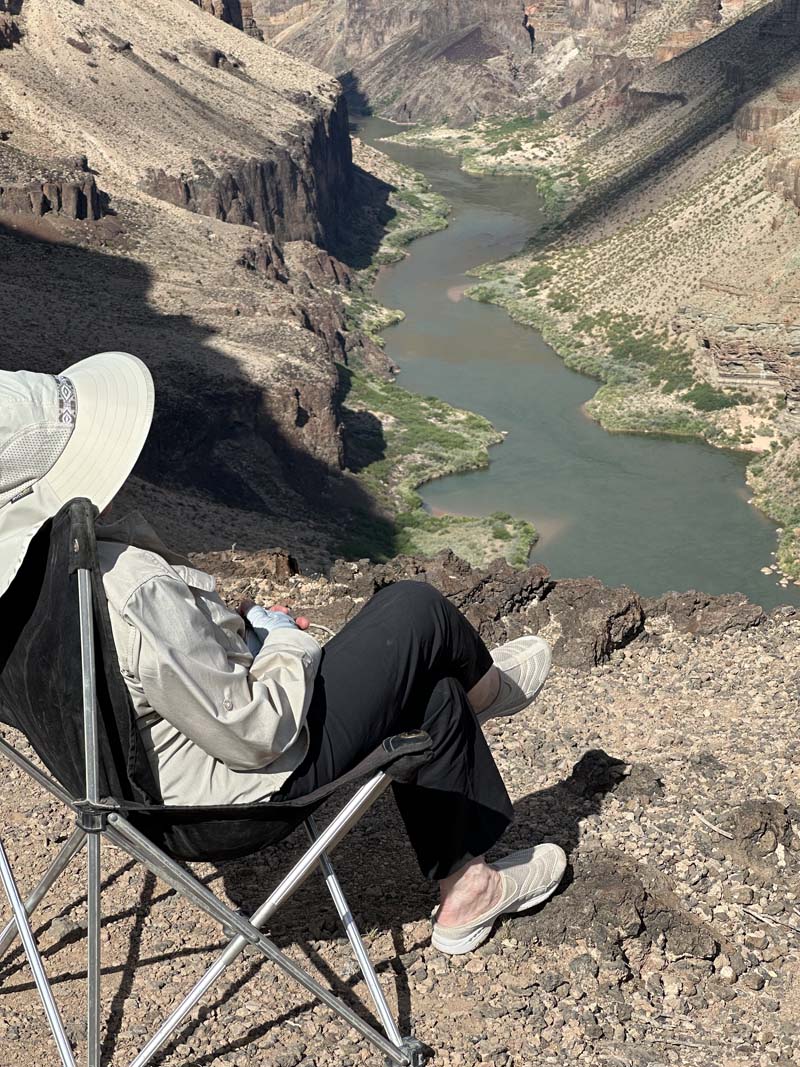
Joan on the North Rim of the Grand Canyon
The MOATCT – “Mother Of All Truck Camping Trips” – came during my 2019 Stanford sabbatical. We spent twenty-nine consecutive days in our camper visiting Bryce Canyon, Zion, Capitol Reef, Canyonlands, and Arches National Parks, plus Goblin Valley, Dead Horse Point, and Grand Staircase-Escalante. Despite the close quarters, we had just one argument: where to stay in Las Vegas on the drive home. I voted for the RV park near downtown. Joan voted for the Bellagio. Somehow, in tied votes, Joan always wins. It was an unusual and memorable ending to our longest truck camping trip.
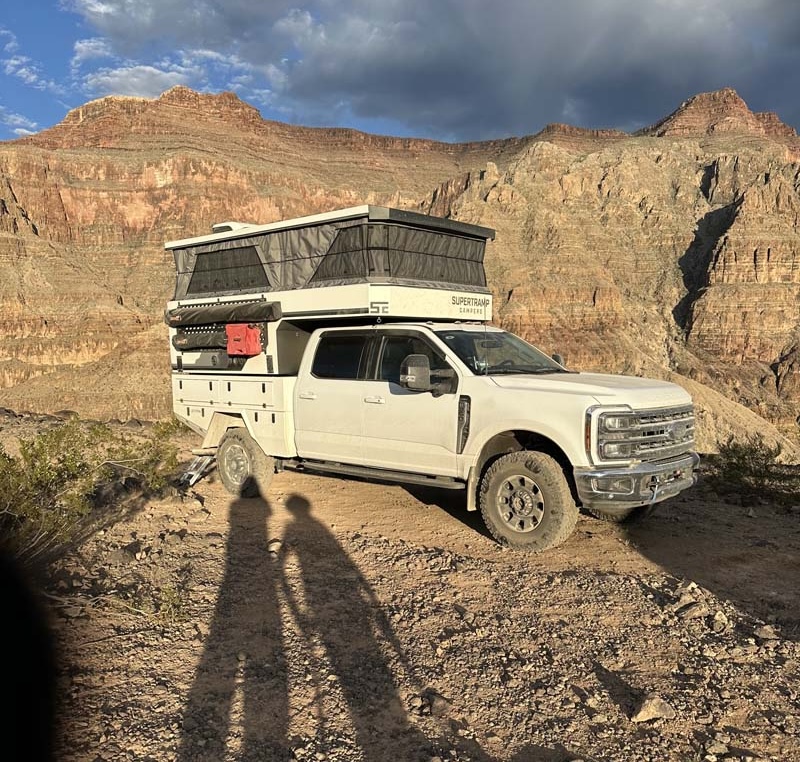
The Flagship LT at the North Rim of the Grand Canyon
We’ve also taken guided truck camping tours with professional off-road instructors. With Bob Wohlers of Off-Road Safety Academy, we visited Death Valley, the San Rafael Swell, and the Black Rock Desert. With Todd Rogers of Four Points Adventures, we traveled to the North Rim of the Grand Canyon and Death Valley.
These tours allowed us to safely tackle routes we wouldn’t have attempted on our own. They were also fun for Joan because of the social interaction, and we enjoyed taking turns driving. The icing on the cake is that we’ve become friends with Bob and Todd. I highly recommend these experiences for other truck camper owners.
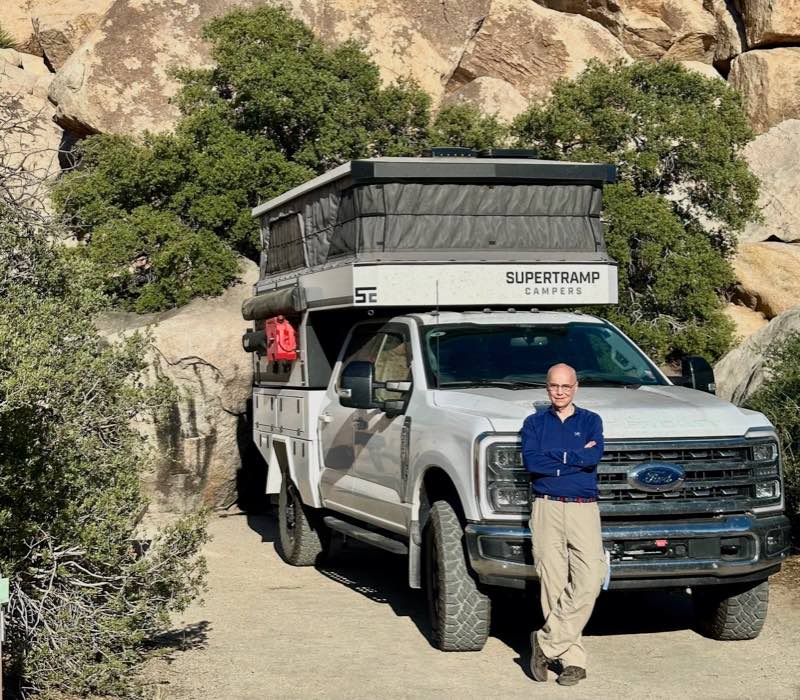
Mitch in Joshua Tree National Park, California
You have a very full and diverse life as a professor, a glider pilot, and a truck camper. Any final thoughts?
I always smile when I think about a famous quip attributed to Mae West, an over-the-top, sultry actress in the 1930s, “Too much of a good thing is wonderful!” She was right.
It’s been sixteen years since you interviewed me the first time. I hope we can do this again in sixteen years. I won’t be a professor. And I won’t be a glider pilot. But I might still be a truck camper! Fingers crossed.