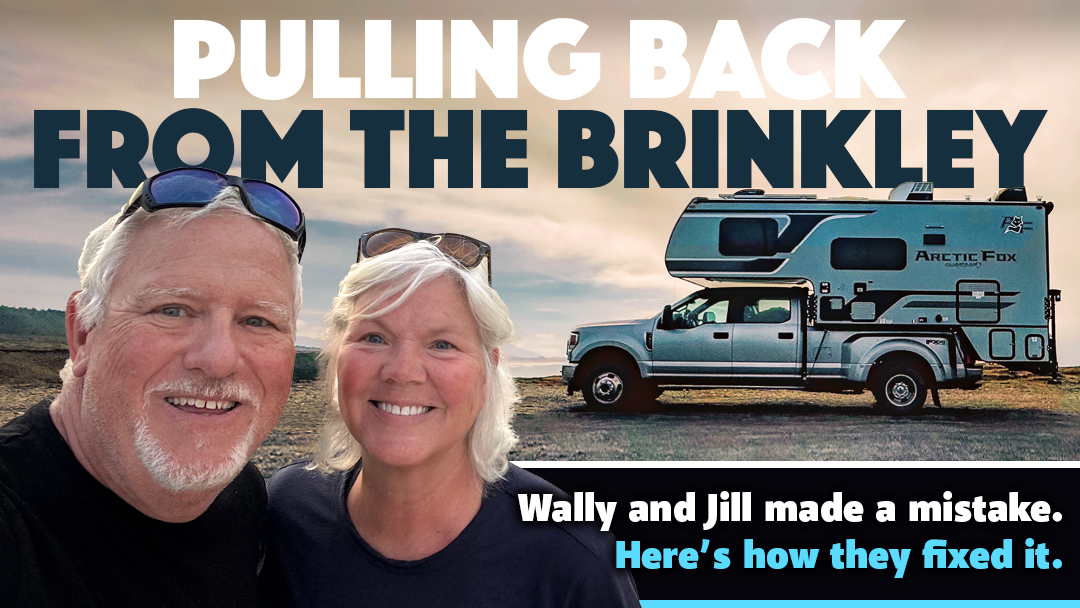
By their own admission, Wally and Jill Cutchin made a terrible mistake. Seduced by a gorgeous Brinkley trailer, they believed bigger meant better. It didn’t. Here’s how they pulled back from the Brinkley and returned to truck camping.
We are never heading to the dark side, but we’d be lying if we said we hadn’t checked out a big travel trailer, fifth wheel, or motorhome at an RV show now and then. Is there anything about these monster RVs that’s genuinely better than a truck camper?
In a word, yes. They offer more living space, more storage, more conveniences, and more overall comfort. We’re talking spacious living rooms with recliners and big-screen televisions, enough storage to pack a Walmart and a Home Depot, residential refrigerators, washer and dryer setups, multiple dry baths, multiple air conditioners, walk-in closets, and huge holding tanks.
For RVers who want to recreate the comforts of home, a monster towable or motorhome can be very enticing. It certainly was for Wally and Jill Cutchin.
Like so many RVers, Wally and Jill found themselves captivated by the size, comfort, and luxury of a Brinkley travel trailer. On paper, it seemed like the perfect next step from their truck camper. But once they started traveling, they discovered something they hadn’t anticipated. They hadn’t simply traded one RV for another. They had traded one lifestyle for another.
Instead of wandering wherever the road looked interesting, they found themselves planning around the trailer. Instead of stopping almost anywhere, they had to think about where they could fit, park, turn around, and camp. The very features that made the Brinkley so comfortable also made it less compatible with the adventures and experiences they wanted to have.
Fortunately, Wally and Jill’s story ends with a triumphant return to truck camping. They didn’t just come back. They returned with an even more capable truck and camper combination. For these two full-timers, the realization was both painful and exhilarating, and the journey back proved every bit as rewarding as the road ahead.
Your “We Made a Mistake” video definitely caught our attention—especially your facial expressions. Tell us how that happened.
Jill: There was no acting. We were filming that when we got the Brinkley and were moving out of our Arctic Fox 990. I didn’t post it or edit that video right away. When we went back to look at it, we could see it on our faces. Uh oh, we screwed up.
The mistake was bigger than we expected. We quickly realized we couldn’t live the way we normally did. The 990 was quick and nimble. We’d pull into a mom and pop gas station or a grocery store or a farmer’s market. If we saw something interesting, we could simply pull over. With the Brinkley, we lost our spontaneity.
Wally: If we had gone directly to a travel trailer, we wouldn’t have known this kind of travel existed. If we truly were ready to just sit, then the Brinkley would have served us well. For what we like to do—moving every two to four days—our truck camper serves our needs. It’s what we love to do.
Jill: We had so much fun in our Arctic Fox 990. It was sad to not travel in it. We were excited about the Brinkley, but our 990 was our “get out and go” rig. For two people, it’s fantastic. And it’s not forty feet behind you.
Wally: I missed a turn one time in the Brinkley and we were on a backroad. It took us fifty minutes to get back on track. With our truck camper, we would have pulled into a driveway, turned around, and been back on the right road in two minutes.
With a travel trailer, you have to think everything out. It is more stressful in gas stations, grocery stores, and even just parking it. There’s also more work once we got to the campsite. I thought it would be easy. I found myself having to crawl underneath it all the time and that made it harder.
We were wowed by the big space, the heated seats, and the fireplace. It was an “Ooh-ah” moment. But once we were living it, we realized it wasn’t for us. It took the fun out of traveling and added stress.
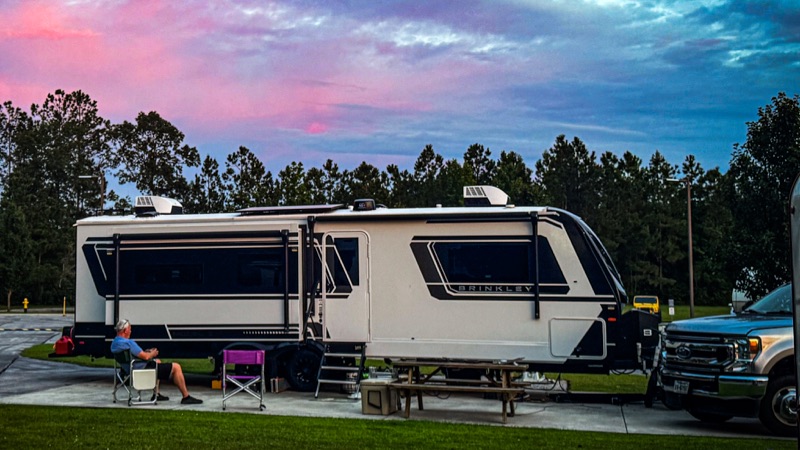
Wally and Jill’s Brinkley 285 Z Air travel trailer at Cherry Point FamCamp near New Bern, North Carolina
Did you realize the mistake right away, or did it take a while?
Jill: It didn’t take too long. I don’t think we realized how big the truck and Brinkley would be going down the road. I don’t remember which one of us was first to say, “Ahhh”.
Wally: I thought it was stressful for the first few weeks, but blamed that on a learning curve. A month in, I knew it, but didn’t want to say anything. Jill had always wanted the Brinkley. This is like the dog your wife picked from the pound, and you don’t like the dog, but are afraid to say anything because your wife picked the dog. When she said the Brinkley wasn’t right for her, and I said, “Oh, I love you”.
Being in the trailer even affected our lifestyle. We were walking less, hanging out more inside, and eating more.
Jill: We put on some Brinkley pounds.
Wally: When we had our 990, as soon as we had our coffee, we’d go outside and piddle. With the Brinkley, we were in the chair.
I came from the boat world. When someone asked about the perfect boat, I’d say, “There is no perfect boat”. Maybe the perfect boat for you is a pontoon or a lake boat. There’s no perfect RV for everyone. It’s what’s best for your lifestyle.
“When we had our 990, as soon as we had our coffee, we’d go outside and piddle. With the Brinkley, we were in the chair.”
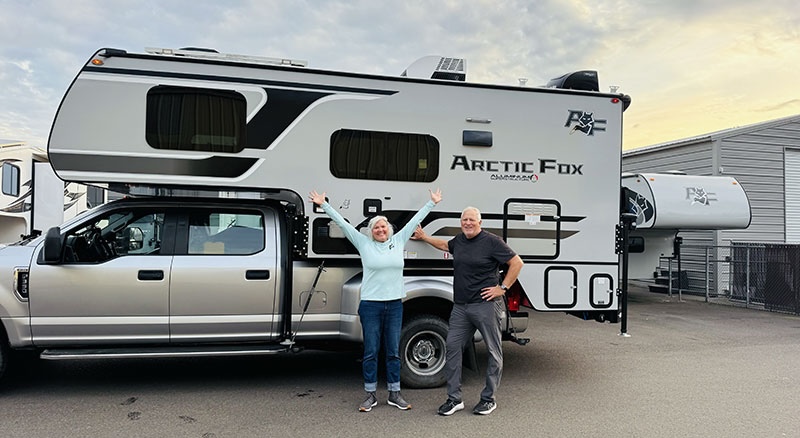
Wally and Jill getting their new Arctic Fox camper in October 2025
We published an article on that very topic. What did you do after this realization?
Wally: We went back to a truck camper. We wanted the Arctic Fox 1150 because it’s similar to the 990, but stretched out with more counter space and storage.
Jill: We considered going to a 1150 when we had the 990. I am the gatekeeper of our money and I’m tight. At the time, I didn’t think eighteen inches of additional space and storage was worth it. Now I know it is.
Wally: For the 990, we had a truck we called Big John. When I scaled that rig, we were within 250 pounds of our maximum payload. When we decided on the 1150, we decided to upgrade to a more capable truck.
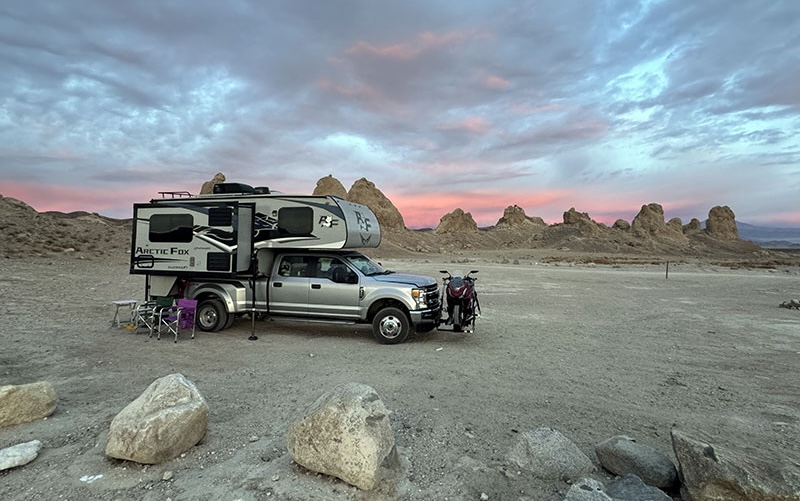
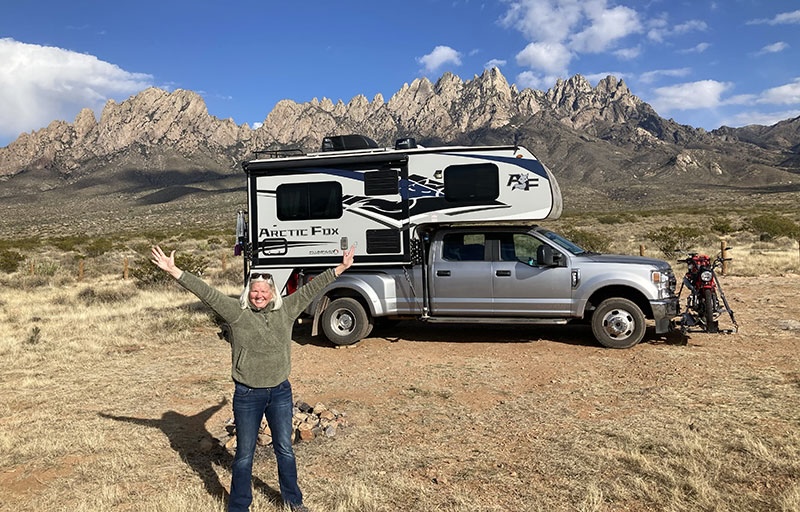
Wally and Jill’s Arctic Fox 990, Trona Pinnacles near Ridgecrest, California, an extremely bumpy and long road to a fantastic boondocking site
Did you hold onto your 990 while you had the Brinkley?
Jill: Yes, we held on to the 990. We kept it because we wanted to go back to Alaska and knew it was the better rig to take. When we bought the 1150, we traded it in.
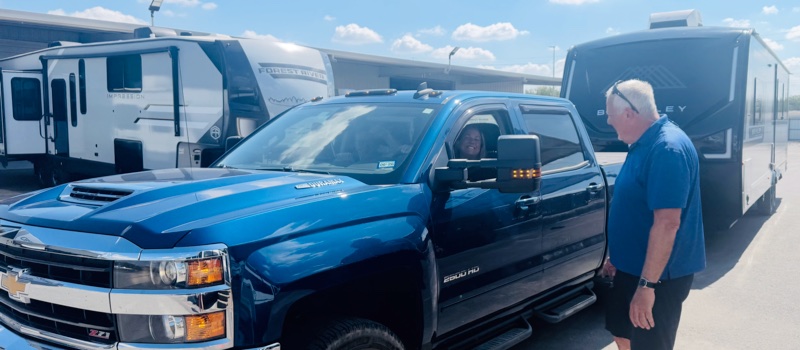
In Texas passing off the Brinkley to the new owners
What happened to the Brinkley?
Jill: We sold it in July 2025, six months after we bought it. We ended up not delivering it to the new owners until October. They wanted to buy it, but did not want to take delivery until October and wanted us to deliver it to them in Texas. We got it there at a time that worked out for all of us, and we have remained friends.
Wally: We custom ordered the 1150 with the things we wanted. We opted for the couch instead of the face-to-face dinette, deleted the oven for extra storage, and added an extra cabinet in the bedroom. We also requested the Furrion air conditioner.
Watch Wally and Jill’s video where they explain the decisions they made to get the 1150
The sofa and tables are a relatively new option for Arctic Fox campers. What do you think of the sofa and table versus the face-to-face dinette?
Wally: I would make that choice again. We really like the alternative spot to sit and lay down. The couch is 76-inches and the dual Lagun tables pivot around. It gives us more space inside. As a bonus, when the full-wall slide is in, it’s easier to get into the camper. That’s a huge advantage.
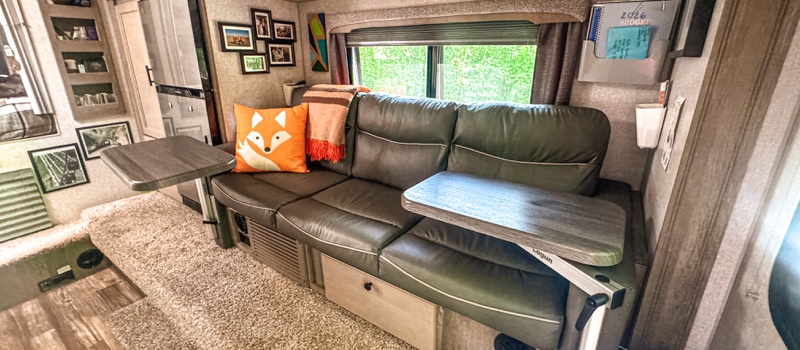
The longer I have the couch, the more I like it. We have never been fans of the booth because we are big people. Getting in and out, and getting our legs out from under the table can be challenging. This is a lot easier.
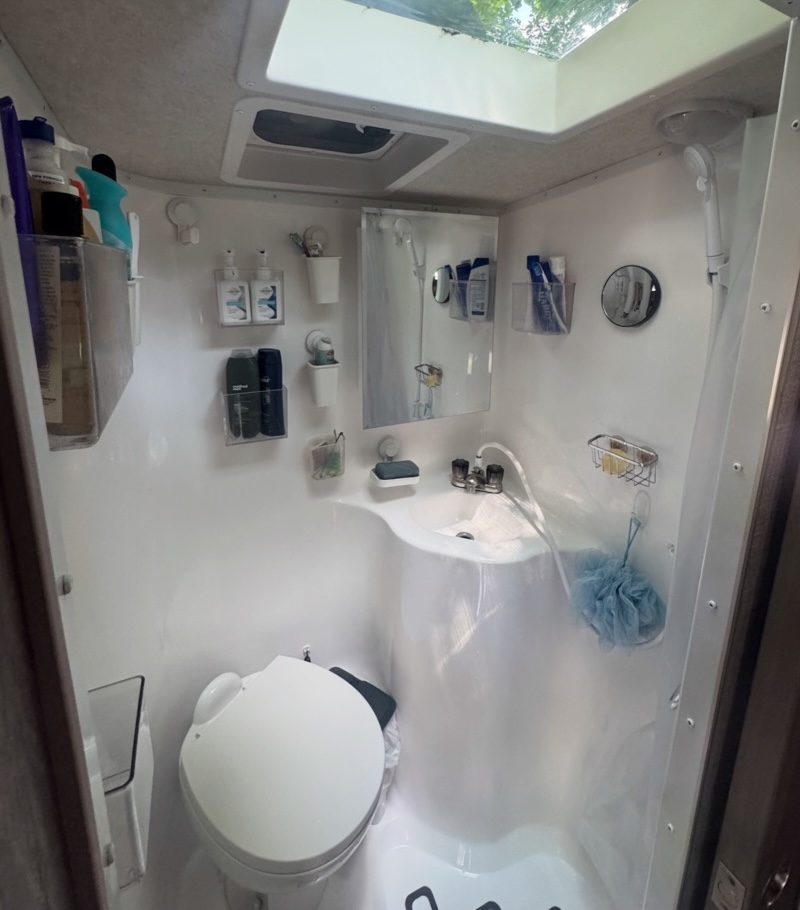
The wet bath configuration in the 1150. Wally and Jill created more useful space with wall mount clear bins and IKEA suction mount storage to hold all the necessary products.
Why did you choose the 1150 wet bath model over the dry bath?
Wally: I’m big at 6’4” and I’m not going to tell you my weight. Jill is tall at 5’11”. The dry bath looks great with the cabinetry, but the shower is smaller and the toilet space is tighter.
Coming from the boat world, a wet bath made sense. There’s more space for me. For living space, we gained cabinets high and low and counter space in the kitchen. We are showering for fifteen minutes, but we are living in the living space all day. I would rather have the living space. To me, it was a no brainer. We also had the wet bath in the 990, so we knew we wanted to keep it.
Jill: Counter space and livability are more important than cabinets in the bathroom.
Wally: Jill is a fantastic cook. Having that counter space to be creative is important.
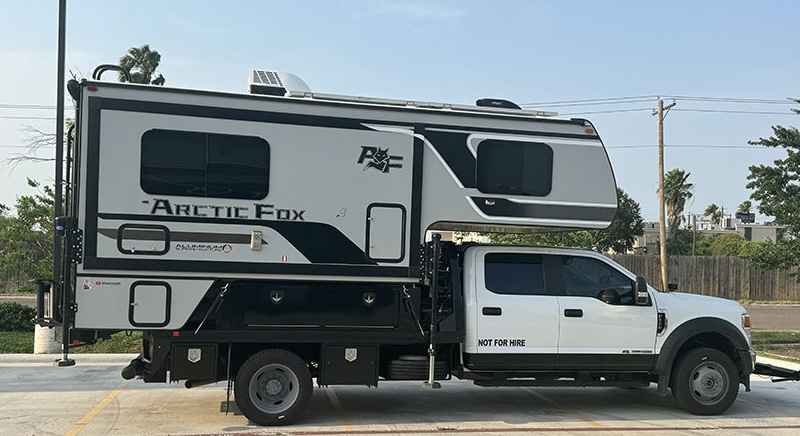
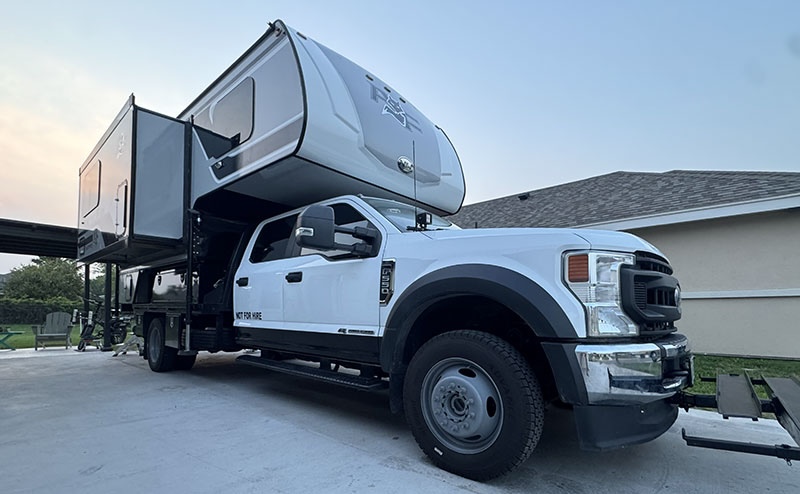
Arctic Fox 1150 on their Ford F-550 diesel flatbed with custom boxes
What was it like to go from a Ford F-350 dually to a Ford F-550?
Wally: The Ford F-350 did the job, but we were definitely exceeding our payload. With the Ford F-550, weight is no longer an issue. We enjoy not worrying about weight.
Our F-550 also drives easier in tight corners and takes turns sharper than our F-350, even though it’s bigger. In some states you have to get special license, but in Texas you don’t need a CDL if the rig is under 26,000 pounds.
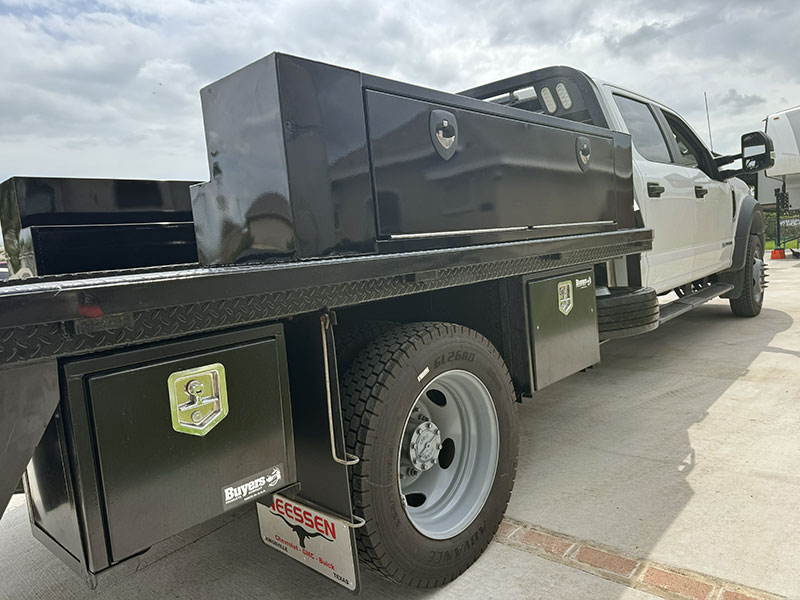
Their 2022 Ford F550 diesel flatbed the Stablecamper 86” long boxes were added on the top of the flatbed. There’s an 18” box in the rear and a 24” box toward the front mounted underneath the flatbed. Also, there’s room in front of the 24” box for the spare tire.
I loved our 990, but our 1150 and F-550 is our dream rig. We can carry anything and everything we want. We have an eleven-foot inflatable boat in our rear seat that has an outboard and electric motor. We also have our tools and our motorcycle on the front.
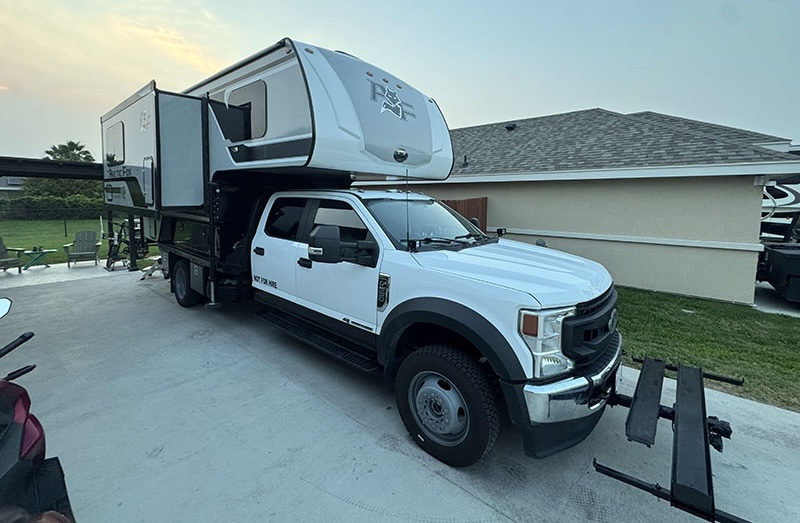
How did you spec your Ford F-550?
We went with the 6.7L diesel, and gained a little mileage. We now need DEF, and diesel fuel is more expensive. I think I would have jumped on the 7.3L Godzilla gas engine, but we couldn’t find one within 500 miles.
We went with the 84-inch cab-to-axle. The F-550 comes as a 60-inch as well. The 84-inch bed is two feet longer, but it only increased the overall length of our rig by 1.5 feet because of how the 1150 fits the bed. The rig turns sharp and feels the same to drive. I recommend getting more truck than you need.
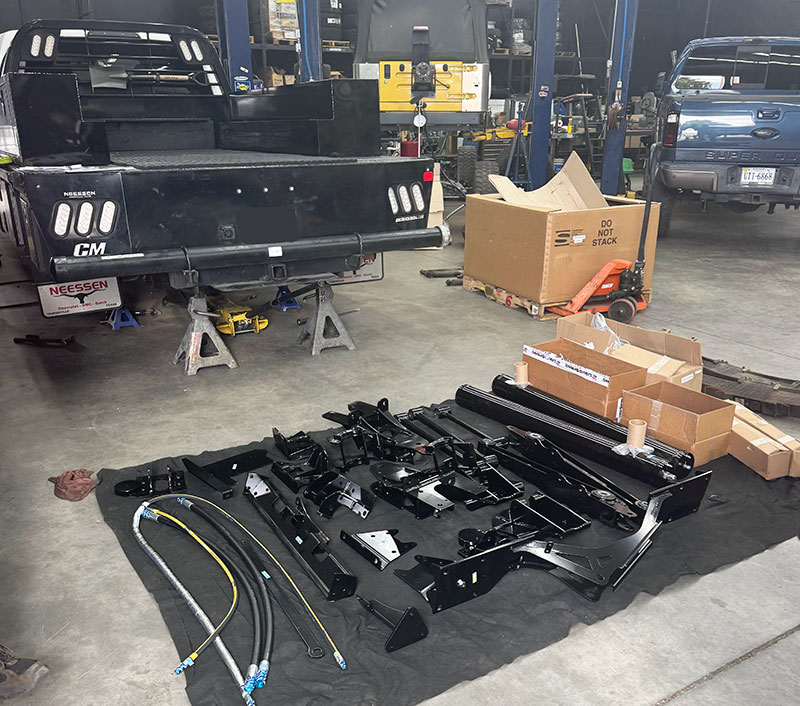
Installation of LiquidSpring suspension on their Ford F-550
You upgraded your F-550 with a Liquid Spring suspension system. What led you to that decision?
Wally: I am used to saying, “bump” just before we go over bridges and things. That’s my warning to Jill who might not be watching the road. Now when I say, “bump”, Jill looks up, and nothing happens. The LiquidSpring system neutralizes the bumps.
You know those tight curves where there’s a speed limit of 30 miles per hour? I was accidentally going 50 miles per hour on one and it sailed through like a Formula One car. It doesn’t lean you to the side of your seat. It compensates.
I went on a ride in our LiquidSpring-equipped truck (without the camper loaded) with the owner of the installation company. We lateraled down the side of a 35-degree embankment. I was holding on like a kid at Busch Gardens theme park. The truck didn’t roll over. The LiquidSpring suspension was able to compensate for those angles and keep the truck safe.
I like that the LiquidSpring system is proactive rather than purely reactive. There’s a computer that constantly recalibrates the driving conditions and the needs of the truck. It gives you confidence of the handling and safety of the rig. Of course we’re still thirteen feet tall, so you don’t want to be too confident.
Jill: I like the comfort and safety factor. It takes stress off our traveling. Wally isn’t as fatigued after a day of long driving, especially when we have wind gusts or a semi passes. I’m also hoping it extends the lifespan of our camper because there’s not as much stress on it when we’re on bumpy roads.
How did you approach the cost of the system?
Wally: Our LiquidSpring installation was $31,000. I approached that figure like a kitchen remodel in a house. No one flinches when somebody builds a deck or updates their kitchen.
Some might say we’ll never get that money back. We’re living on the road full-time, so that’s not my goal. I put $100,000 into a house remodel and lost that home value after 2008. The housing market can crash. We lived through that.
I bought a basic Ford F-550 work truck and put a LiquidSpring system on it instead of a Lariat package and all the bells and whistles. Our total investment in the truck is about $90,000.
Jill: It’s our truck and our home, so we look at it differently.
Wally: The LiquidSpring system allows you to lower the truck and camper eight inches. That really comes in handy at dump stations, and when we load our rig. The rig rides like a daily driver now. I think it’s better than driving a Ford F-150.
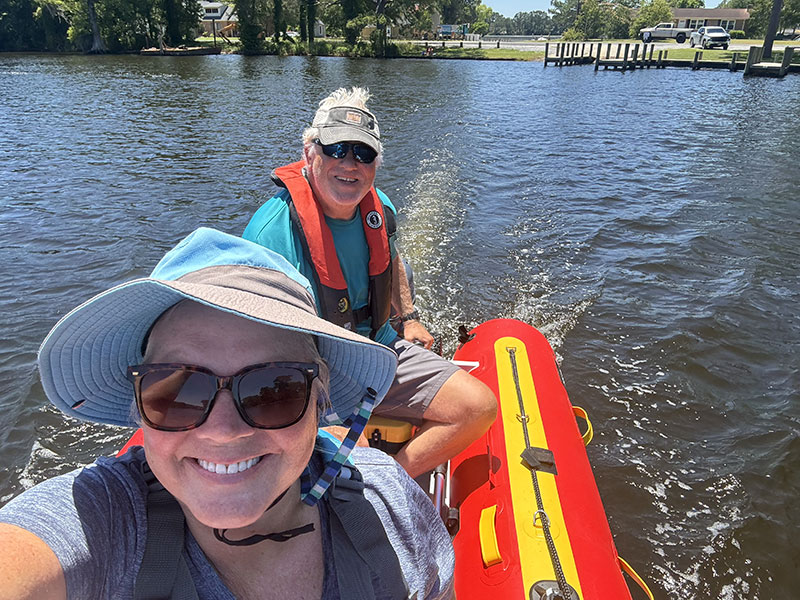
Jill and Wally Maiden voyage on their TrueKit catamaran 3.3m inflatable boat on the Neuse River in New Bern, North Carolina. The boat folds up and they carry it and a 6hp Yamaha motor, as well as an electric trolling motor in the back seat of their truck.
You started full-timing in the summer of 2022. What was it like to sell your house and go full-time?
Jill: When Wally presented me with the idea of going full-time, he still had a civilian job with the Coast Guard. He took me to Princess Craft in Round Rock, Texas to look at the three largest truck campers on the lot. Before we arrived, I told him, “You are not taking me out of my home and sticking me in a truck camper”.
Then I stepped into those campers and said, “I can do this”. After looking at the bigger units, we saw an Arctic Fox 990, and bought it.
To go full time, we sold everything we owned. It’s a process to let go of the things you’ve had for thirty some years, or longer. That was not an easy decision, and it was not done lightly. It was a long and sometimes difficult process. Once we made the decision, we got rid of things in steps. We sold the house and moved into an apartment. Then, there was even more downsizing.
Wally: I had twenty-two years of active duty, so we moved a lot. We also had a flood, and lost some things in that experience. We weren’t in one home all our lives. We were nomadic and moving, and we have replaced things before. That helped me because everything has been temporary.
Your readers might think, “But what if you sell your house and have regrets?” To me, it was just a roof. I can get another roof somewhere. I’ve lived in thirty places in my life. I know people who have owned a house for forty years and have attics full of stuff. Going full-time would be much harder for them.
Jill: Once we went full-time, it was so freeing. I have never felt so free, so light, and so happy. I was so grateful. The first year was amazing. We would go and see all these things most people only see in photographs.
Wally: We paid off our truck and camper with the proceeds from our house, so we were debt free. We were just looking back at our photos of our full-time life so far, and we have genuine smiles in all of them.
“Once we went full-time, it was so freeing. I have never felt so free, so light, and so happy.”
How did your friends and family react to you going full-time on the road?
Wally: It’s a big life change and it’s not the norm so a few friends were concerned we would not like it and wondered what we would do once we discovered that. Luckily, that has not been our case. Honestly, most people were happy and excited for us.
Before we sold our Texas house, we were paying over $1,000 a month in property tax. That was in addition to HOA fees and with our applicable discounts. Now we don’t have those fees.
I would go full-time again a hundred times over. I don’t feel like I’m missing anything. Half the stuff people own, they don’t even know they have.
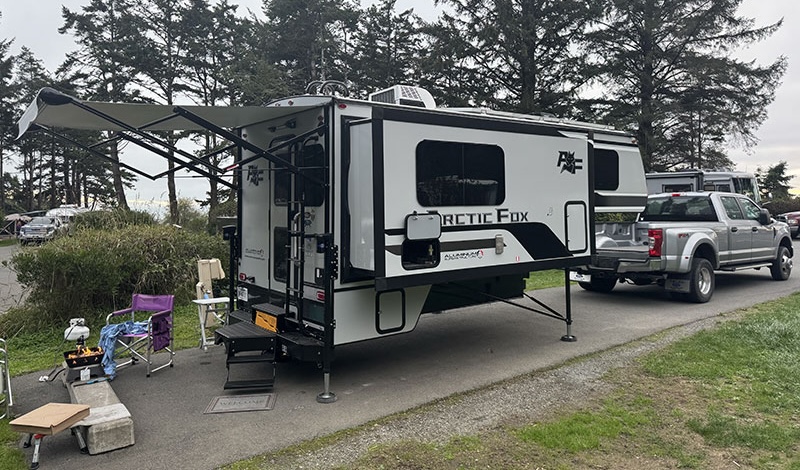
Beverly Beach State Park in Oregon
Jill: We also had people looking at our camper and saying, “You must like each other a lot.” I married Wally—so yes, I do.
Wally: We adore each other and put each other first. It’s a nice, wonderful relationship. Our relationship has grown more since we’ve been full-time on the road.
If you argue as a couple and don’t like being around each other, don’t get a truck camper. Actually, no RV is good for you.
Jill: We still find ways to get space. Wally goes fishing and I go out for walks. I will fly out for a girls’ weekend. I just flew to Texas to see my mom and brother. There are ways like that to have breaks.
“I would go full-time again a hundred times over. I don’t feel like I’m missing anything. Half the stuff people own, they don’t even know they have.”
What’s surprised you about being full-time truck campers?
Jill: We have seen family more than we would have with a house.
Wally: I thought it would be a negative to be away from our friends and family, or that socially we’d be on an island. Instead, we’ve met more people than ever before.
We have seen old military friends and college friends. We have seen people we haven’t seen in forever and have reconnected. We have seen family more doing our loops. We stay in people’s driveways. You can’t do that in a big pull behind.
You’ve been full-time in a truck camper for four years now. If you could go back and talk to yourselves the week before moving into your camper, what advice would you give yourselves?
Wally: I was an adventurous soul, even as a kid. I do not have a lot of fear. I did a lot of research watching YouTube before we went full-time.
I would say to myself that it’s going to be more fun than it would be staying home and doing the norm.
Jill: For me, I think my concern was money. Will we have enough? Should we spend it on this? We are lucky because, being military, we have a pension and health care. Not everyone has that, which is an amazing benefit.
I would go back and say it’s going to be okay and there will be enough. Lean into it and don’t worry about everything. If you can manage money at home, you can do it in an RV.
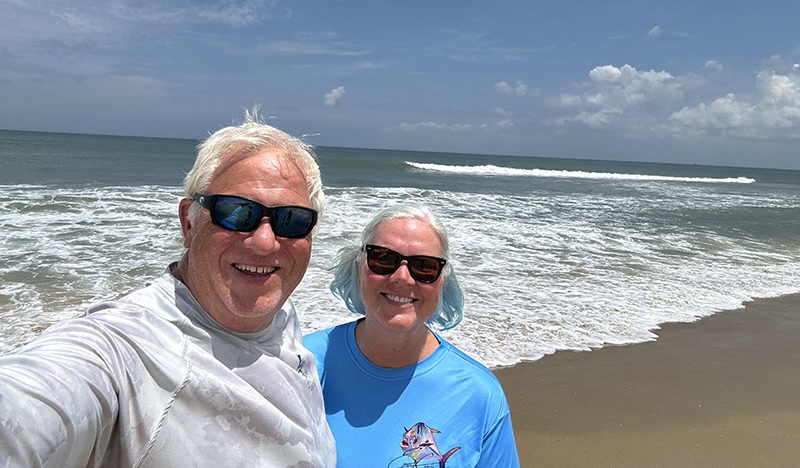
Wally: We’ve been able to do everything we’ve wanted to do. We have continued learning and seeing things. Our life has been more enriched.
Jill: Pursue things that you’ve been dreaming about from a grandchild’s T-ball game to visiting the Grand Canyon. You can be anywhere, and do anything.
Wally: We went to our grandson’s baseball game and grilled hot dogs at the game. There’s a fun factor that the truck camper gives us. At the time we started this lifestyle, we didn’t know that was going to happen.
Jill: Plus, there’s a cool factor to owning a truck camper. So many people ask us about it. I wish I had a dollar for every time people ask us about our lifestyle.
Wally: Just do it. Don’t be afraid. Some people are scared to take a gamble. People don’t allow themselves to do things. Change for us was easy because of our previous military lifestyle. We know it’s not for everyone.
What’s day-to-day like as a full time truck camper?
Jill: Our mindset is flexible and comfortable. I’m a fixer and a doer. At my house, I would have a schedule for chores. With my camper, I have a lot of free time because there’s less to maintain than a home. I am free to take walks, read a book, do paint by numbers, or go to karaoke. My latest passion is singing karaoke.
Our days are mundane. We have coffee, talk and look at our phones, and share articles or videos. As far as travel is concerned, we wing it all the time. I might plan a general area. Often times, we don’t make a reservation unless we are going somewhere special. We have the freedom to do what we want to do. There’s no other way to describe it.
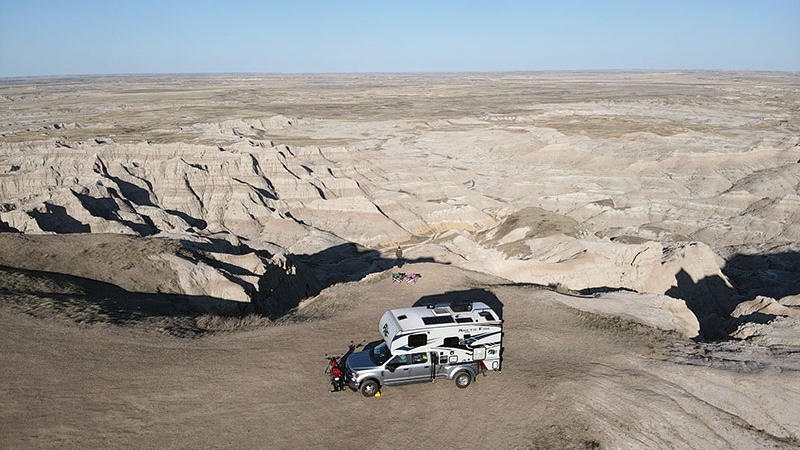
Boondocking on public land just outside of Badlands National Park
Where do you typically camp?
Jill: Generally, we use the Campendium app to find places. Sometimes we’ll look at All Stays. In the beginning, when we went out west, we were almost exclusively boondocking. On the East Coast, there are fewer boondocking opportunities available. It depends on the region we’re in. If we’re on the East Coast, we try to find budget friendly state parks or national forests.
Wally: We prefer boondocking and our rig is set up for that. Even when we go to a full-hookup campsite, I don’t always hook up to power and water. Sometimes, I will ask if there’s a place to park, and they will give us an overflow spot or a field and we pay less. You couldn’t do that with a pull behind trailer.
I see your leveling blocks under your step into your camper. Do they stay there?
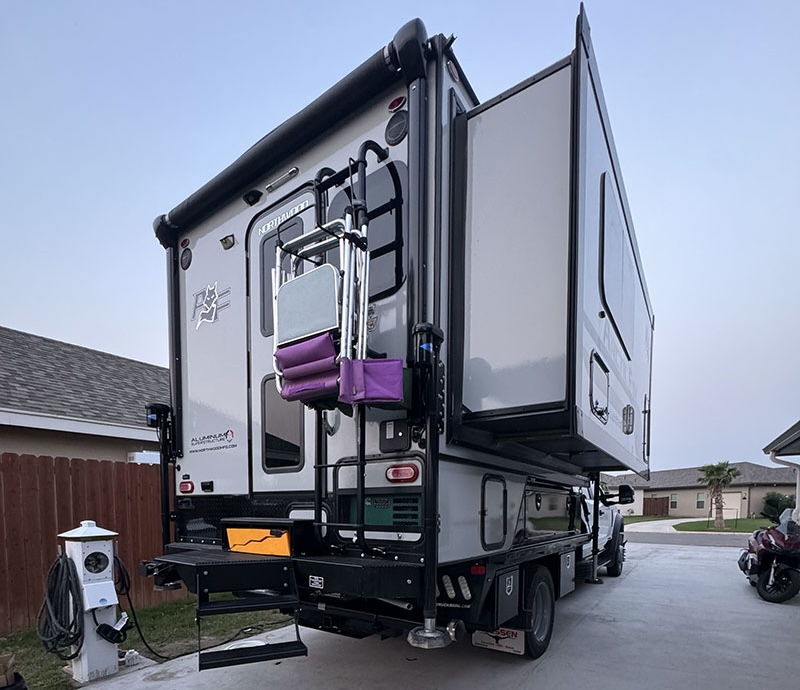
Jill: The Fox Landing folds up and the leveling blocks pocket it in there.
Wally: They fit in there perfectly. We always get creative with our storage spaces. We probably won’t need the leveling blocks anymore once we start using the Liquid Spring Tru-Earth leveling.
What other mods have you done to your camper?
Jill: Everyone loves my spice rack. It’s on Amazon. It’s on the wall and has magnetic pods. They never fall off.
Wally: We use nano tape on everything. We put clear plastic wall mount bins in the shower to hold things and—all with nano tape. Outside, we have solar panel lights that stick on the rig. We have one on each side, and on the entry door.
Jill: We have peel-and-stick fake tiles in the kitchen. Other than that, we haven’t changed anything. The 1150 is perfect for us the way it is.
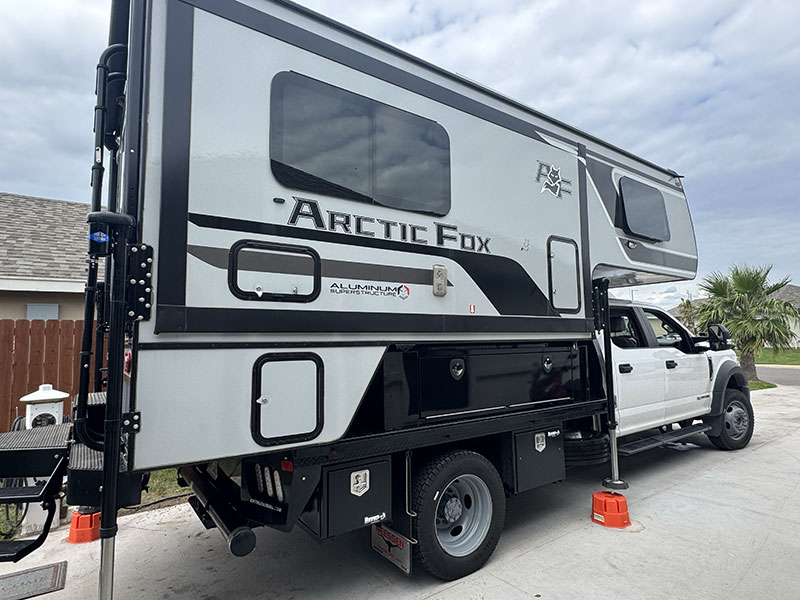
Snap Pads on their Rieco-Titan jacks and eight-inch bucket stands
Wally: We love our Torklift Fastgun turnbuckles. They’re worth it. We also have Snap Pads on the Rieco-Titan jack legs. With a flatbed, you will need an extension for the jacks; we use the eight-inch bucket stands when we want to remove the camper from the flatbed.
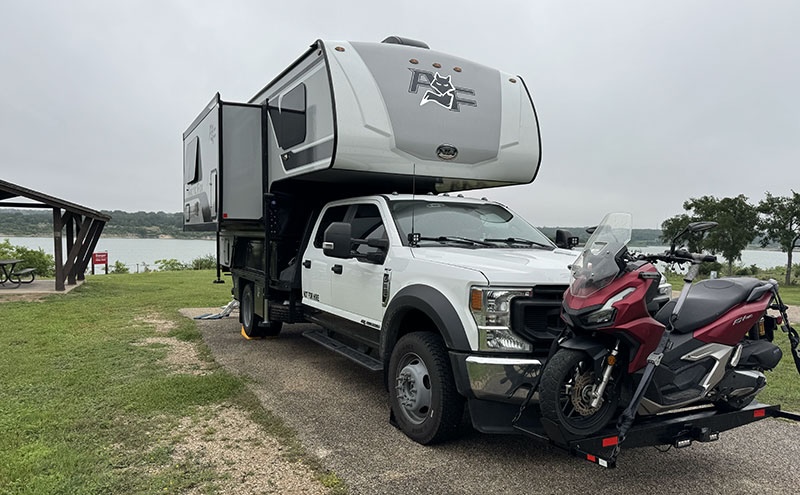
Their Ford F550 and Arctic Fox 1150 with their 2024 Honda ADV 160 on the front hitch in Cedar Breaks Campground, Georgetown, Texas
Tell us about the motorcycle on the front of your rig.
Wally: Our go to motorcycle is a Honda ADV 160, which I highly recommend. I installed a front hitch on the F-550, so we can haul it. The Honda goes over 65 miles per hour with two people, and has storage under the seat. It also has off-road capabilities. There are no gears. It’s just twist and go. It’s a little heavier than our Honda Trail 125, but gives us more ability.
Jill: It’s our second vehicle and a great addition for grocery runs and scouting ahead for great boondocking sites. The 160 expanded our capabilities and I got my motorcycle license, and I can drive it. I didn’t know how to ride a trail bike with changing gears.
Wally: We throw on safety vests and go!
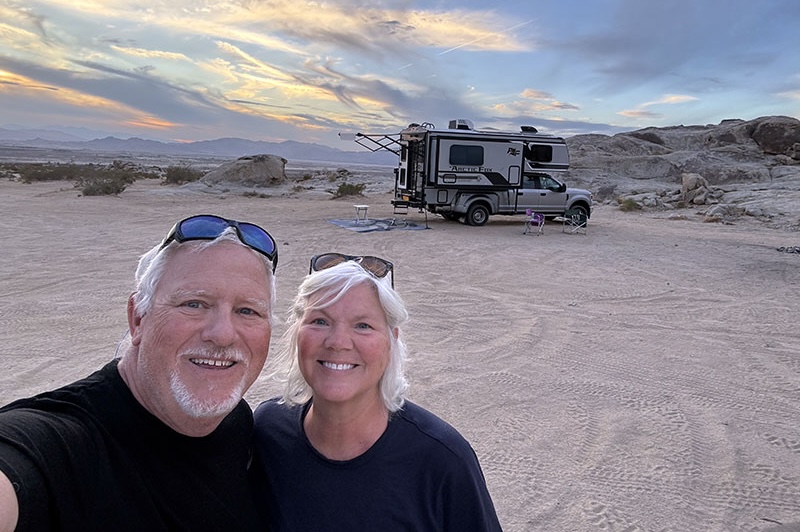
Cougar Buttes Dispersed Camping outside of Lucerne Valley, California
For our readers who are reading this interview and dreaming about hitting the road full-time, what’s one thing you wish they knew?
Wally: The true reason, and why we retired early, was that we started losing good friends. Our youngest friend was 44 and our oldest was 63. We have recently lost seven people within our circle.
That opened our eyes. Living your life to the fullest is more than a paycheck and a cubicle.
I started asking myself: What are we doing? What’s important? Another day is not guaranteed.
Jill: There are so many places, and not enough time.
Wally: I have one more suggestion for anyone curious about truck campers, but is not sure. When we were in Alaska, we saw many truck camper rentals. There were hundreds of them. Renting a truck and camper rig would be a great introduction to British Columbia, the Yukon, and Alaska, and you’d get the experience without buying a rig. Spend a week in Banff, then drive through British Columbia and into the Yukon. It’s a great way to test the lifestyle and see if it’s right for you.
Check out Wally and Jill’s YouTube channel, FoxPartyof3.
Wally and Jill’s Rig
2022 Ford F-550 flatbed
2026 Arctic Fox 1150