LiquidSpring manufactures hydraulic suspension systems designed to adapt to changing loads and road conditions. With a system that adjusts in just 40 milliseconds, LiquidSpring aims to redefine the way trucks ride—with or without a camper.
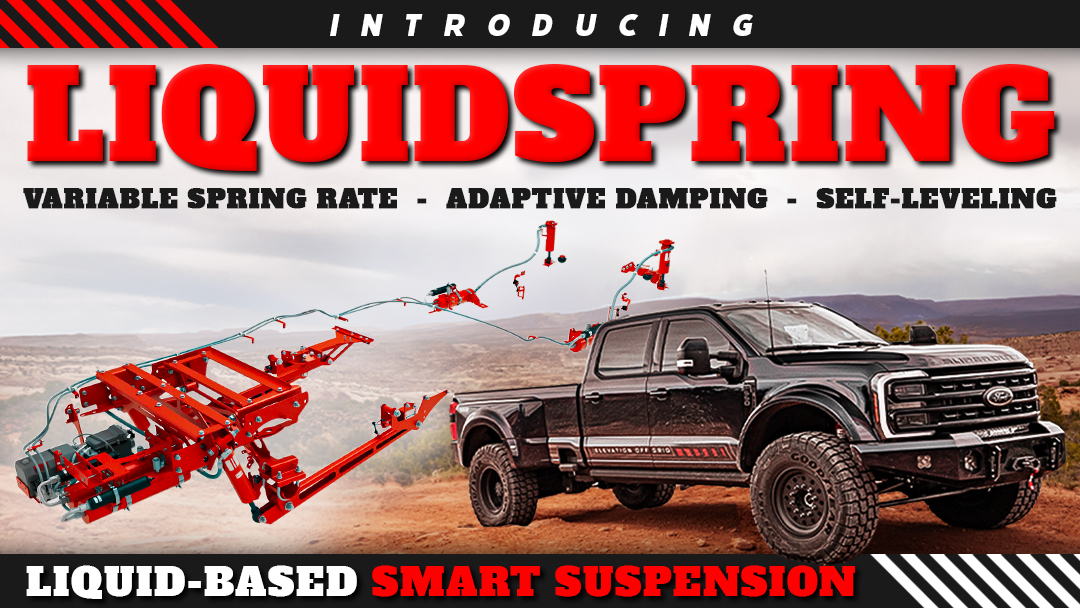
Truck campers demand more from a pickup than perhaps any other RV. One weekend, your truck is hauling thousands of pounds over mountain passes and rough forest roads. A few days later, your camper is offloaded on corner jacks, and that same truck is back to commuting or making a run to the hardware store. Finding a suspension that performs equally well in each situation has long been one of truck camping’s greatest challenges.
Rather than forcing owners to choose between loaded and unloaded or highway and off-road, LiquidSpring invented a patented hydraulic suspension system that changes in real time. LiquidSpring is designed to deliver a composed and predictable driving experience, whether a truck is carrying a camper or running empty.
That all sounds impressive, but let’s address the obvious. A LiquidSpring suspension system is a significant investment. Before anyone takes the leap, they deserve to know exactly how it works, where the technology came from, and perhaps most importantly, how it will affect their truck camping experience.
We talked to Carl Harr, National Sales Manager for LiquidSpring, to trace the company’s suspension technology from its origins in mining equipment and emergency vehicles to today’s truck campers.
Click here for a LiquidSpring brochure
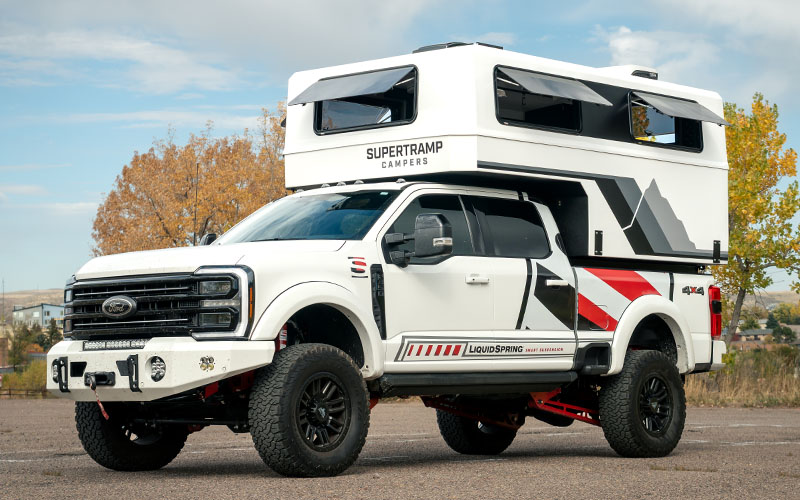
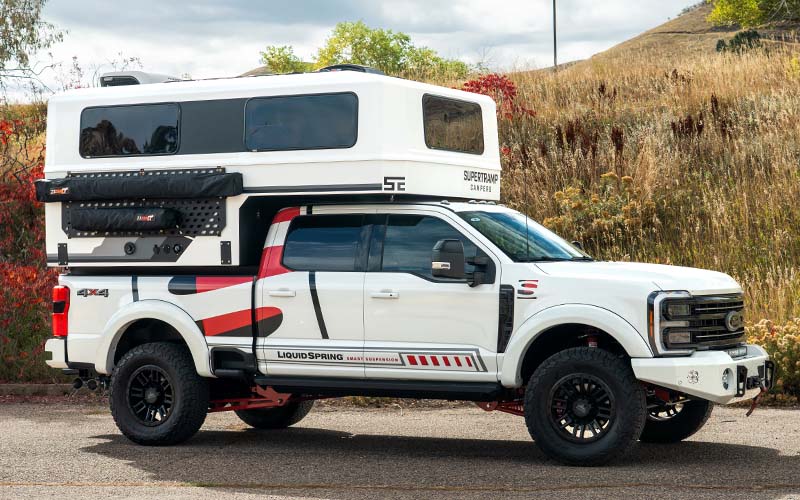
Ford F-350 and Supertramp Flagship HT with LiquidSpring suspension
What is the origin story of LiquidSpring, and how did it evolve into the RV and pickup truck markets?
Richard Meyer was originally an investor in the LiquidSpring fluid technology. After acquiring the patents, he spent nearly a decade working with engineers to refine and advance the technology. Today, he is the Principal and President of LiquidSpring Technologies Inc., based in Santa Fe Springs, California.
In 2004, Richard partnered with Dean Bartolone, President and CEO, to form LiquidSpring LLC in Lafayette, Indiana. In the early days, Dean and Dave Negreski, Director of Advanced Engineering, worked out of a garage to bring the first completed systems to market.
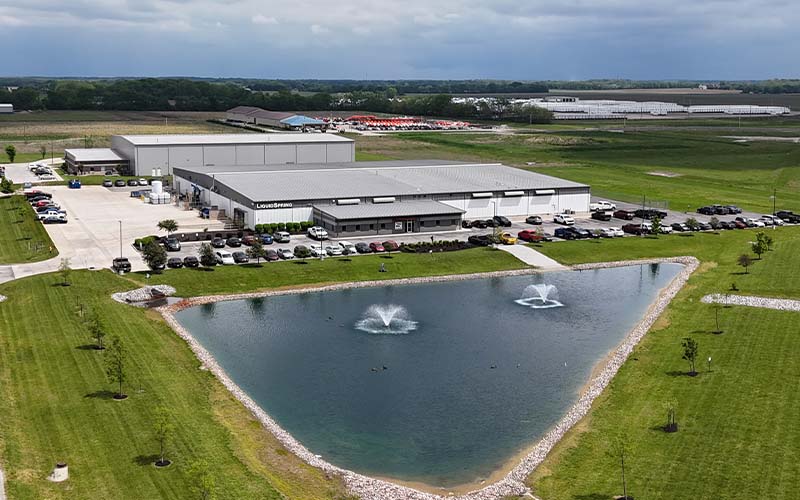
LiquidSpring LLC manufacturing facility in Lafayette, Indiana
Our parent company, LiquidSpring Technologies Inc., develops the core technology in California, including the software, fluid controls, and durability testing. At LiquidSpring LLC in Indiana, we engineer, manufacture, and bring complete suspension systems to market.
LiquidSpring’s first applications were in the mining industry. The technology was used on Terex dump trucks and 100,000-pound coal cars. From there, it evolved into military applications before entering the civilian market in 2012. Within three years, LiquidSpring was installed on approximately ninety-five percent of all Type 1 ambulances built in North America.
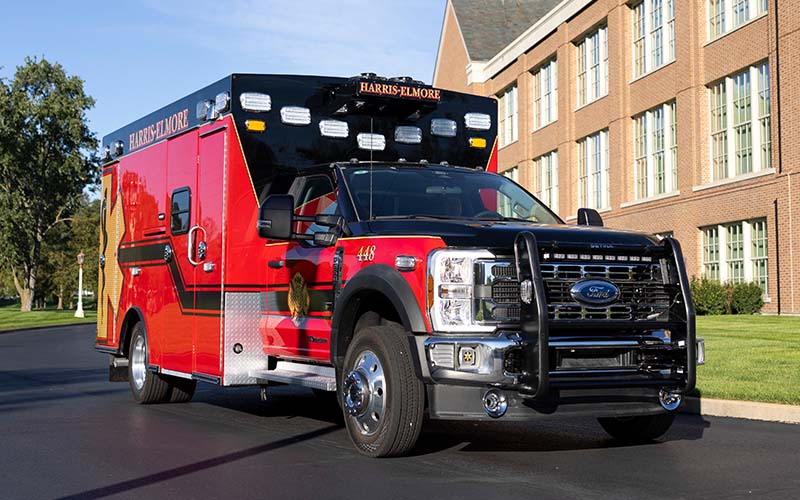
Type 1 Ambulance with LiquidSpring suspension
LiquidSpring entered the RV market in 2013 with a rear suspension system for Fleetwood gas Class A motorhomes. We then expanded into Class C and Super C coaches. A major turning point came in 2017 with the launch of Ford’s new Super Duty platform.
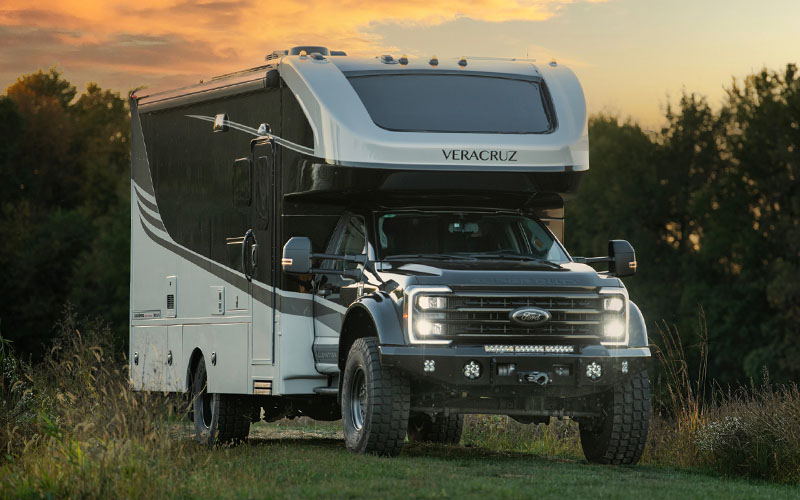
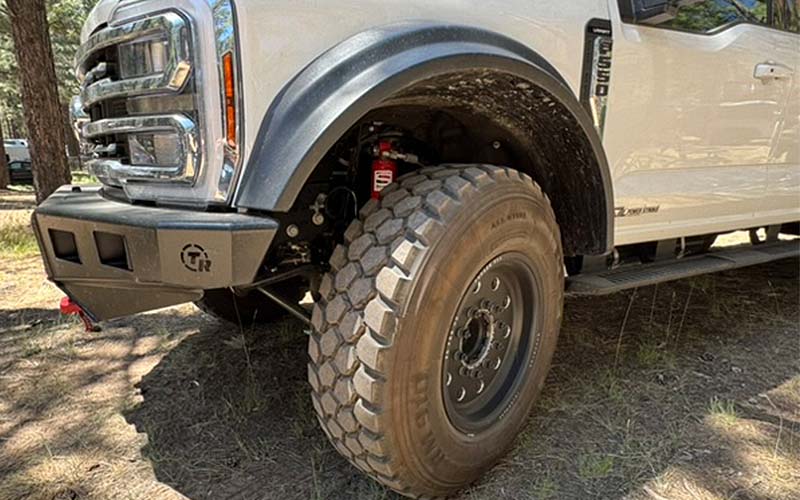
LiquidSpring suspension on a Ford F-550 Renegade Veracruz
LiquidSpring developed a four-corner suspension system for the Ford F-550, and it quickly gained traction in overland rigs, flatbed campers, and expedition vehicles. From there, expanding into pickup trucks and truck campers was a natural progression.
What’s your background, and how did you end up at LiquidSpring?
I retired as a Master Chief in 2004 after twenty-three years in the U.S. Navy. My role focused on aircraft maintenance, particularly hydraulic and pneumatic systems. I learned a great deal about fluid dynamics and how hydraulic and electronic systems work together.
After retiring, I spent seven years in the commercial suspension business. I eventually took a break and moved to Oregon with plans to become a flight instructor. Before that happened, Richard reached out and asked if I’d be interested in joining LiquidSpring. I’ve been here ever since.
Thank you for your service. After a career as a Master Chief in the Navy, what was it like bringing that experience and skill set to LiquidSpring?
Compared to the hydraulic systems on F-14s and F-18s, LiquidSpring is fairly straightforward. My military career also gave me the opportunity to work with diplomats from around the world, which has proven invaluable in building relationships with customers.
In a nutshell, how does LiquidSpring suspension work?
LiquidSpring replaces the factory springs with a four-link or five-link hydraulic suspension that adapts in real time to road and load conditions. It stays soft for ride comfort, then firms up when needed for cornering, braking, crosswinds, or uneven terrain. The result is a smoother ride, better stability, and more control, whether the truck is empty or carrying a fully loaded truck camper.
How does the four-link or five-link suspension design improve ride quality?
Most heavy-duty pickup trucks use coil springs in the front and leaf springs in the rear. They create unwanted movement that forces the entire truck body to twist, resulting in what we call “head toss.” With a four-link or five-link system, the axles can articulate over bumps and uneven terrain, keeping the truck’s frame relatively level.
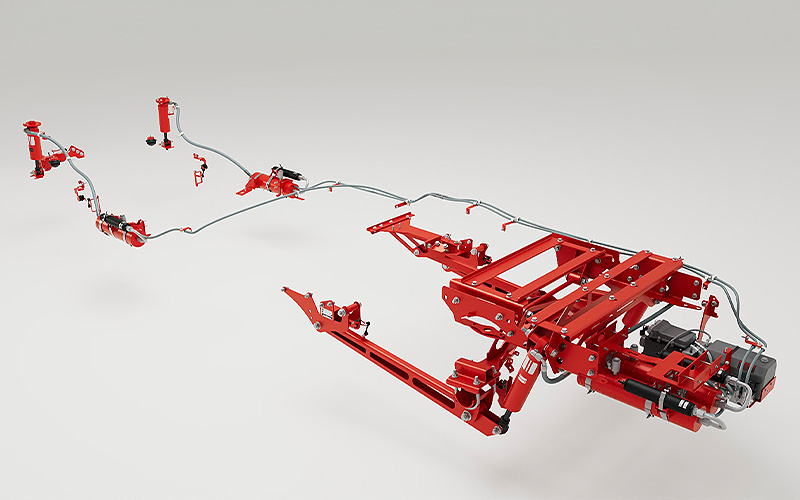
LiquidSpring four-link system
For our heavy-duty pickup truck systems (F-250, F-350, F-450, Ram 3500), we use a four-link configuration consisting of two heavy-duty trailing arms per side with liquid-filled struts at each corner of the truck.
Our medium-duty cab chassis systems (F-550, F-600, Ram 4500, Ram 5500) use a five-link design with two upper trailing arms, two lower trailing arms, and a lateral panhard rod that accompanies the liquid-filled struts at each corner.
What is RideSync technology?
RideSync introduces an accumulator charged with nitrogen to each strut. When the truck is lightly loaded, the suspension uses the compressibility of the nitrogen to create a softer ride. As more weight is added, the system gradually transitions to relying on the compressibility of the silicone liquid.
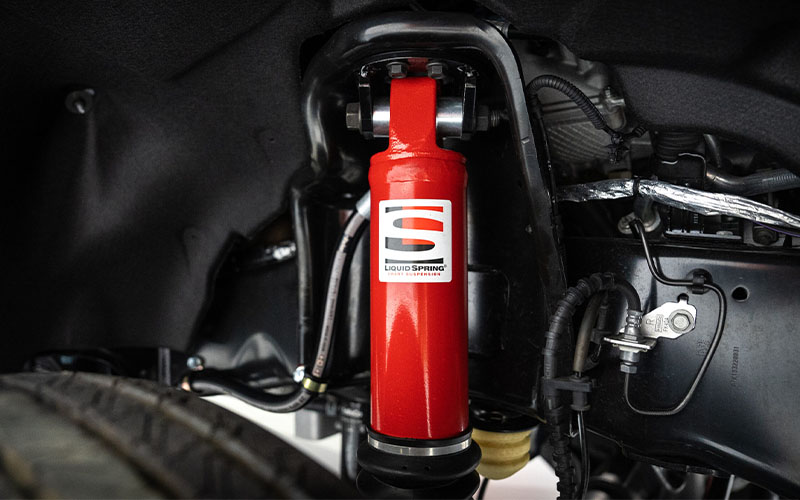
LiquidSpring front strut
RideSync allows a pickup truck to deliver nearly the same ride quality whether it’s empty or carrying a truck camper.
Let’s talk through a few driving scenarios. How does LiquidSpring improve interstate driving?
The suspension is riding on its softest spring rate while you’re driving down the interstate. When you hit a pothole, the silicone liquid absorbs much of that impact energy before it reaches the chassis.
Say a strong crosswind from a passing semi hits the side of the camper, creating a pressure wave. The LiquidSpring sensors detect that movement and immediately counteract it. It’s like having an electronic sway bar.
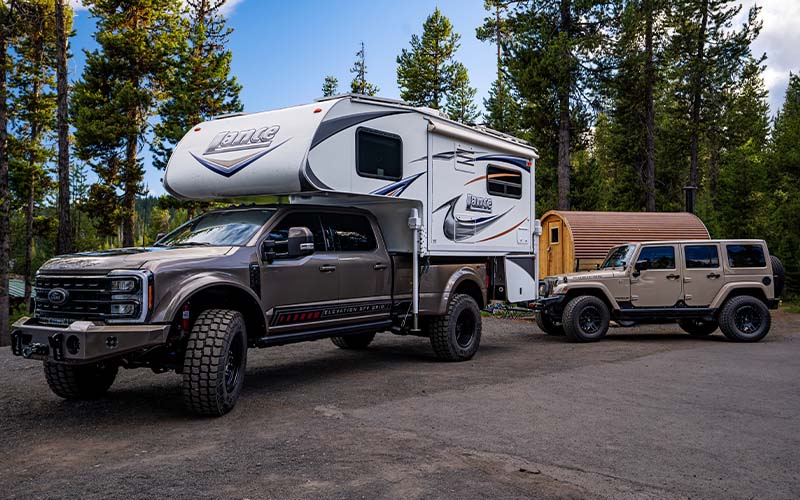
Ford F-550 and Lance 1181 with LiquidSpring suspension
Drivers can select between Comfort, Normal, or Sport mode. Comfort allows more body movement before responding, while Sport reacts more quickly.
Instead of constantly correcting the steering wheel, your shoulders relax, your hands relax, and you go from white-knuckle driving back to driving with your fingertips.
Say we’re driving the Million Dollar Highway in Colorado. How does LiquidSpring perform on winding mountain roads?
The system continuously monitors the steering angle 1,000 times per second and adjusts the spring rate in forty milliseconds. As you wind through a mountain pass, it minimizes body roll to keep the truck flat through turns.
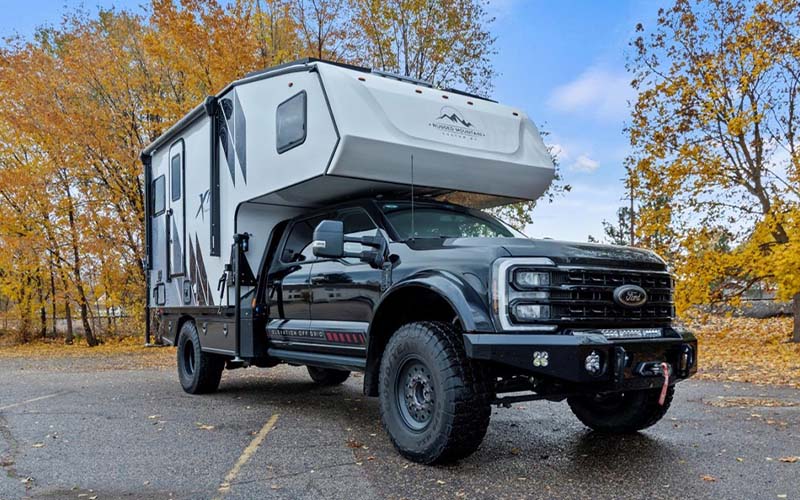
Ford F-550 and Rugged Mountain X12 with LiquidSpring suspension
“You go from white-knuckle driving back to driving with your fingertips.”
The system also incorporates anti-dive technology. During hard braking, the front suspension firms up to reduce nose-dive. This improves traction and stability while shortening stopping distances.
Imagine we just turned down a dirt road that will eventually become a rocky trail. How does LiquidSpring perform off-road?
Washboard roads and rocky trails are a challenge for every suspension system. I’d love to say you won’t feel them at all, but that’s just not realistic. The combination of the hydraulic suspension and the four-corner design allows the suspension to move freely beneath the truck instead of tossing the entire vehicle around.
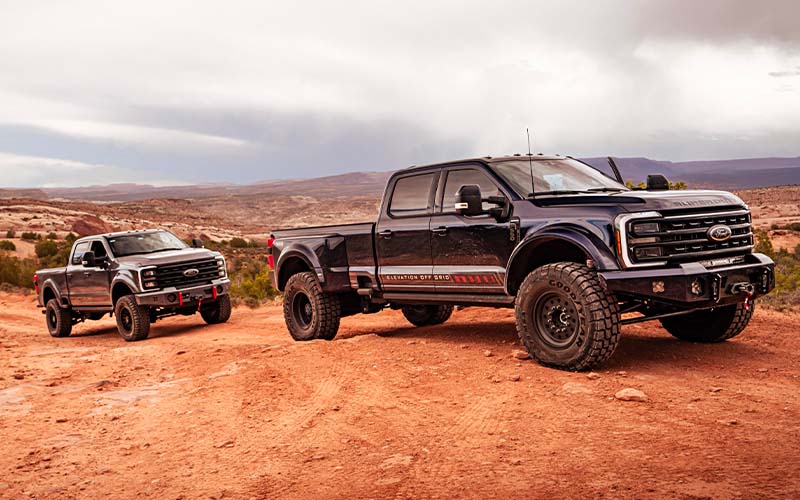
Ford F-350 (left) and Ford F-550 (right) off-road in Moab
“LiquidSpring is a well-rounded system designed to improve ride quality on highways and on dirt.”
We’ve tested our systems in places like Moab, including Top of the World and Hell’s Revenge. The system performs very well in demanding off-road environments. That said, I wouldn’t describe LiquidSpring as an off-road suspension system. LiquidSpring is a well-rounded system designed to improve ride quality on highways and on dirt.
What is TRU-Earth Leveling, and what does it mean for truck campers?
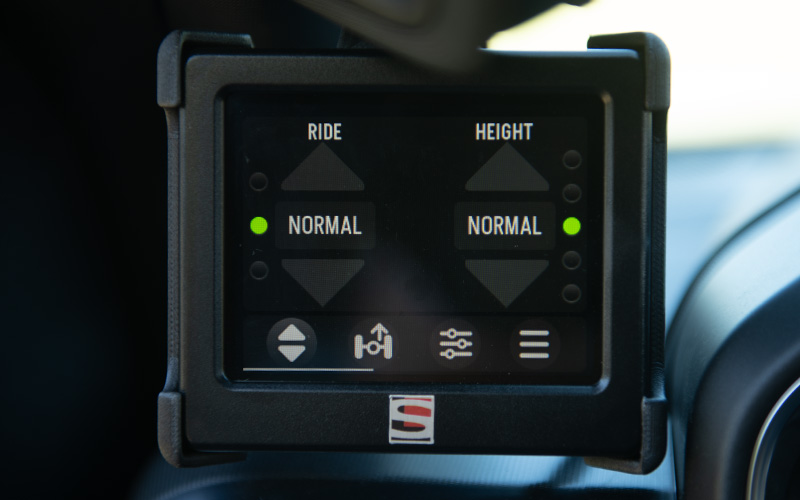
For truck campers, our patented TRU-Earth Leveling software means you won’t need leveling blocks. It allows the truck to automatically level itself with the press of a button.
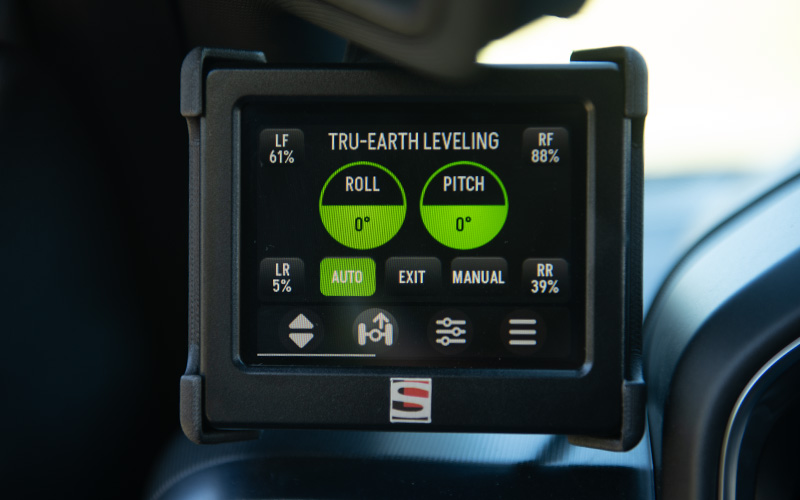
LiquidSpring touchscreen interface in TRU-Earth Leveling mode
“Our patented TRU-Earth Leveling software means you won’t need leveling blocks.”
The TRU-Earth system uses an accelerometer to determine zero pitch and zero roll. If you park at an uneven campsite, the suspension adjusts each corner independently within the eight inches of available strut travel until the truck is level.
Owners can lower the suspension to its minimum ride height before activating TRU-Earth Leveling. The result is a level campsite and more comfortable access to the camper using the entry steps and running boards.
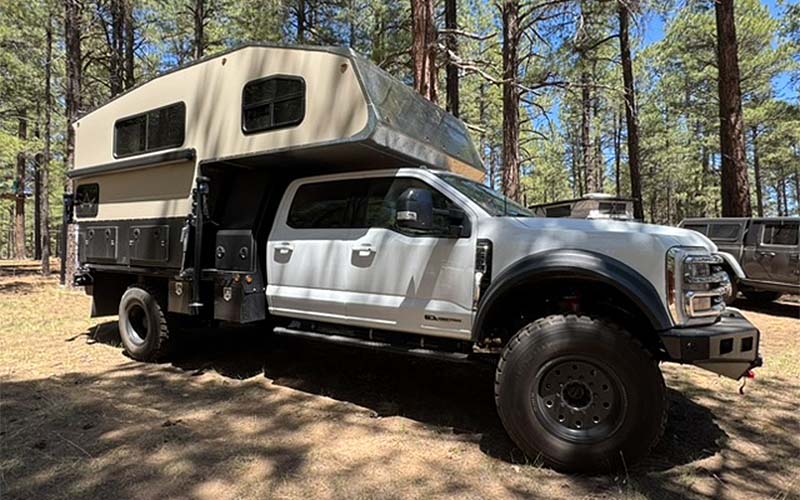
Ford F-450 and Kingstar KRUZR 10 with LiquidSpring suspension
Once leveled, the system continues monitoring the truck for up to seventy-two hours, automatically making adjustments as needed to maintain a level position.
Can LiquidSpring lower the truck to make loading and unloading a demountable truck camper easier?
Yes. After finding a level spot to demount the truck camper, LiquidSpring owners can lower their jacks at normal ride height, then lower the suspension to medium-low (rear only) or low (front and rear), and drive out from under the camper.
The result is a camper that sits closer to the ground, reducing how far the jacks need to extend and making it more stable while demounted. We’ve seen this feature be extremely useful for lifted truck camper setups with large tires.
What truck models are currently compatible with LiquidSpring?
We currently offer LiquidSpring systems for Ford F-250, F-350, F-450, F-550, and F-600 trucks, along with Ram 3500, 4500, and 5500 models. We have solutions for single-rear-wheel, dual-rear-wheel, and super single conversions.
Available configurations vary by truck and application, with systems offered at stock height, a two-inch lift, or a four-inch lift. Depending on the configuration, suspension travel can be up to eight inches.
How do LiquidSpring suspension systems vary between heavy-duty pickup trucks and medium-duty cab chassis trucks?
Structurally, the four-link systems are very similar across the heavy-duty pickup trucks. The biggest differences are the strut sizes and their load capacities. For example, a Ford F-250 uses a smaller-capacity strut than an F-350, while the F-350 dually and F-450 use larger struts designed around their higher axle ratings.
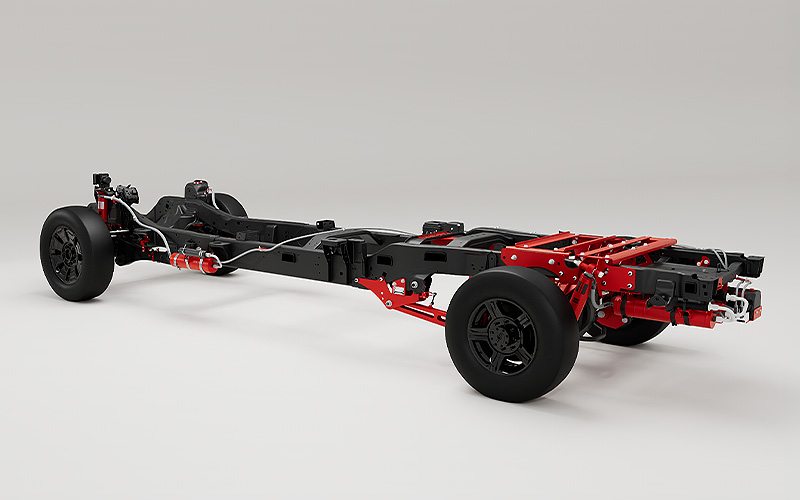
Stock height Ford F-350 with LiquidSpring RideSync
The power modules, pumps, valves, and overall operating principles remain the same. Software is calibrated for each vehicle, but the technology itself is consistent across the lineup.
When you move into medium-duty cab chassis trucks like the Ram 5500 and Ford F-550, the suspension transitions to our five-link design and uses larger struts to accommodate the increased capacities.
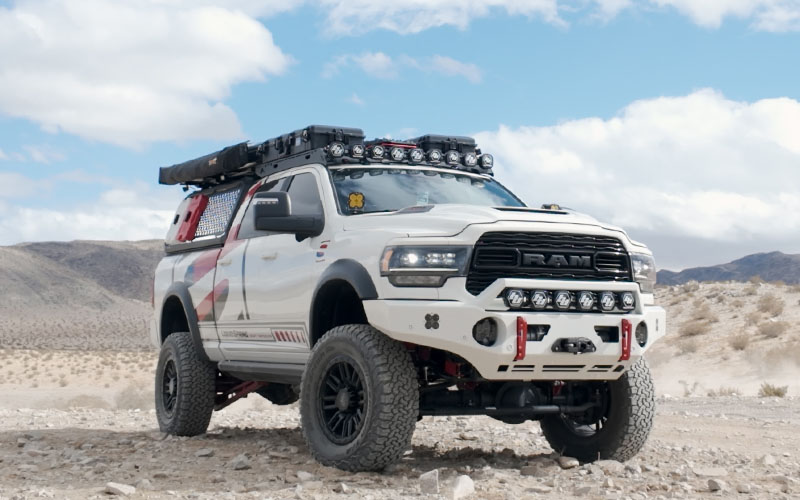
Ram 3500 with LiquidSpring RideSync
RideSync is currently only available on the heavy-duty pickup platforms (F-250, F-350, F-450, Ram 3500), but we’re working toward bringing it to medium-duty cab chassis trucks (F-550, F-600, Ram 4500, Ram 5500) in the near future.
Are you developing systems for Toyota, Chevrolet, GMC, or any of the half-ton and mid-size trucks?
We’re not ready to promise anything, but we are exploring systems for half-ton and mid-size trucks. We recently packaged our LiquidSpring Technology into a suspension system small enough for Polaris side-by-sides.
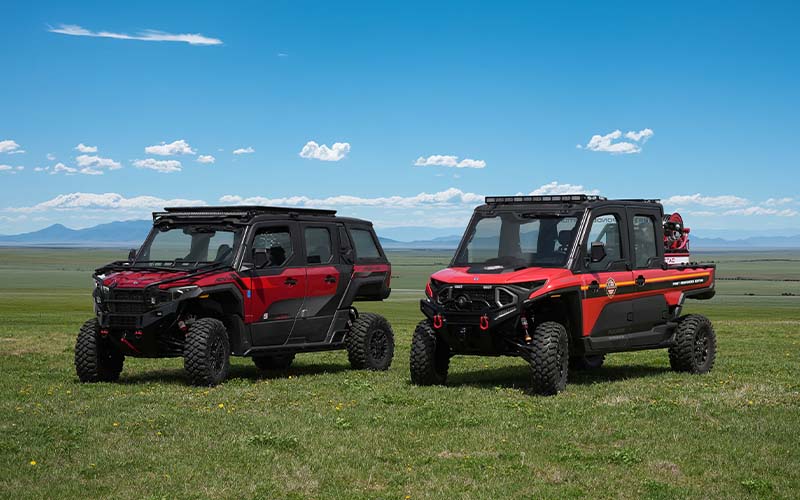
Polaris side-by-sides with LiquidSpring suspension
Scaling the technology down to side-by-sides gives us confidence that it can be adapted for half-ton and mid-size pickup trucks.
Being a liquid-based suspension, does LiquidSpring’s performance change in extreme temperatures?
LiquidSpring is designed to operate in temperatures as low as 50 degrees below zero Fahrenheit and in extreme heat. Conventional suspension oil becomes much thicker in cold weather and thins considerably in high temperatures. Our patented silicone oil remains consistent.
Many ambulance fleets switched from air suspension to our hydraulic system because it doesn’t suffer from the issues that air systems experience in freezing climates. Ambulance fleets with LiquidSpring suspension have been operating throughout Canada and Alaska for more than fourteen years. We also have vehicles in desert regions like Arizona, Saudi Arabia, and Kuwait.
LiquidSpring holds more than fifteen patents. What are they for, and how were they developed?
LiquidSpring’s earliest patents centered on controlling the silicone liquid. From there, we developed patents covering expandable fluid volumes, variable spring rates, and technologies like TRU-Earth Leveling and RideSync.
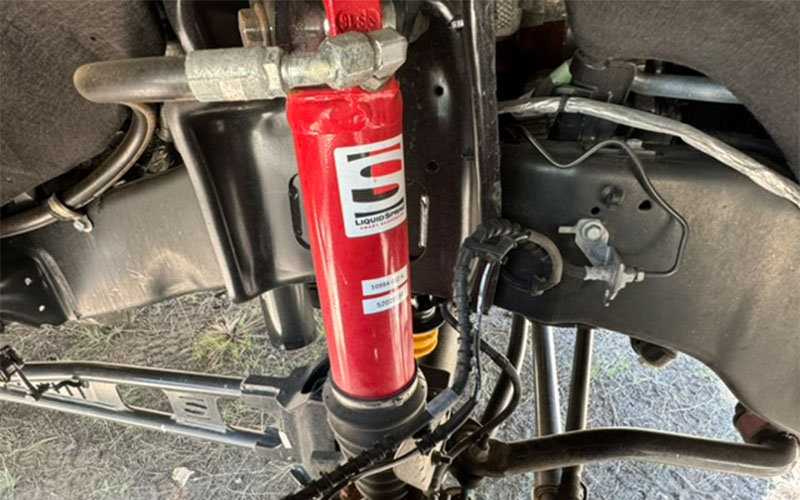
LiquidSpring front strut and trailing arm
Our engineers use an MTS testing machine to precisely measure damping curves throughout a strut’s travel. This performance data has been a major contributor to developing the technology we use today.
What does the manufacturing process involve? Is everything built in-house?
LiquidSpring is a very vertically integrated company. We manufacture nearly everything ourselves in our 100,000-square-foot facility in Lafayette, Indiana.
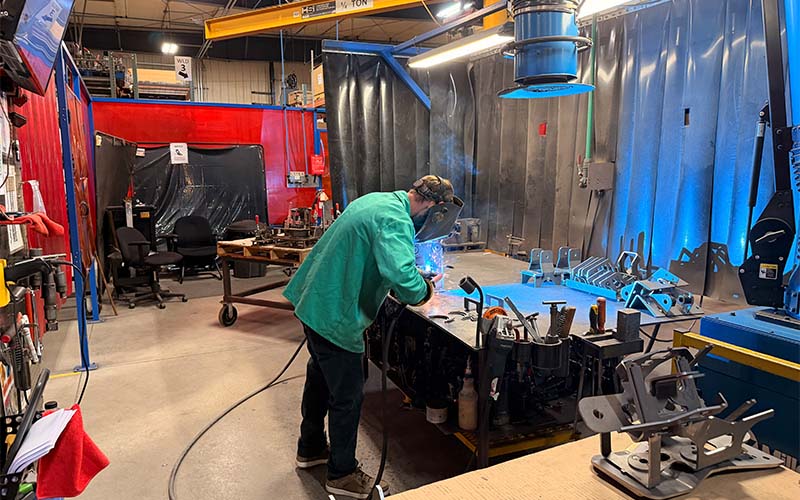
LiquidSpring team member welding suspension components in a precision fixture
There are only a few specialized parts, such as castings, that come from outside suppliers. Keeping the majority of the system in-house helps us maintain a high level of quality control and ensures contaminants never enter the hydraulic systems during production.
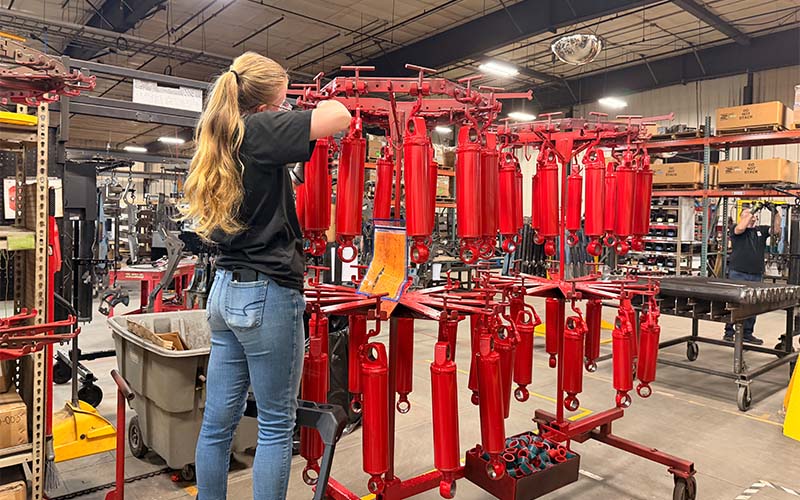
LiquidSpring struts receiving an inspection fresh out of powder coating
Our production includes laser cutting, press braking, welding, powder coating, machining, and final assembly.
How does LiquidSpring affect a vehicle’s Gross Vehicle Weight Rating?
Every LiquidSpring system is engineered to match the GVWR established by the manufacturer. We also work with each truck manufacturer to guarantee that LiquidSpring owners retain their factory warranty.
How much does a LiquidSpring system add to the curb weight of a truck after the OEM suspension has been removed?
A complete four-corner (front and rear) LiquidSpring suspension system adds up to 500 pounds to the vehicle’s overall weight, depending on the application.
A rear-only LiquidSpring suspension system adds approximately 300 pounds to the vehicle’s overall weight.
What is the MSRP for a LiquidSpring smart suspension system?
Customers can purchase a rear-only system or a complete four-corner system.
The rear-only LiquidSpring system retails for $12,000 USD. The rear suspension is the foundation of the LiquidSpring system, incorporating the multi-link suspension, power module, ECU, hydraulic pump, valves, and other primary control components.
A stock-height four-corner LiquidSpring system starts at $17,950 USD. Installation requires about thirty hours of labor. Installation costs will vary based on the shop’s hourly labor rate.
Complete two-inch and four-inch lift systems retail for $20,600 USD and will require about forty hours of labor to install. All pricing is based on the current 2026 MSRP.
What would you say to readers who are thinking, “Wow, that’s expensive”?
We understand that it’s a significant investment. When you compare LiquidSpring to other premium suspension systems, we’re competitive in price while delivering capabilities that traditional suspensions simply can’t.
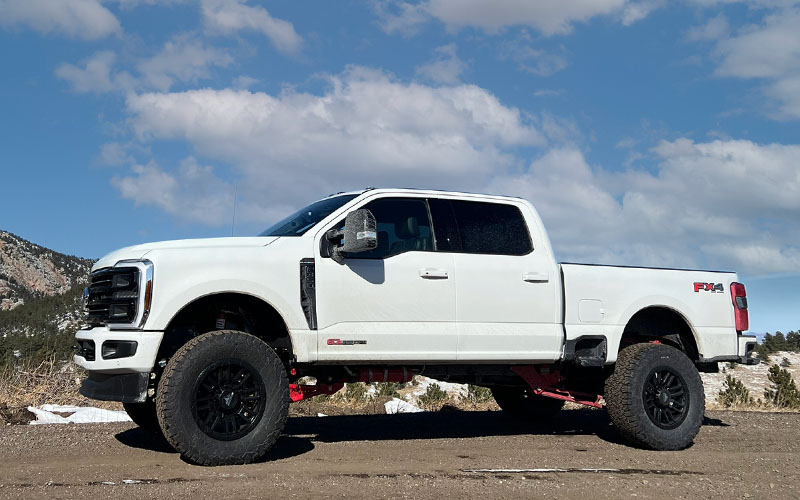
Ford F-350 with LiquidSpring RideSync and four-inch lift
The investment extends beyond the suspension. You experience less fatigue while driving. You’re reducing wear on the truck and the camper. That’s where the value really begins to show.
What does the ordering and installation process involve?
It starts with a conversation about your truck and how you use it. We’ll verify the year, make, model, and configuration, along with what you’re carrying. We then coordinate installation through one of our authorized dealers.
Once the order is placed, lead times are typically three to five weeks before the system ships. Installations can take anywhere from two to five days, depending on the system you choose.
The installation includes a road test and system calibration. Before you leave, installers will walk you through the controls, mobile app, and features so you’re comfortable using the system.
What maintenance does the LiquidSpring system require?
After the first 1,000 miles, the suspension should be retorqued. That’s a one-time procedure.
Each system includes a desiccant breather filter that changes color from purple to pink as it absorbs moisture. It will need to be replaced more frequently in humid climates than in dry regions like Arizona, where it may last for years.
The hydraulic struts will eventually experience normal seal wear. Many customers see between 75,000 and 100,000 miles before replacing struts, while some have exceeded 150,000 miles before service was required.
The only other maintenance is making sure the software is up to date. Our latest system receives updates over the cloud through the LiquidSpring mobile app. Previous systems can be updated using a USB drive.
What happens if something goes wrong while traveling in a remote area?
We currently have more than 200 service providers across the United States and Canada, including two in Alaska.
If a significant problem occurs, the truck simply lowers onto its bump stops. The ride won’t be as comfortable, but you’ll still be able to drive the vehicle to a repair shop.
What warranty does LiquidSpring offer?
Structural components are covered by a five-year, 100,000-mile warranty. Electronic and hydraulic components are covered for three years or 50,000 miles. We also provide a one-year labor warranty.
What does the future hold for LiquidSpring and truck campers?
We’re continuing to add new features with truck campers in mind. Very soon, manual TRU-Earth Leveling will allow owners to adjust the height of each strut individually using the LiquidSpring touchscreen or the app. This will make draining tanks and loading or unloading a truck camper easier.
Beyond that, we get requests for mid-size and half-ton trucks, especially Toyotas. Developing a new system is a major engineering effort, but we’re always looking at what’s next. As we continue to refine our technology and package it into smaller applications, there will be even more opportunities in the truck camping and overland markets.
For more information on LiquidSpring, visit their website at liquidspring.com. To request information on a LiquidSpring smart suspension for your truck camper rig, click here.