Time’s up! Put down your Number 2 pencils and pass your papers in. How did you do on the Truck Camper Knowledge Test? Let’s find out!
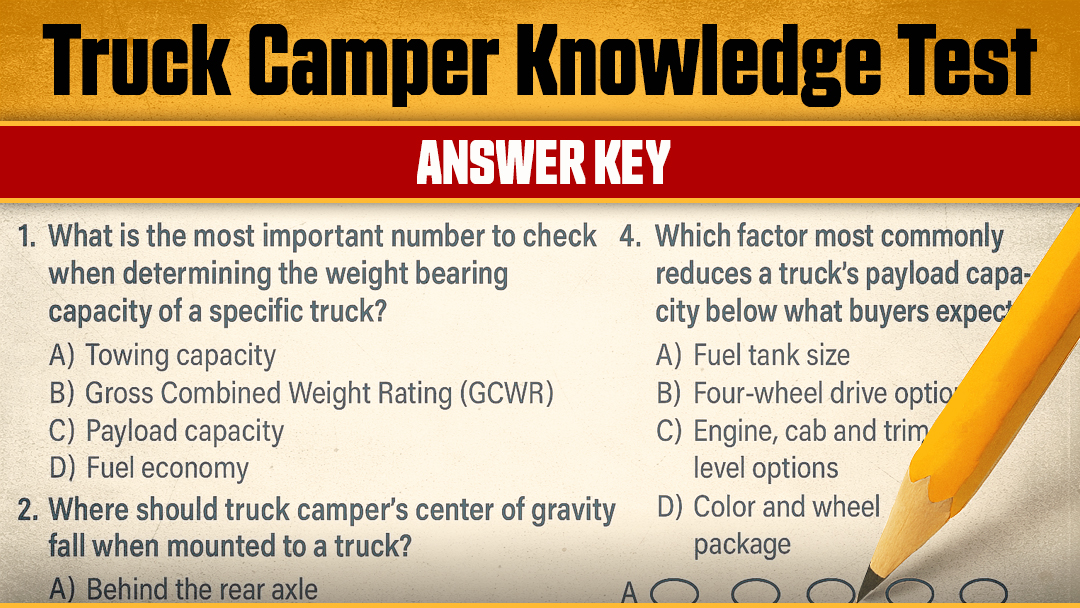
The MCAT? Easy peasy. Bar exams? No sweat. CPA exam? Like taking a nap. The TCM CKT (Camper Knowledge Test)? You’d better study, buster!
Maybe you wrote your CKT answers on an index card and tucked it behind a sofa cushion. Perhaps you inked your answers on the underside of your left foot and haven’t taken your socks off for days. Or did you type it into your phone and secure it with your favorite password: c4mp3rs-r0ck?
Wherever you jotted your answers down, get them out now. It’s game time. Here are the official answers to the Camper Knowledge Test.
1. What is the most important number to check when determining the weight bearing capacity of a specific truck?
A) Towing capacity
B) Gross Combined Weight Rating (GCWR)
C) Payload capacity
D) Fuel economy
Correct Answer: C
Explanation: Payload capacity determines how much weight the truck can safely carry in the bed, which is critical for truck campers.
2. Where should a truck camper’s center of gravity fall when mounted to a truck?
A) Behind the rear axle
B) In front of the front axle
C) Over or in front of the rear axle
D) Anywhere if tie-downs are secure
Correct Answer: C
Explanation: The center of gravity must be over or in front of the rear axle to ensure safe handling and load distribution.
3. What is the best way to verify your specific truck’s payload capacity?
A) Check the towing guide
B) Look up the manufacturer’s curb weight
C) Search Google for the answer
D) Check the yellow “Tire and Loading Information” sticker on the driver’s side door jam
Correct Answer: D
Explanation: The yellow “Tire and Loading Information” sticker shows the actual payload capacity of a specific truck as built.
4. Which factor most commonly reduces a truck’s payload capacity below what buyers expect?
A) Fuel tank size
B) Four-wheel drive option
C) Engine, cab, and trim level options
D) Color and wheel package
Correct Answer: C
Explanation: Trim options like four-wheel drive, larger cabs, and premium packages add weight, reducing available payload.
5. Why do slide-out campers typically weigh more than non-slide models?
A) They require more insulation
B) They are longer and wider
C) Slide mechanisms and structure add significant weight
D) They include more tanks
Correct Answer: C
Explanation: Slide-outs add mechanical components and structural reinforcement, increasing total camper weight.
6. Which of the following is a major benefit of a pop-up truck camper compared to a hard-side camper?
A) Lower profile and better fuel mileage
B) Higher insulation value
C) More interior space
D) Larger fresh water tanks
Correct Answer: A
Explanation: Pop-up campers have a lower profile when in the travel position helping with handling and fuel economy.
7. What is RAWR (Rear Axle Weight Rating)?
A) Maximum weight allowed on the rear axle
B) Curb weight of rear wheels
C) Weight distribution with trailer
D) Payload subtracted from GVWR
Correct Answer: A
Explanation: RAWR is the maximum weight a truck’s rear axle can handle, important for camper loads.
8. Why might a crew cab short bed have less payload capacity than a regular cab long bed?
A) Shorter bed
B) Smaller wheels
C) Heavier cab and trim level
D) Lower suspension rating
Correct Answer: C
Explanation: Crew cabs are heavier, leaving less available payload than regular cabs. Higher trim levels also add weight further reducing payload capacity.
9. Which of the following pickup truck types generally offers the highest payload capacity?
A) Half-ton gas
B) Three-quarter ton diesel
C) One-ton single rear wheel diesel
D) One-ton dual rear wheel gas
Correct Answer: D
Explanation: From the available choices, one-ton dually gas pickup trucks have the highest payload capacities due to the extra rear wheels and lighter powertrain.
10. Why is it important to account for passengers and gear in payload calculations?
A) They affect fuel economy
B) They increase total towing capacity
C) They contribute to the truck’s total weight
D) They increase tire wear
Correct Answer: C
Explanation: Passengers and gear add to the truck’s total weight and must be included in payload calculations.
11. Which of the following are key benefits of a long bed truck for truck campers?
A) Easier maneuvering and better turning radius
B) Higher payload capacity and more floor plan and model options
C) Better off-road capability and camper fitment
D) Lower insurance rates and overall cost of ownership
Correct Answer: B
Explanation: Long beds can carry more weight and accommodate a wider range of camper makes and models.
12. Why are non-slide campers preferred over slide-out models by some hard side truck camper enthusiasts?
A) Lower weight and fewer mechanical systems
B) Larger holding tanks and battery storage capability
C) Bigger windows and better insulation
D) More interior cabover room
Correct Answer: A
Explanation: By removing slide-out rooms and slide-out mechanisms, non-slide campers have lower weight, fewer moving parts, and less potential for repairs.
13. When does a truck camper’s weight exceed the manufacturer’s published weight?
A) When camping at high altitude
B) When options, aftermarket accessories, and cargo are added
C) When the camper is off the truck
D) When the mattress, windows, and appliances are removed
Correct Answer: B
Explanation: Options, accessories, and cargo add weight that isn’t included in a manufacturer’s published weight.
14. Which part of the truck is not going to degrade if overloaded with a camper?
A) Engine
B) Rear suspension
C) Front brakes
D) Windshield wipers
Correct Answer: D
Explanation: If you are overloaded, the engine, suspension, and brakes will be stressed more than a properly matched truck and camper. Windshield wipers are not impacted by an overloaded truck.
15. When matching a truck and camper, what is one reason why it’s recommended to choose the camper first?
A) Campers are more expensive than trucks
B) It’s often easier to find a truck to match a camper than vice versa
C) Camper models are limited
D) Trucks have standardized payload capacities
Correct Answer: B
Explanation: Campers vary widely in weight. For this reason, it’s often easier to match a truck to a specific camper than the other way around.
16. What is the primary reason for weighing your fully loaded truck and camper combination?
A) To determine fuel efficiency
B) To ensure compliance with payload, GVWR, and GAWR limits
C) To estimate resale value
D) To adjust tire pressure
Correct Answer: B
Explanation: By weighing your fully loaded truck and camper rig at a certified scale, you will have accurate information to make sure you don’t exceed your truck’s payload, GVWR, and/or GAWR.
17. What does GVWR (Gross Vehicle Weight Rating) represent?
A) The weight of the truck alone
B) The maximum allowable weight of the truck and all its contents
C) The weight of the camper alone
D) The towing capacity of the truck
Correct Answer: B
Explanation: GVWR includes the truck, passengers, cargo, and camper—the total allowable loaded weight.
18. How can aftermarket accessories affect your truck’s payload capacity?
A) They have no impact
B) They can increase payload capacity
C) They add weight, reducing available payload
D) They improve fuel efficiency
Correct Answer: C
Explanation: Accessories add weight, reducing the remaining truck payload capacity.
19. What is the weight of a gallon of water, which must be considered in payload calculations?
A) 5.5 pounds
B) 6 pounds
C) 8.34 pounds
D) 10 pounds
Correct Answer: C
Explanation: Water weighs 8.34 pounds per gallon—a major payload factor.
20. What are the potential effects of operating a truck beyond its rated payload capacity?
A) Improved stability
B) No noticeable change
C) Reduced handling performance and longer stopping distances
D) Better fuel efficiency
Correct Answer: C
Explanation: Operating a truck beyond its rated payload capacity affects braking and steering, which can lead to longer stopping distances and less predictable handling.
21. Suspension enhancements are designed to improve handling, but do they increase a truck’s legal payload capacity?
A) Yes
B) No
C) Only with manufacturer approval
D) Depends on the product
Correct Answer: B
Explanation: Suspension upgrades can help ride quality but don’t legally increase payload ratings.
22. For trucks that don’t come standard with a sway bar, what is a common benefit of installing a sway bar on a truck carrying a camper?
A) Increased payload capacity
B) Reduced side-to-side body roll
C) Improved fuel economy
D) Enhanced acceleration
Correct Answer: B
Explanation: Sway bars reduce body roll for safer, more comfortable handling under load. For this reason, many truck camper rigs have sway bars installed, or upgraded/larger sway bars installed.
23. What is a wet bath in a truck camper?
A) A bathroom with separate shower and toilet areas
B) A bathroom with a combined shower and toilet area
C) An outdoor shower setup
D) A bathroom without a sink
Correct Answer: B
Explanation: A wet bath combines the toilet and shower in a single waterproof area.
24. How does a dually (dual rear wheel) truck benefit camper hauling?
A) Decreased payload capacity
B) Improved stability and higher payload capacity
C) Reduced traction
D) Increased turning radius
Correct Answer: B
Explanation: Dual rear wheels provide more stability and support more weight.
25. What does a typical 30-gallon water tank weigh when full? Answers are rounded to the nearest tenth.
A) Approximately 180 lbs
B) Approximately 75 lbs
C) Approximately 250 lbs
D) Approximately 100 lbs
Correct Answer: C
Explanation: 30 gallons × 8.34 lbs/gallon ≈ 250.2 lbs; rounded to 250 lbs.
26. What is the purpose of airbags in a camper setup?
A) Replace leaf springs
B) Help level the truck under load
C) Increase GVWR
D) Support sway bars
Correct Answer: B
Explanation: Airbags help level loads and ride quality but don’t increase legal payload ratings.
27. What’s the legal maximum height for an RV or camper in the US and Canada?
A) 12 feet 6 inches (6.4 meters)
B) 13 feet 6 inches (4.2 meters)
C) 14 feet (4.3 meters)
D) 16 feet 2 inches (4.9 meters)
Correct Answer: B
Explanation: The legal maximum height for RVs and campers in most U.S. and Canadian jurisdictions is 13 feet 6 inches (4.2 meters), ensuring safe clearance under standard overpasses and bridges.
28. What’s the downside of ignoring rear sag?
A) Cosmetic only
B) Uneven tire wear and unsafe handling
C) Reduced engine power
D) Affects 4WD engagement
Correct Answer: B
Explanation: Rear sag can lead to uneven tire wear, misaligned suspension geometry, and unsafe handling.
29. What does DRW stand for?
A) Direct Rear Weight
B) Dual Rear Wheel
C) Diesel Ready Weight
D) Double Reinforced Wheel
Correct Answer: B
Explanation: DRW stands for Dual Rear Wheel—a dually truck.
30. When truck camping, what does “boondocking” refer to?
A) Camping on pavement
B) Camping off-grid with no hookups
C) Using generators
D) Towing without braking
Correct Answer: B
Explanation: Boondocking means camping without hookups. It’s also called dry camping, or camping off-grid.
31. Which 12-volt system requires the most power in a camper?
A) Water pump
B) Compressor refrigerator
C) Electric jacks
D) Roof fan vent
Correct Answer: C
Explanation: Truck camper corner jacks draw upwards of 60-amps to run all four camper jacks at the same time—by far the highest 12-volt load in most truck campers.
32. What are the benefits of lithium batteries in campers?
A) Cheaper than lead-acid and AGM
B) Safer in high heat and freezing temps
C) Higher usable amp-hour capacity and lighter weight
D) Built into solar panels and roof racks
Correct Answer: C
Explanation: Lithium batteries are lighter and offer more usable amp-hour capacity than a lead-acid or AGM of a similar size.
33. Which insulation type is most common in truck campers?
A) Spray foam
B) Fiberglass batts
C) Closed-cell foam board
D) Bubble wrap
Correct Answer: C
Explanation: Closed-cell foam is most commonly used in truck campers for its high R-value and moisture resistance.
34. What causes condensation buildup inside campers?
A) Too much insulation
B) Interior humidity and cold surfaces
C) Open windows
D) Airflow from vents
Correct Answer: B
Explanation: Humidity inside meets cold surfaces, causing condensation.
35. What’s the function of an enclosed and heated basement in a 4-season truck camper?
A) Adds extra sleeping space
B) Stores extra propane
C) Protects water tanks and plumbing from freezing
D) Improves tire clearance
Correct Answer: C
Explanation: A heated basement protects plumbing and tanks from freezing.
36. What is a risk of using a camper’s plumbing system in freezing conditions without freeze protection?
A) Cracked or busted water pump
B) Cracked or busted water lines
C) Cracked or busted toilet valve, outside shower, and dump valves
D) All of the above
Correct Answer: D
Explanation: Freezing temperatures can damage water pumps, toilet valves, outside showers, and dump valves if not protected. Campers need to be winterized if stored in freezing temperatures.
37. Which is true of a cassette toilet compared to a black tank system?
A) Requires a permanent dump station
B) Has a larger capacity
C) Able to dump into a standard toilet
D) More expensive
Correct Answer: C
Explanation: Cassette toilets can be emptied in more places, such as pit toilets, toilets in gas stations or rest stops, or residential toilets at home.
38. What’s the purpose of rubber bed mats under truck campers?
A) Reduce rattling noise
B) Prevents the camper from sliding and reduces abrasion
C) Trap heat in the bed
D) Add weight for traction
Correct Answer: B
Explanation: Rubber mats help prevent camper movement and potential truck bed damage.
39. What is shore power?
A) Charging from solar
B) Drawing power from your truck alternator
C) Plugging into household or campground 120-volt AC power
D) 12V DC from camper battery
Correct Answer: C
Explanation: Shore power means plugging into 120-volt AC at home or at a campground.
40. What is a charge controller used for?
A) Managing propane use
B) Regulating solar panel input to batteries
C) Controlling shore power flow
D) Boosting alternator output
Correct Answer: B
Explanation: Charge controllers manage solar input to avoid overcharging batteries.
41. What is a battery isolator used for?
A) Separates truck and camper batteries while dry camping
B) Connects the propane sensor
C) Grounds the inverter
D) Turns off the solar from charging the batteries
Correct Answer: A
Explanation: Battery isolators keep truck and camper batteries from discharging each other while dry camping.
42. What is the ideal method to store a camper long-term off the truck?
A) Hanging from garage rafters
B) On a slope
C) On its jacks only
D) On camper stands or blocks with jacks down
Correct Answer: D
Explanation: Camper stands reduce stress on jacks and are safest for storage.
43. What’s the legal maximum width for an RV or camper in the US and Canada?
A) 80 inches (2 meters)
B) 96 inches (2.4 meters)
C) 102 inches (2.6 meters)
D) 106 inches (2.7 meters)
Correct Answer: C
Explanation: 102 inches (2.6 meters) is the legal maximum width for RVs and campers on most U.S. and Canadian highways, ensuring compliance with federal and provincial transportation regulations.
44. What’s the benefit of using a weight scale (like a CAT scale) for your truck camper setup?
A) Tune your shocks
B) Ensure you are within axle and total weight limits
C) Check MPG
D) Adjust tire tread
Correct Answer: B
Explanation: Scales help verify axle and total weights are within limits.
45. What maintenance step helps avoid camper roof leaks?
A) Clean black tank
B) Apply RV wax
C) Inspect and reseal roof seams annually
D) Leave it alone
Correct Answer: C
Explanation: Regular roof inspections and sealing are essential to prevent leaks. Annual inspections are an absolute minimum. Twice a year is even better.
46. What system is most likely to drain a battery the fastest when dry camping?
A) Lights
B) 12-volt compressor refrigerator
C) Furnace fan
D) Water pump
Correct Answer: C
Explanation: Furnace fans draw the most power when dry camping, especially in cold conditions.
Bonus: According to Truck Camper Magazine, what’s the best truck camper?
A) The one that costs the most
B) The most popular brand
C) The one that fits your needs and matches your truck
D) The one you find on a top 10 list on the internet
Correct Answer: C
Explanation: There is no best truck camper for everyone. The best truck camper for you is the one that fits your truck, stays under your truck’s payload capacity, and fits your truck camping lifestyle. And looks awesome!
Thank you to the readers who helped us compile this and provided valuable feedback. Readers, thank you for taking our truck camper test.