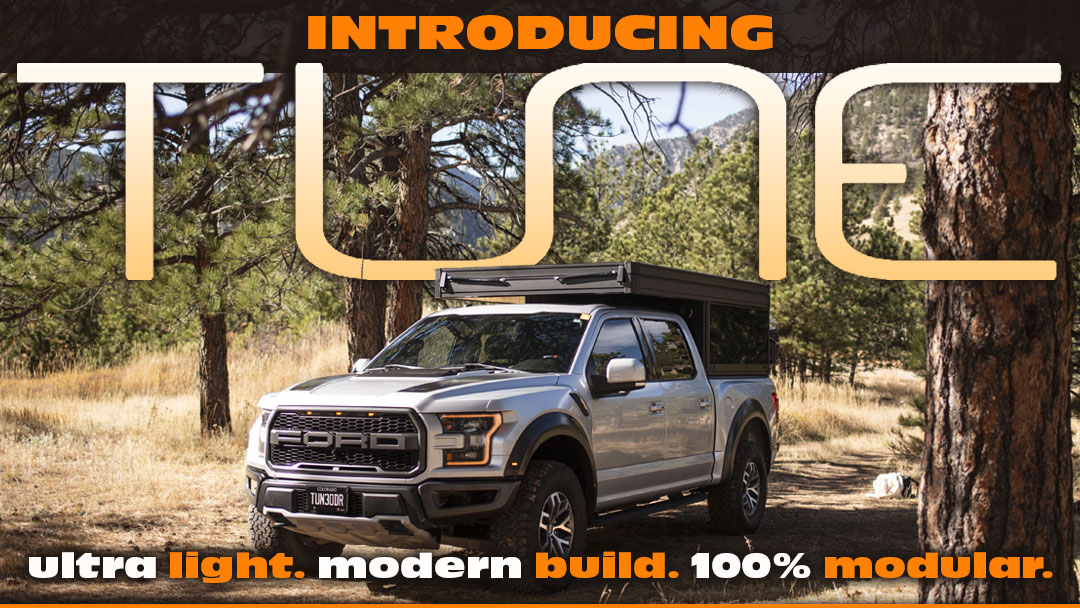
Tune Outdoor set out to build the most lightweight, configurable camper possible. The result was the M1—an innovative pop-up canopy built with custom aluminum extrusions and advanced FRP. Now, with the M1L, that vision expands to nearly any pickup, from Rivian to one-ton and beyond.
What would happen if a seasoned and diverse team challenged themselves to build the most lightweight, modular, configurable, overland-first camper possible? That’s exactly how Tune Outdoor began six years ago in Denver, Colorado.
With expertise in large-scale manufacturing, mechanical engineering, advanced material fabrication, and a heavy dose of entrepreneurial grit, the co-founders triangulated their objectives to create a singular result.
Believing a traditional slide-in was too heavy for their weight and truck compatibility goals, they distilled their concept to a pop-up canopy. The team then focused on modularity and configurability by developing a custom aluminum T-track extrusion system. Meticulously considered proportions, material choices, and a flourish of color achieved the desired modern and purposeful aesthetic.
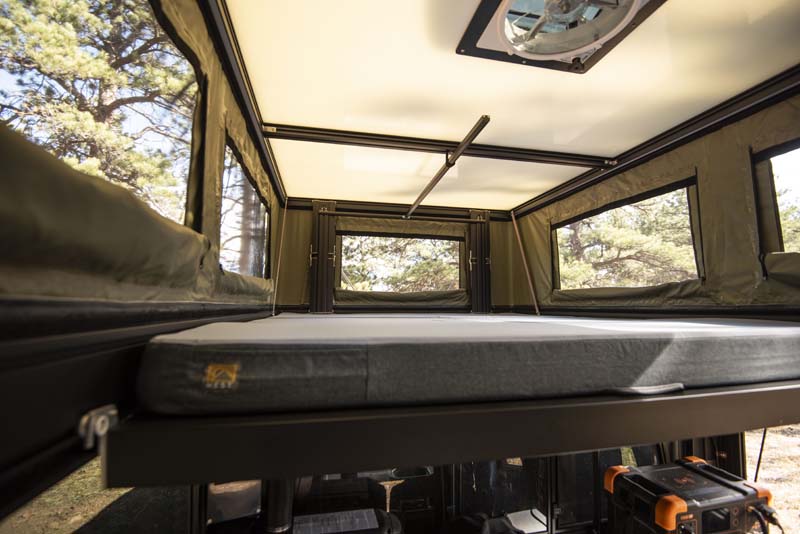
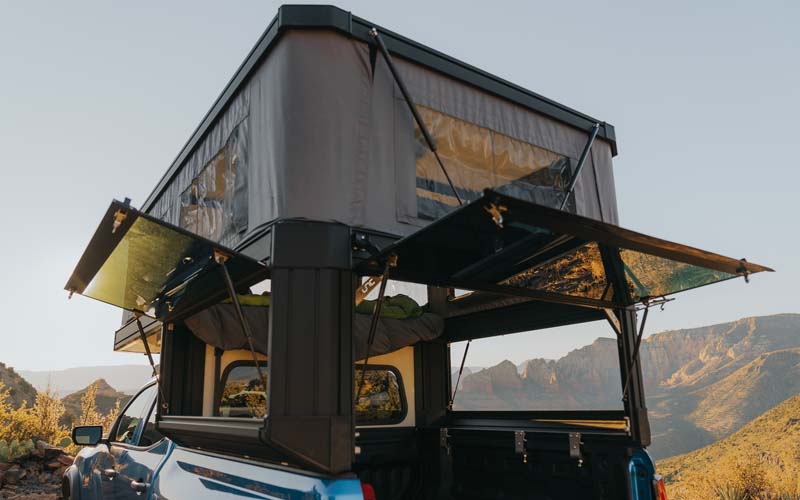
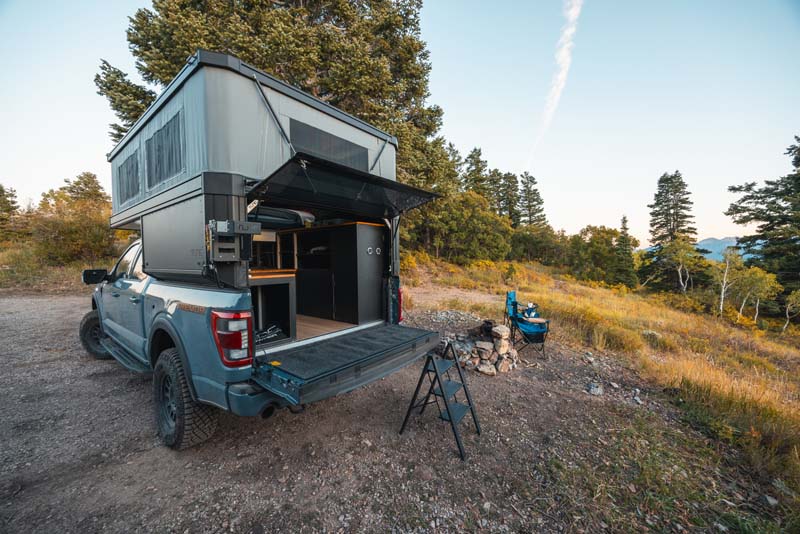
Along the way, the team introduced thoughtful innovations including WingWall bump-outs that extend the camper six inches to enable a true east-west queen cabover while still staying within the truck mirrors. The team also employed a translucent FRP that brings natural light inside and allows Starlink satellite internet to function from within the camper. Perhaps the most visually striking feature is the optional smoked architectural glass awning doors, elevating the design. Don’t be surprised to see these ideas appear in our annual Readers’ Choice Award vote for Innovation of the Year.
Where some might see minimalism, Tune sees the distillation of years of design work into a singular idea. What started as a blank canvas became an elegant foundation for campers to shape into their own travel and adventure dreams. Within the Tune envelope, nearly any truck fits and almost any interior vision is possible. The idea is simple: Tune in, and make it yours.
To learn more about Tune Outdoor, we talked to Sean Kepler, Co-Founder of Tune Outdoor.
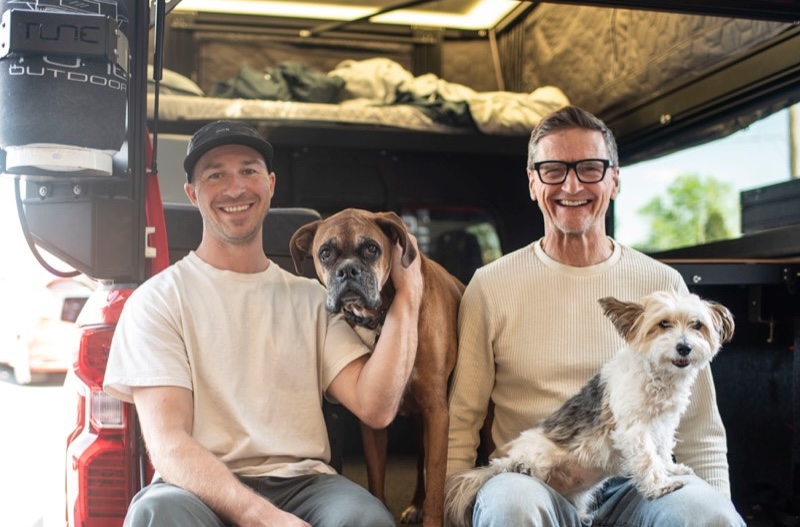
Kris Arnold and Sean Kepler, Co-Founders, Tune Outdoor
Before we talk about Tune, tell us about your professional background and how that led to co-founding Tune in 2020.
Before co-founding Tune, I was in the outdoor industry. I worked at The North Face, which was purchased by VF Corporation, and worked for a number of their brands running aspects of operations. Then, I joined Crocs and ran their operations in Europe.
I was one of two founding members at Tune. Kris Arnold is the product lead, and I’m the business lead. Kris comes from a design and build background. His dad is a master carpenter, and Kris brings strong, creative engineering and building skills. I am lucky to be partnered with him.
We then brought in Broc Patterson, who’s a gifted mechanical engineer, and Bruno McGowan. Bruno co-founded Backcountry Access, a backcountry equipment and safety company, and sold it to K2. Finally, we added an ownership stake for Robert Koche, our talented COO. I worked with Robert at Crocs, and he later launched GoPro in the EU. We have a really well-rounded team.
The idea for Tune came from Kris. After a deep dive looking into the industry, we decided there was something there, so we got to work.
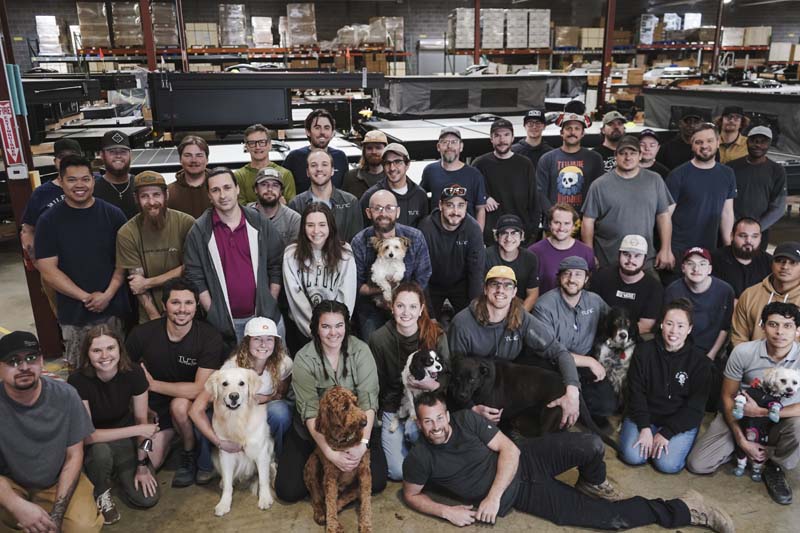
The team at Tune Outdoor
Were you an outdoor or overland enthusiast before launching Tune?
Well, I have done a ton of road-tripping around the US. I’m also a huge traveler and adventurer. I’ve lived in Europe twice and traveled through Africa and most of the world.
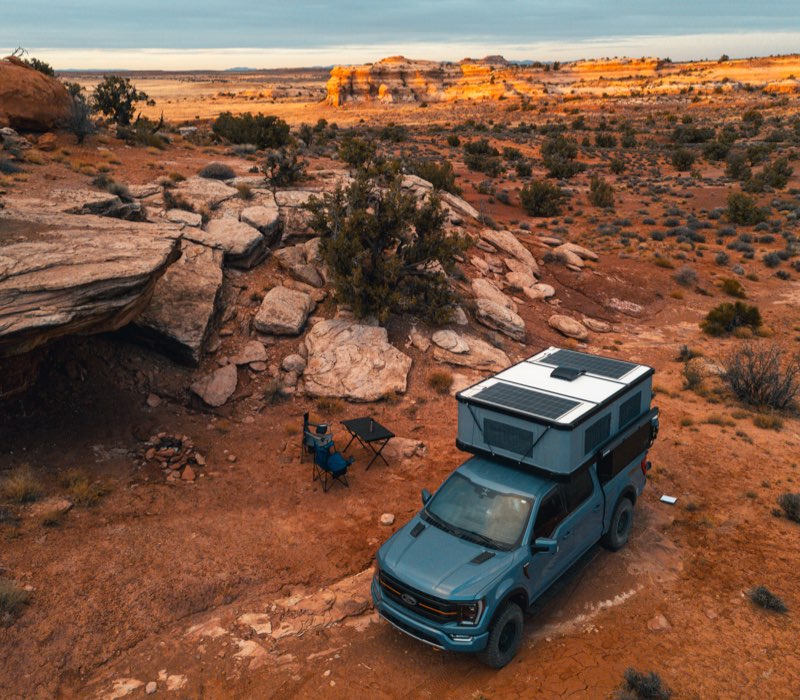
Our team is made up of outdoor enthusiasts and travelers, including rock climbers, skiers, and snowmobilers. We don’t often use the word “overland” because it has an unclear definition. We talk about vehicle-based adventuring. Privately, I see the Tune camper as a meditation-delivery device.
Mediation-delivery devices. That’s fun.
People want to go to beautiful places like the Steens Mountain area in southeastern Oregon. Everyone has a place or experience they’re looking for, and we support that.
Tell us about the overall design and development process for Tune. Was it primarily CAD-driven, or did you also build physical prototypes along the way?
We started with a simple idea. We believed wedge campers didn’t provide enough space for what people want in the backcountry, or really anywhere. People need enough interior room to get out of the weather, store their gear, and sleep comfortably. We also focused on aesthetics. We wanted a camper that was beautiful, modern, and something we would genuinely want to camp in ourselves.
“We wanted a camper that was beautiful, modern, and something we would genuinely want to camp in ourselves.”
We started with that guideline, and then honed in on some keywords for our brand; lightweight, modular, configurable, and aesthetic. Those are the four principles we designed the product around.
The Tune M1 was designed in CAD using SolidWorks. To create the first prototype, we ran thirteen 3D printers for ten days, producing foot-long slotted pieces that were assembled with metal rods. We reviewed the result, made adjustments, and committed to the product.
Why did you decide to focus on a pop-up camper canopy instead of a traditional slide-in truck camper?
We wanted the lighter weight of a pop-up camper canopy. Looking at the slide-in competition, we didn’t find 1,200 pounds to be lightweight. Slide-ins also don’t use space efficiently.
The canopy approach is more configurable and allows us to match every truck exactly. You get perfect fitment, lighter weight, and better space utilization with a pop-up camper canopy.
The Tune M1 features a patented WingWall bump-out design. What were you looking to achieve with that concept?
The WingWall gives you an additional six-inches on each side. The key benefit of the WingWall is the ability to have an east-west queen-size cabover bed in a mid-size truck. When we launched, nothing on the pop-up camper or canopy market offered those cabover dimensions.
The WingWall design also keeps a camper housed inside the truck mirrors. People drive to their mirrors, especially in the backcountry. That was an important design consideration.
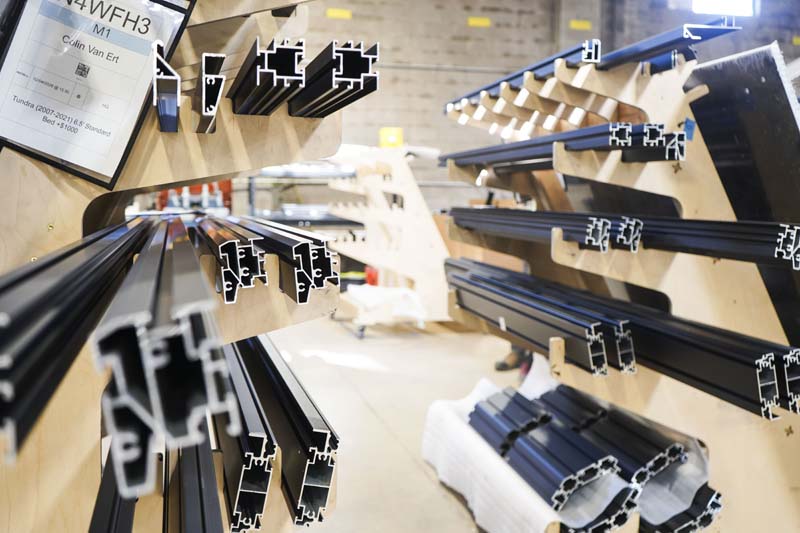
Tune’s aluminum extrusions
You chose to create your own aluminum extrusions—a significant investment. What made custom aluminum extrusions necessary?
The WingWall design is managing a lot of forces. There’s weight, the physical energy the camper experiences in the backcountry, and the normal forces of an automobile at high speed. The WingWall concept wouldn’t work with off-the-shelf aluminum products, so we needed our own extrusions for strength and performance.
Custom extrusions were also necessary to achieve the aesthetic we wanted while adhering to the principle that form follows function. The extrusions were thoughtfully designed to provide the mechanical properties required for the M1 while incorporating multiple functions into a single part. For example, the LED light housing, T-tracks, window hinges, and more all reside within one component. This approach reduces weight and minimizes moving parts, which can become future failure points.
The aluminum extrusions interlock using bolt-together construction instead of welding. What advantages does that approach provide?
Every bonding methodology—from gluing to bolting to welding—has its pros and cons. Welds can fail, and when they’re buried inside walls, repairs often require returning to the factory. We also wanted to avoid the assembly-line mindset. If something happens with our product, we can fly out, take it apart, and put it back together. Our design is also more scalable, cleaner, and more efficient.
Kristian and Broc chose to use extrusions for the majority of the framing and take advantage of best-in-class Type III hard coat anodizing, which can last 30 to 60+ years in direct UV exposure. This decision also drives the assembly strategy, as there’s no feasible way to uniformly anodize something the size of the M1 after assembly.
For the record, there’s no welding at Tune?
Zero. Now and then, we need to weld a unique mounting bracket, but nothing on the camper is welded.
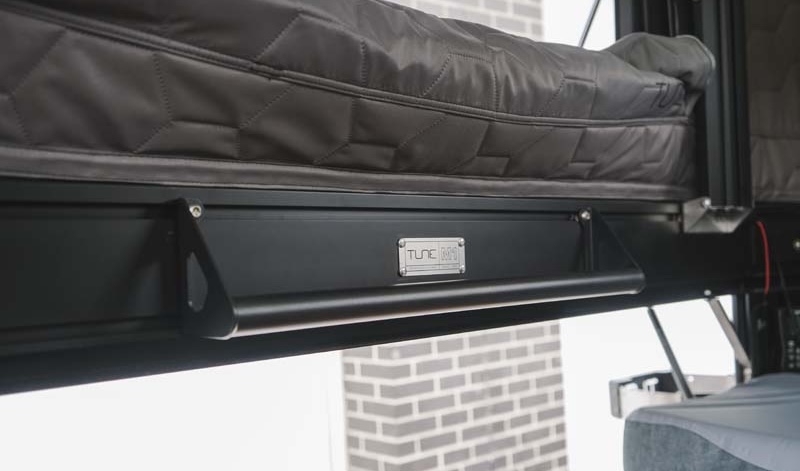
Tune’s T-Track in use
The aluminum extrusions include over 440 feet of integrated T-track. What was the thinking behind the T-track?
That fits into the modularity and configuration of our campers. You can add things. Every aspect of Tune is modular. From the mounting to the battery, nothing is permanent.
“Every aspect of Tune is modular. From the mounting to the battery, nothing is permanent.”
Nylon Corner Brackets
The molded glass-filled nylon corner brackets are another unique material choice. What role do they play in strength and durability?
Broc and Kristian had a mantra while designing the M1: “The way you do one thing is the way you do everything.” They applied this thinking rigorously, ensuring the corner bracket designs complemented the extrusions both visually and functionally.
Injection molding was the clear solution, and glass-filled nylon offered the right balance of strength, durability, and weight. At roughly 50 percent of the weight of aluminum, it maintains structural integrity, resists corrosion, and enables fully custom parts. In fact, the aluminum extrusions fail before the injected brackets do. The same material is used for boat propellers, allowing it to withstand harsh environments and prolonged UV exposure.
You’re using FRP (fiberglass reinforced polymer) for the walls and roof. Why did you choose FRP?
We were looking for something lightweight and hard. The insulation value is a plus. FRP is commonly used in refrigeration trucks in the United States, among other applications.
When we designed that first prototype and then went to market, we conducted focus groups with Colorado truck camper owners. The number one thing they said was to make the roof out of something that would not be damaged by hail. Aluminum roofs can be damaged by a hailstorm. FRP is incredibly strong and nearly impervious to hail.
How did you test the roof against potential hail damage?
We hit the FRP material with a sledgehammer in an early Instagram post and there were just the slightest of nicks. We’ve had zero complaints of damage to FRP.
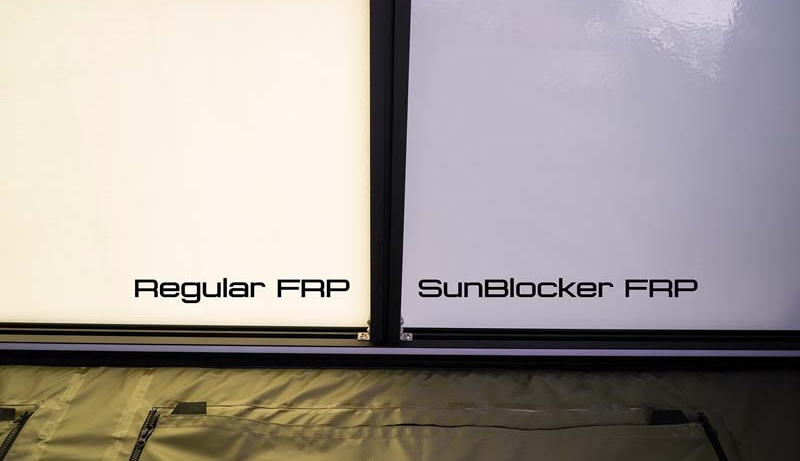
The FRP roof is translucent, allowing light into the camper. That’s definitely innovative, but tell us about the SunBlocker option for folks who want to control the light inside their campers.
About 80 percent of our customers prefer the translucent roofs. Our median buyer is in their late 40s and they get up early. When the sun hits the FRP roof, it creates a warm glow. Most of our customers like it.
We also offer a Sunblocker option, which includes a carbon sheet inside the FRP. The Sunblocker is still white, but there’s no light. That could be an option for people with infants or people who don’t want the light. You can also wrap the FRP. We’ve had customers create a drape that’s connected to the T-track and pull that across to block the light.
Your website suggests that a Starlink satellite internet system can work through your FRP roofs. Does that really work?
Yes, that’s for real. As long as you mount the Starlink under the roof and not under metal, it works. We’re also coming out with our own Starlink mount. Our sales team uses Starlink on the road and we have quite a few customers using it.
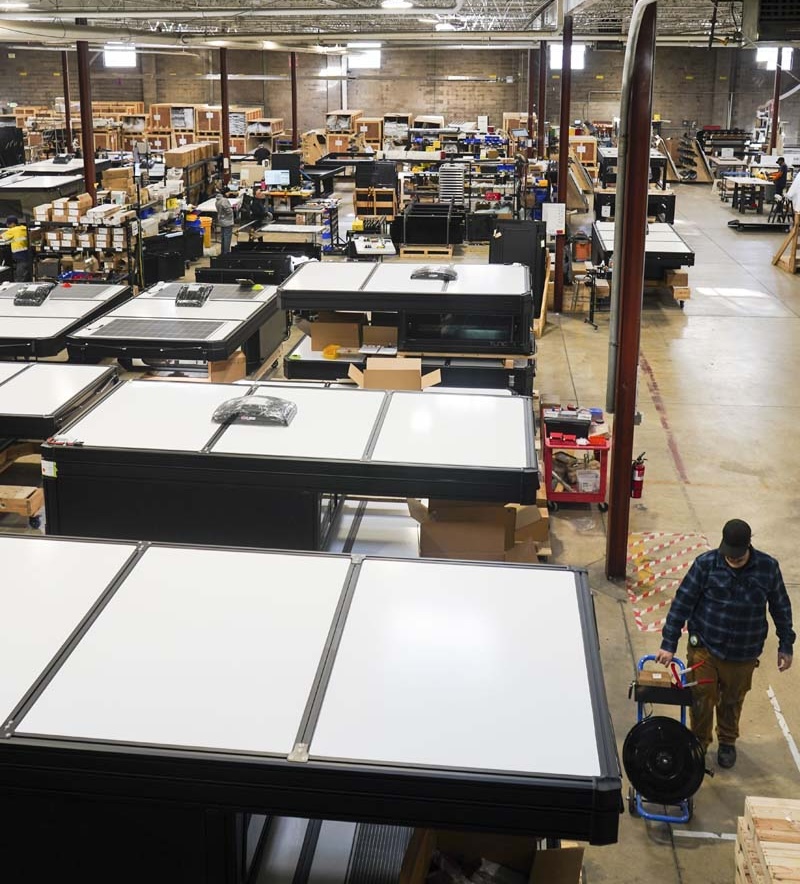
Inside the Tune Outdoor factory in Denver, Colorado
Where are the Tune M1 and M1L manufactured?
The Tune M1 and M1L are fully assembled and manufactured in Colorado. That said, we do operate within a global supply chain, thoughtfully chosen to deliver the best possible quality and performance.
Our aluminum extrusions come from South Korea, where the precision and consistency are among the best in the world. The glass-filled nylon components are produced by a top-tier injection molding partner in China. Our soft walls are sourced from the Far East, where quality material supply chains and sewing expertise exceed what we were able to find domestically.
We explored building these components entirely in the United States. For example, we contacted more than forty American aluminum extrusion suppliers when we got ready to launch, but none were willing or able to produce what we needed across our line. We wanted to be fully American-made, but ultimately had to adapt to ensure the product met our standards.
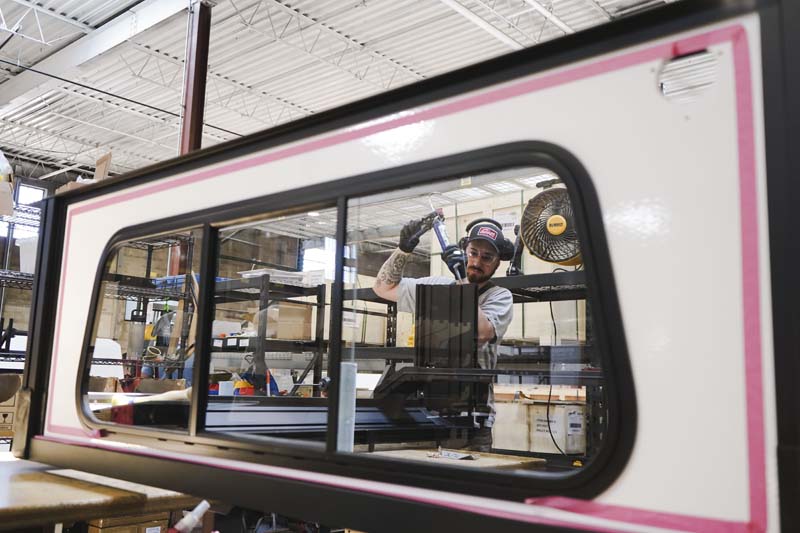
The core of the Tune M1 and M1L remains American. Engineering, assembly, key fabrication, sewing, final integration, and all human-based services are happening in Colorado.
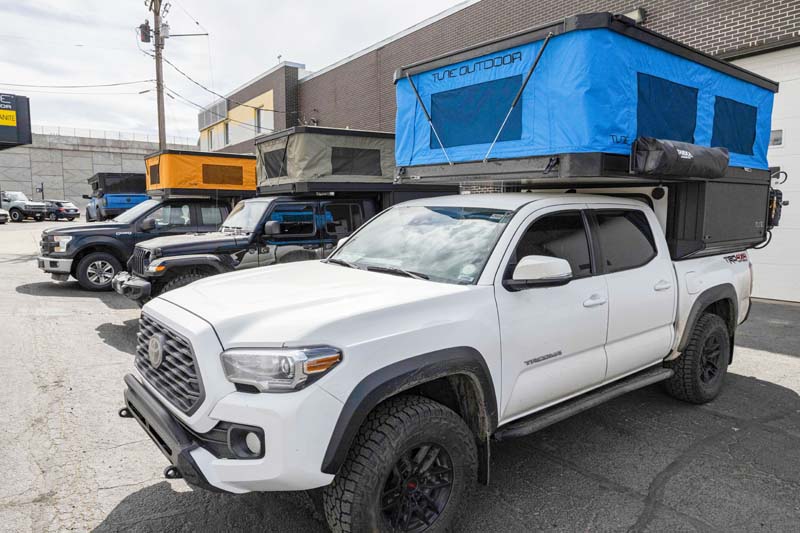
You offer five canopy fabric colors for Tune campers: Sand, Steel Blue, Charcoal, Forest Green, and Action Orange. Why was that important for the Tune concept?
Nobody offers colors like we do. I have experience in the apparel industry, and my wife of twenty years was a color specialist. People love color. Like apparel, in the end, most people select a neutral color. Our Charcoal Gray is our top seller. When we bring Steel Blue or Action Orange to shows, people are drawn to them because they pop. We do sell these pop colors, just to a lesser degree.
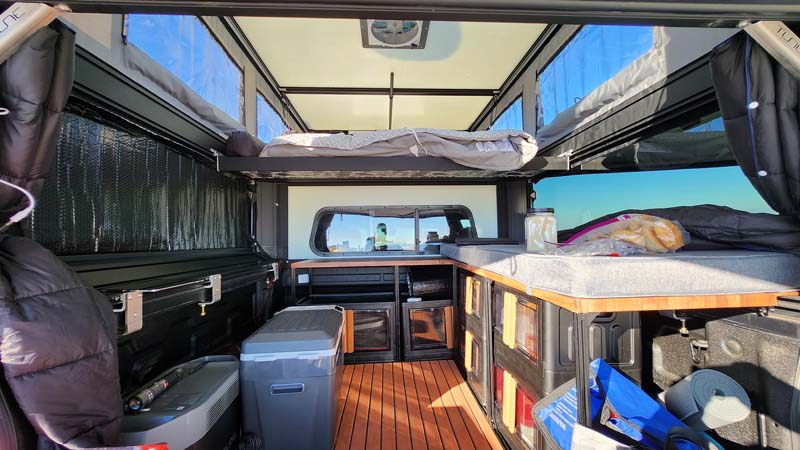
The canopy fabric is 600D polyester with an Oxford weave and ripstop grid. Why was that material selected?
I started my first outdoor industry job at The North Face. After going to law school, I transitioned from being a lawyer to a product line manager for tents and sleeping bags at The North Face. I ran the team that designed new products and developed the seasonal offerings. Based on that experience, Tune uses some of the best fabrics available for the camper canopy.
No one wants to be in a vinyl tent. You want something lightweight with light transmission. We also wanted the fabric to support screens and large windows because we want our customers to be inside and comfortable while still feeling connected to the outdoors.
Extremely strong Keder rails anchor the canopy at the top and bottom. On each edge, a thin sheet of plastic is sewn into the fabric and then run through a slot in the connecting extrusion. When the canopy is sewn to the proper dimensions, it becomes extremely taut. In a big windstorm, the truck will move before the canopy does.
Do the Keder rails allow you to swap out the canopy fabric if needed?
Yes. We’ve been swapping out first-generation canopies on Tune campers. We launched in 2023 with Top Gun acrylic-coated polyester, but the needle holes allowed for potential water egress, and the fabric could not be taped. So we moved to a tapeable fabric and now replace canopies as needed. With our Keder system, you can sit in a customer’s driveway and swap out the canopy relatively easily.
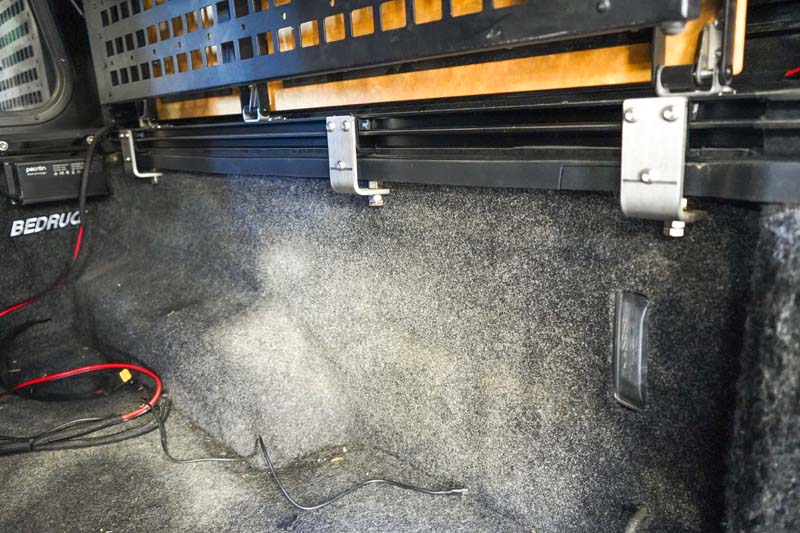
How are Tune campers mounted to a truck?
There are six mounting brackets. The camper mounts to the bedrails. The brackets need to be torqued properly. It’s not difficult, but care is needed when taking the camper on and off—as with any truck camper—to get the camper in the right place, with the right force.
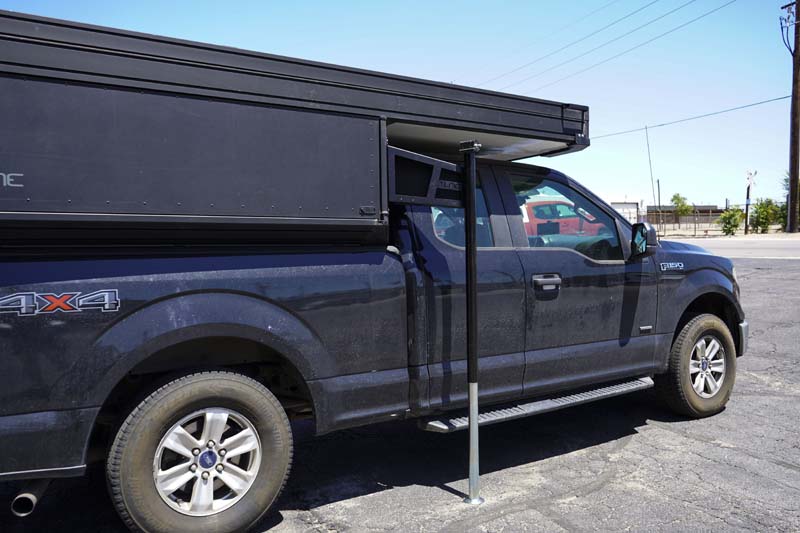
Tell us about the optional camper jack system and how the M1 can be mounted and demounted.
Well, 95 percent of Tune owners never remove their camper. Its industrial design allows the truck to be a truck, even with the camper there. You lose a bit of truck bed functionality, but not much.
That said, the jack mounts attach to the vertical extrusions at the corners of the camper structure when removal is necessary. You undo the mounting brackets, raise the jacks so that your camper comes off the truck, and drive off. That’s the simple version.
There are other ways to unload the camper. You could have a roof-mounted system with pulleys in your garage, or apply casters to some sort of jack system and move the camper. Customers have different creative ways to load and unload their campers when they want to.
We have a camper jack system for the M1 now, and are going to launch jacks for the M1L in the immediate future.
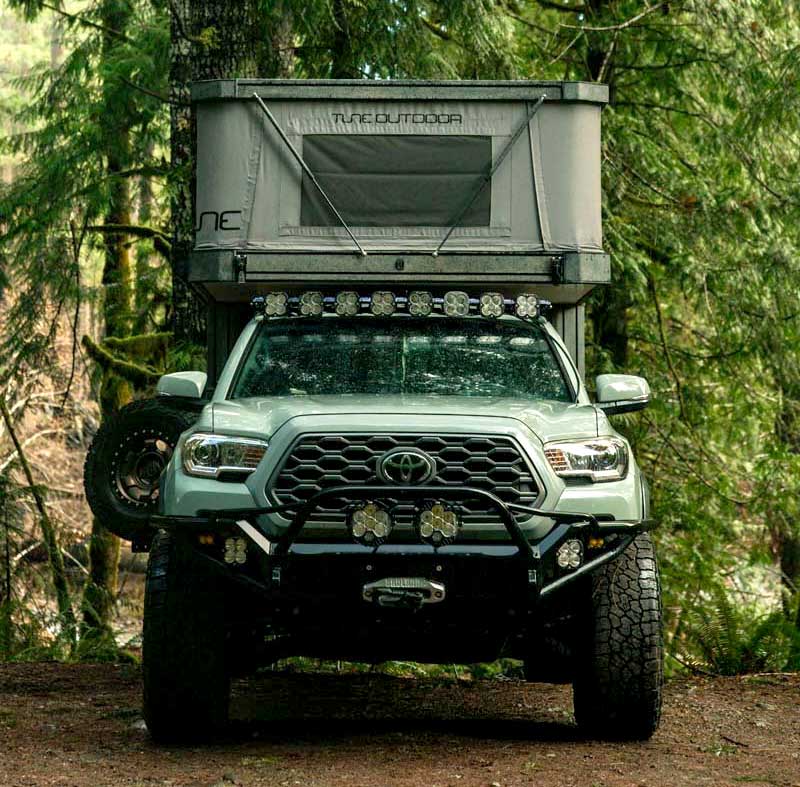
What pop-up mechanism are you using for Tune campers?
We have custom-designed lifting arms. The four arms move in an accordion-like action when raising and lowering. There are three things actually holding the canopy up. First, there’s the lifting arms.
Second, the four struts that are used to assist the raising and lowering action provide structure. When the strut engages one to two inches up or down, the canopy then moves up or down. Third, the tension in the fabric itself, created by the Keder rail construction, adds additional stability.
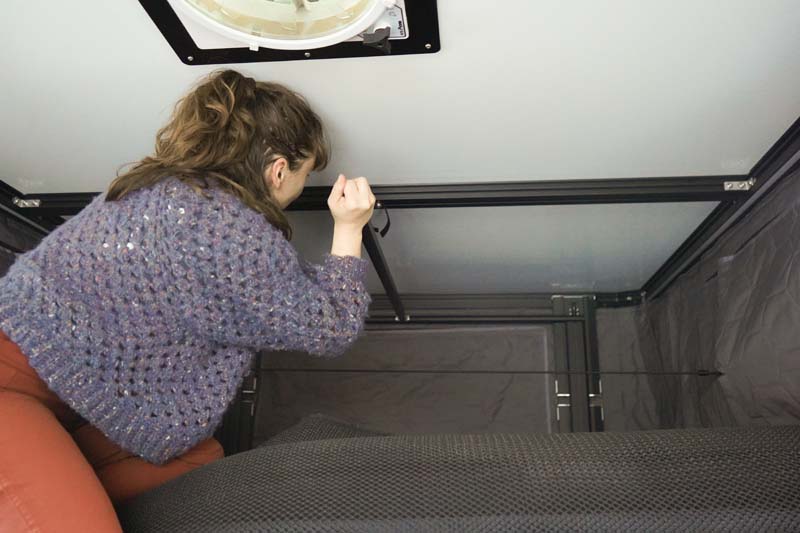
When the canopy is lowered, the arms fold down. A Velcro attachment on the backside of the lifting arms connects to the canopy, and side-to-side bungees between the side windows suck the canopy inward during raising and lowering. This helps keep the canopy neatly contained and properly aligned.
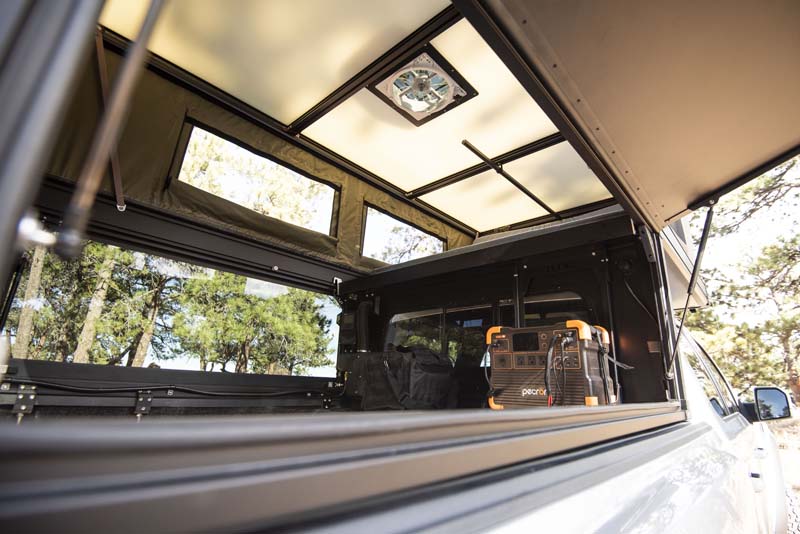
The side and rear awning doors on the M1 and M1L open fully with gas struts. How does this approach improve functionality?
The key innovative thing we did was create awnings that cover the full space. We are not cutting out a small awning. We are working with the whole side of the camper. You needed gas struts to move that much weight.
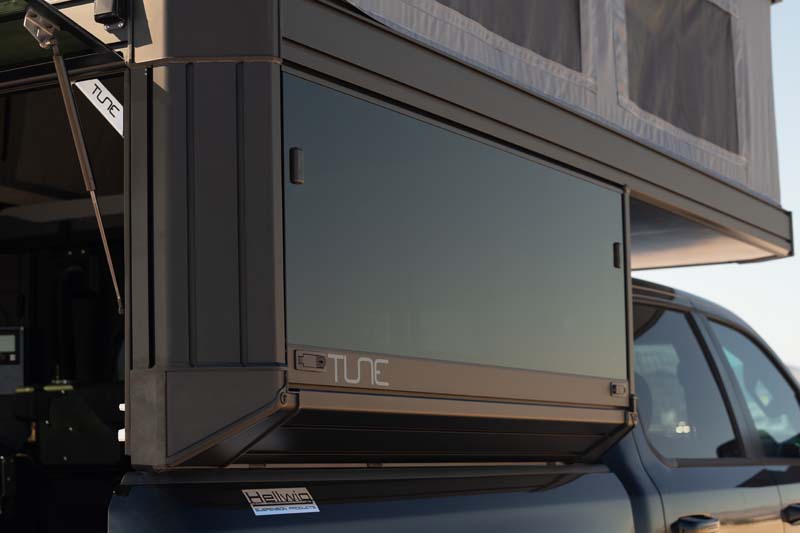
We also innovated with quarter-inch-thick, architectural tempered smoked glass awnings as an option. This was something new to the industry. This type of glass is typically used in building applications.
We also rethought how the windows function by integrating them directly into the extrusion design from the beginning. This approach allows us to offer owners a full panoramic glass view, since each camper is built to order rather than relying on off-the-shelf RV windows with limited dimensions.
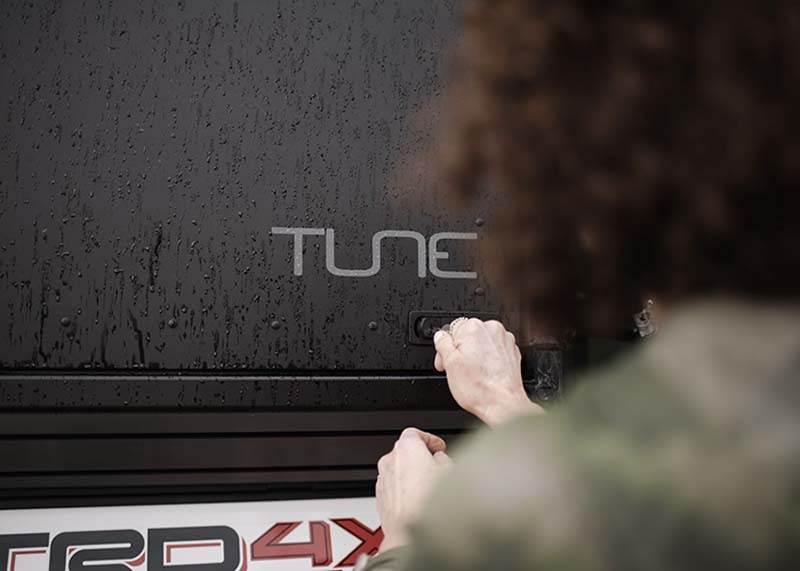
Aluminum awning on a Tune Camper
Can the glass awnings break?
Yes, they can break. We’ve done close to 2,000 sheets, and there have been under ten that have broken. If you are in the backcountry and hit a tree, it might break. That said, it’s twice as thick as automotive glass and remains amazingly resilient in both testing and community use.
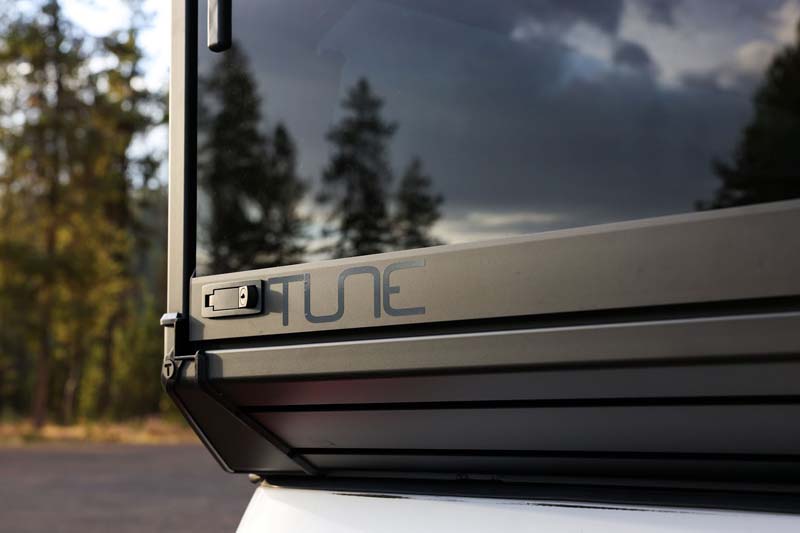
Glass awning on a Tune Camper
Why would someone choose the glass awnings over the standard aluminum awnings?
It’s primarily about the aesthetic. Users like the way their truck looks with the glass. It also provides a sense of inside-outside connection beyond the six canopy windows.
For someone who lives in an urban environment or carries expensive gear and has security concerns, they might choose aluminum awnings. They could also have the glass awnings and install them when they take a three-week trip into the wilderness.
The awnings use a hurricane hinge. To change the awning, you disassemble the strut and lift the awning off the hinge. It does not take long to swap awnings out, but you definitely need two people to handle the glass.
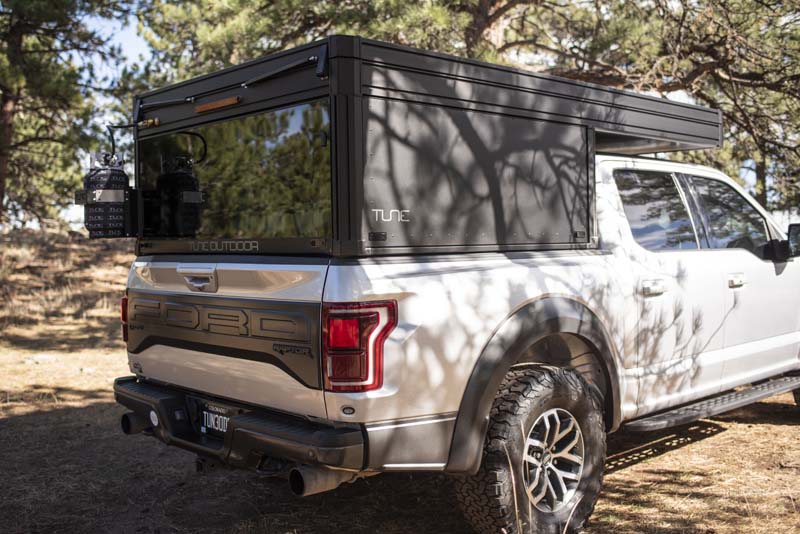
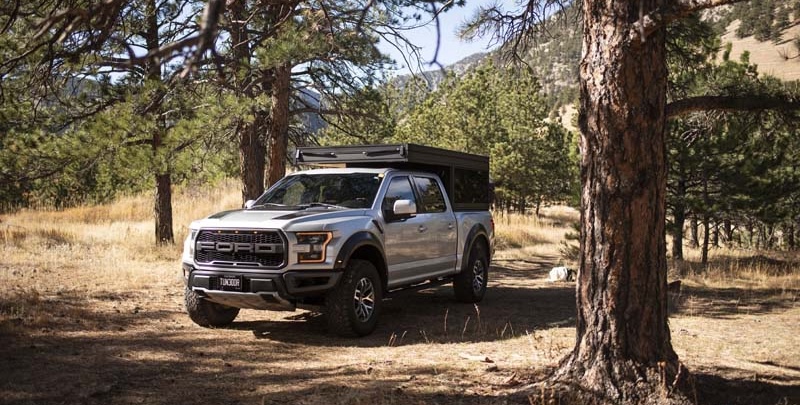
The Tune M1L on a Ford Raptor
The M1L is narrower and lighter than the M1. Is the M1L essentially the same camper with the identical build and materials but without the WingWall bump-outs?
Essentially, yes. With the M1L you get a different bed rail extrusion without the WingWall, a little different functionality in sleeping, and a little less T-track.
Do the M1 and M1L target different niches or customers?
The M1L is for customers who want a camper that’s more affordable, lighter weight, and smaller in size. Those are the three attributes the M1L addresses. In general, couples like extra space in the M1.
The M1L is really targeting the wedge campers. We launched it at a price that’s very competitive in that market and it offers that customer a lot more interior space.
What does the L stand for in M1L?
The “L” stands for Lite, indicating a lighter-weight camper with less space and a more economical cost.
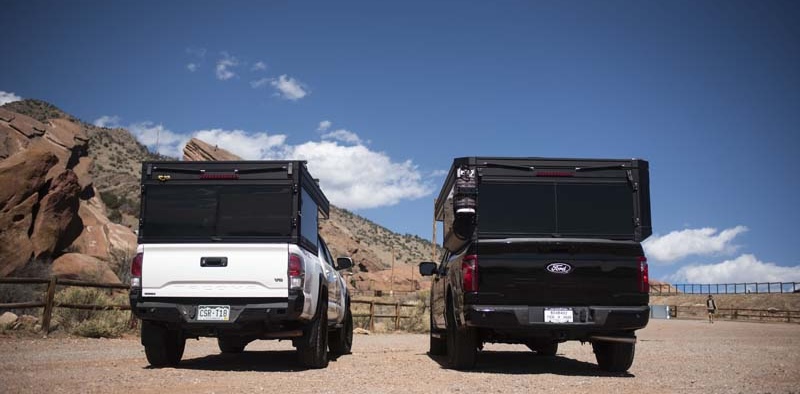
What trucks are the M1 and M1L designed for?
The M1 and M1L are each designed specifically for individual truck platforms, with a separate sub–Bill of Materials tailored to the dimensions of each vehicle. As a result, Tune campers are built to fit everything from Rivians to full-size one-ton trucks with eight-foot beds.
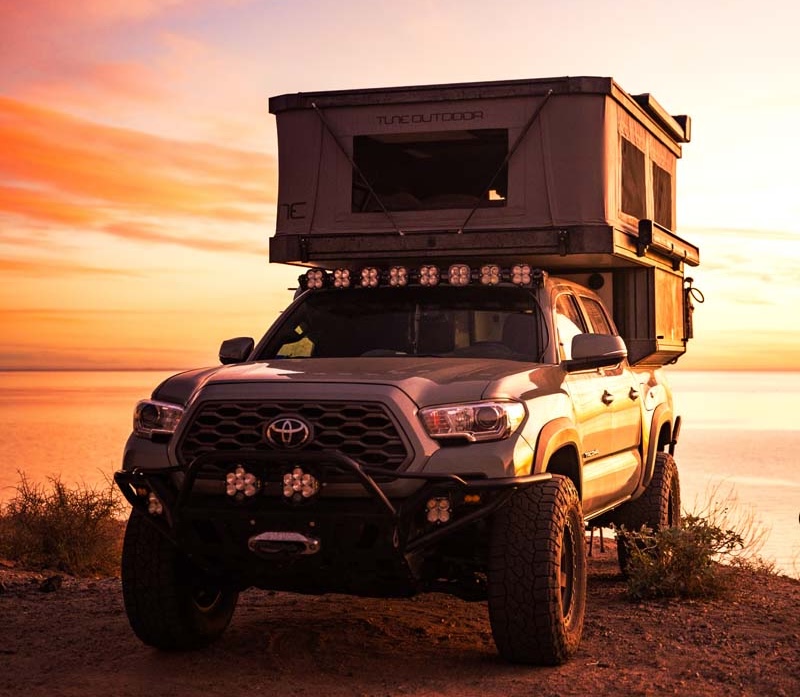
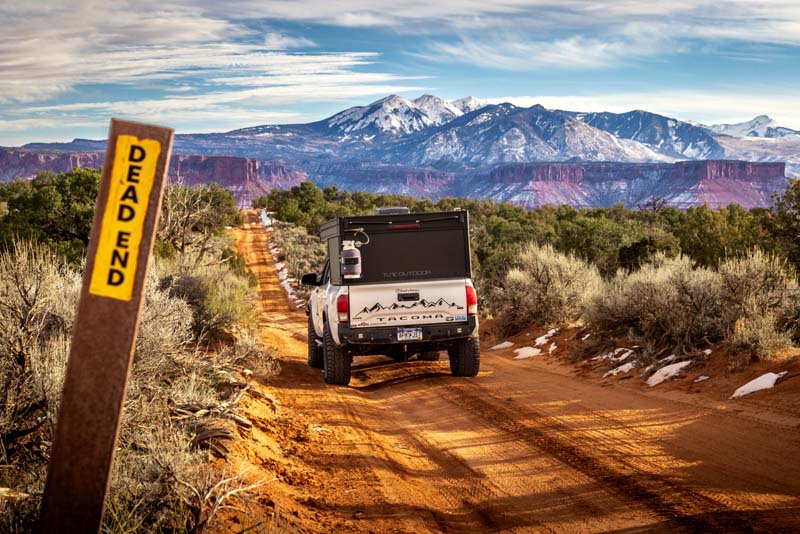
Tune M1 on a Tacoma
Do Tune campers come with built-in features, or are they designed as more of a blank slate for customers to build around?
It’s definitely a blank slate. The configurator on our website walks you through how you can build out a Tune. You start with a base camper at a base price. Then we offer best-in-class features like Hest mattress systems and Truma Varioheat Eco heaters. If you want something we don’t offer, we support that decision, but we don’t install it.
Is there a bulb seal or gasket around the truck bed?
Yes, there’s a rubber gasket. It adheres to the bottom of the camper. If the camper is frequently coming on and off, we recommend you replace the gasket every few switch-outs.
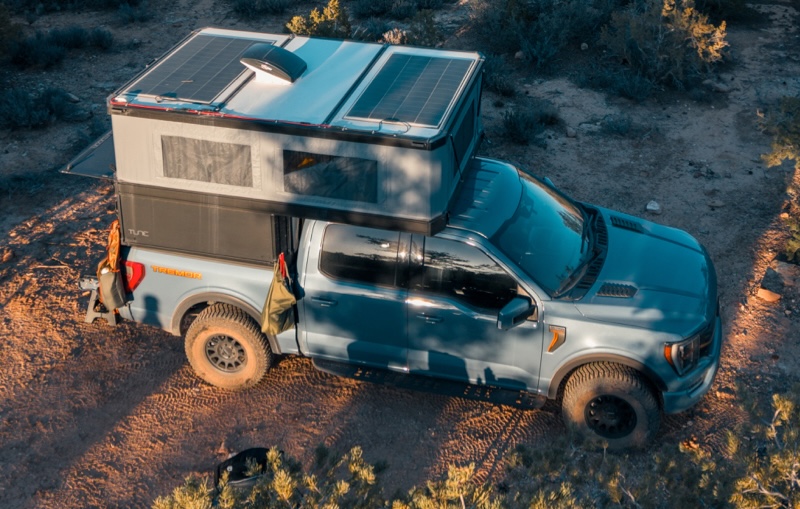
How much solar is standard on the M1 and M1L?
No solar is standard, but we offer up to two panels on our full-size and mid-size campers. We offer a 200-watt panel on the mid-size and a 240-watt panel on the full size. You can get one or two panels. If you want your own solar, we’ll install a port for you and pre-wire it to the roof of the camper. We try to make the solar option configurable to a user’s needs.
Is solar pre-wire an option?
Yes, it’s an option. We can also do a retrofit of the solar port after the sale. We don’t care if people want to cut into their roof, but we don’t warranty the cut.
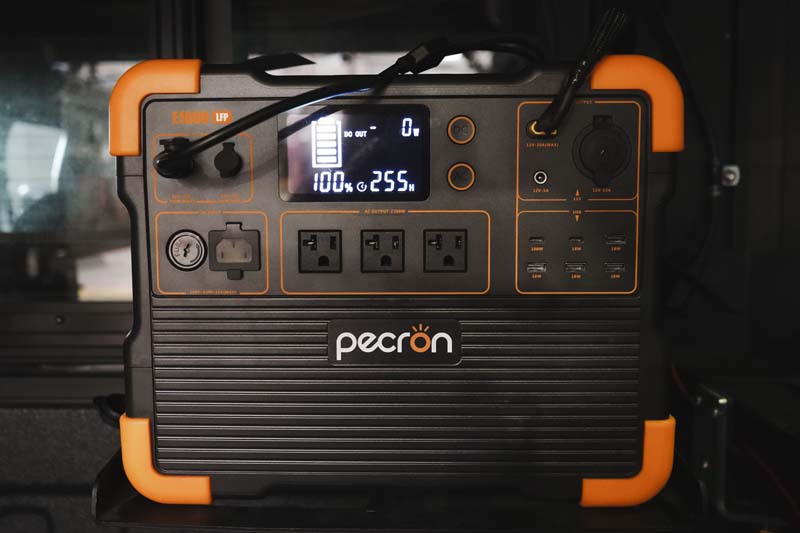
What battery systems are available for the M1 and M1L?
We only offer Pecron. It’s a Chinese supplier with a good product at a reasonable price. For 1500-watts, it’s $550. We like it because it handles a 30-amp surge. That handles your heater, and anything we are able to put in our campers. It also has all the ports you would want.
I know Truck Camper Magazine deals with a lot more sophisticated builders with more electrical systems. Those systems offer more capability, but they could also be outdated in a year. We try to keep it simple.
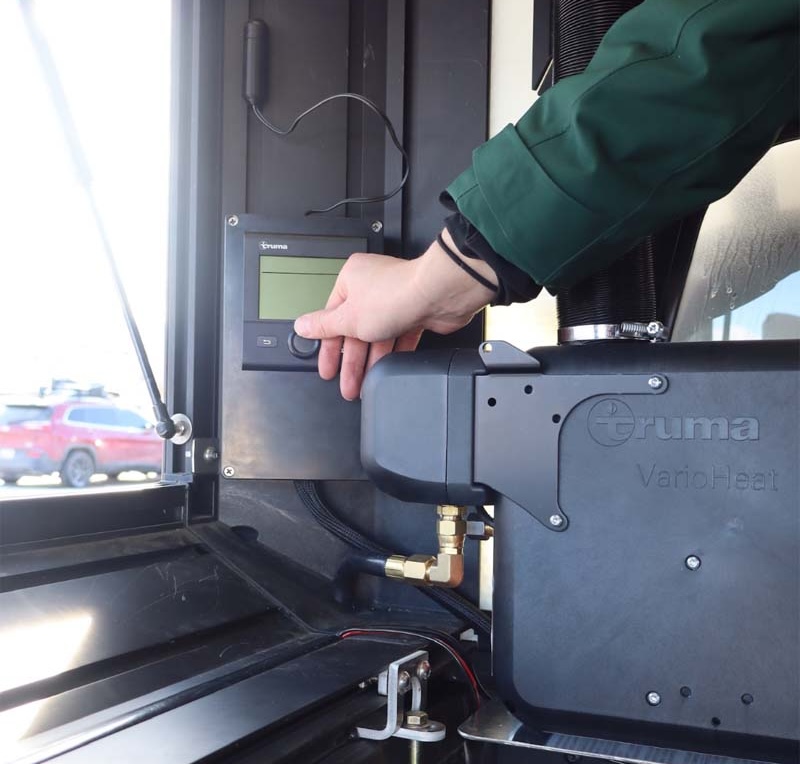
What heating solutions are available for the M1 and M1L?
We offer the Truma VarioHeat Eco.
We started our heater testing with diesel models based on price, but we ultimately didn’t like the fuel management. We moved to the Truma because it’s clean and efficient. About 40 percent of our customers order heaters. If you camp in winter conditions, you need heat. You can also add an insulation pack to the canopy and use electric blankets in the cabover.
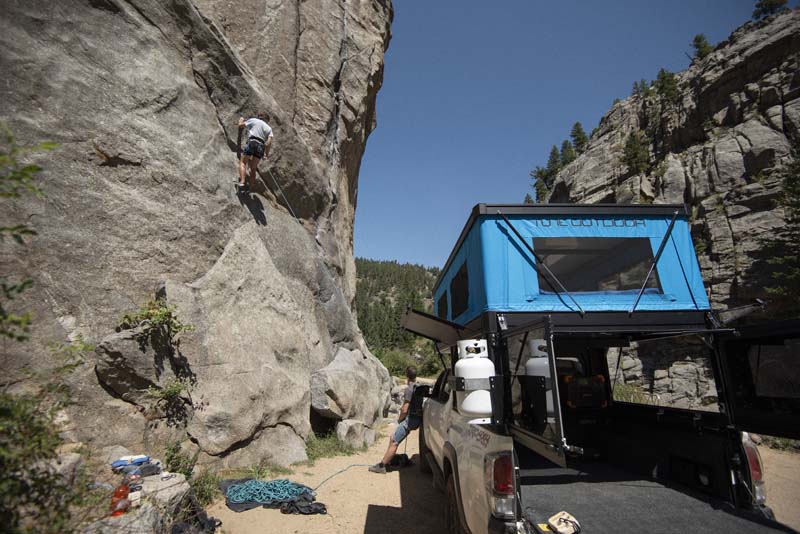
With our camper, the propane tank does not extend off the side. It’s flush with camper profile and the propane line is routed through the bed rail extrusion. It’s not impacted during loading or unloading of the camper, and it’s otherwise hidden from view.
Are there options for a refrigerator or air conditioner on the M1 and M1L?
We don’t offer a refrigerator, as there are many excellent 12-volt portable options, and we don’t believe customers are looking to us for that. As for air conditioning, we’re currently exploring options available in the marketplace.
Does Tune Outdoor sell direct, or through a dealer network?
We sell direct to consumer, but we have a national dealer/partner base for installations. We will also call existing owners and connect them with a future customer who wants to see a Tune camper in person. Our customers are our best salespeople. Most of our customers will gladly meet people and show them their camper. It’s a regular occurrence at the store or gas station for Tune owners.
Walk us through how someone buys a Tune camper.
Interested people can text, call or email us. We recommend that people get on our website, start an investigation, and then call or text us. If you want to place an order, you start with a deposit. Then we have a video meeting to discuss, possibly modify, and confirm the draft build.
How many Tune campers are out there?
There are well over a thousand at this point.
What is Tune’s warranty coverage?
We have a three-year warranty and lifetime support. We designed the camper to outlast the truck.
If a Tune customer has a warranty issue, how is that handled?
If we can’t fix it remotely or at a local dealer, we fly out and fix it in person. Most times, though, it’s simple issues like LED lighting that we’re able to solve with the owner. If we can’t make a Tune owner whole, we’ll take the camper back. We’ve only done that twice to date. We focus on production quality and quality control to make sure there isn’t a problem in the field.
What is the current lead time from order to delivery?
We’ve managed our labor and production lines to maintain an average 90-day delivery. We may work to reduce that to 60 days in the future. There’s a fine line between immediate delivery and effectively managing resources and the supply chain.
If you come to us to pick up your camper, delivery and installation are free, but you’ll pay Colorado sales tax. If you choose installation in Oregon or New Hampshire, there’s no sales tax, but you’ll pay to have the camper shipped, plus a $500 remote installation fee that we pass on to our dealer partner. Outside of those states, you’ll also need to account for state sales tax. About 20 percent of our customers choose remote installation. Our Colorado headquarters is doable for most people.
What is the base weight of the M1 and the M1L?
We have tables that we use to give people the accessorized weight for the model they need. Our base midsize weighs 400-450 pounds. We have campers on Rivians and 6-foot Tacomas in that range. Our full-size campers start around 500 pounds and go up based on bed size.
What is the center of gravity for the M1 and the M1L?
The 58-inch cantilever over the cab moves the center of gravity forward of the rear axle. This helps distribute the load forward, resulting in less rear suspension sag. People often ask whether they need to upgrade their truck suspensions. My first Tacoma and Tune rig ran fine on my stock TRD for two years. Of course, it’s relative to how you pack it and behave in the backcountry.
What is the base MSRP of the M1 and the M1L?
The mid-size starts at $9,000 for the MIL and $13,000 for the M1. For the full-size, add $1,000 for both models. With popular options, a typical M1L camper going out is around $14,000 and the M1 is around $19,500-$20,000.
What are the popular options?
Our more popular options are the Truma VarioHeat Eco heater, the Hest mattress system, the glass awnings, the battery inverter with a mounting bracket, and solar. That option list will take a Tune over $20,000.
Will you be developing additional models in the future?
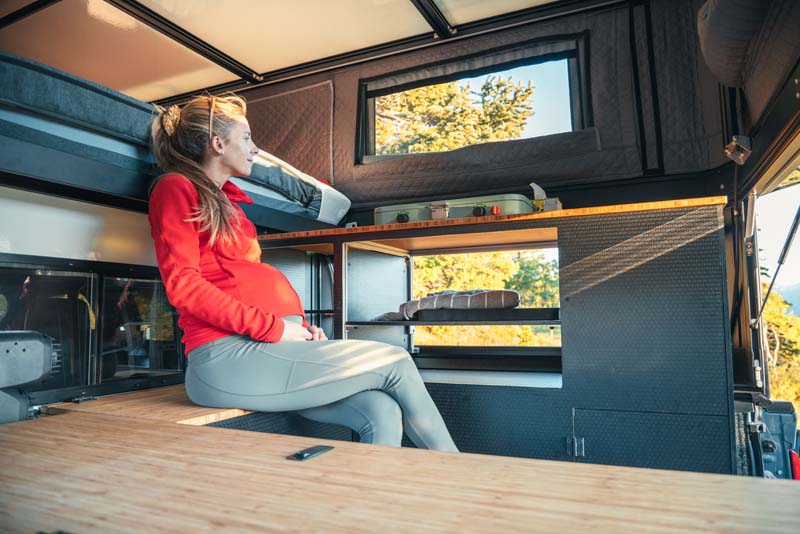
We’re not working on a new model, but we will be launching our own interiors. The interiors utilize our T-track. Pretty much everything from the propane tank system to the battery uses the T-track.
There are a lot of people out there who are left-brained. They’re engineers or mathematicians and love building their own interiors; cabinetry, seating, whatever it may be. Our new interiors will complement these customers and give package buyers a new palette of items to build from.
Will Tune build a slide-in camper in the future?
If we think we can do it better, we’d do a slide-in. They’re very interior-centric. The question is, how do we innovate and create a competitive advantage to what’s already out there? I really don’t like losing all that interior space, but the beauty of the slide-in is the insulation. As of now, we’re scaling to meet demand with what we have and considering how we can best serve our community.
What’s your long-term vision for Tune Outdoor?
We’re having fun now. We’re working to meet the needs in the market while also enjoying where we’re at. We have an amazing team and a strong community of outdoor enthusiasts. We want to continue creating value with our product offerings. Most of all, we want to help tune people into their natural states. That’s what we aimed for with this company. If we can create more products that accomplish that, we will.
Is there anything else you’d like to add about Tune Outdoor, the M1, or the M1L?
I attend many of the public-facing shows, and we also try to get out into the backcountry. Our customers appreciate connecting with the HQ team in the field. We’re an approachable company, and we believe in the responsible use and stewardship of public lands.
Last fall, we held our first community off-site on public land near Moab, and about sixty Tune campers attended. We expect even more this year. It’s a very cool community. Everyone has a unique story and a shared drive to experience the draw of public spaces across the United States. People are doing interesting and meaningful things with their lives.
We also publish a newsletter featuring community members in our Natural States series. We invite you to join our newsletter and reach out if you’d like to see our product.
For more information about Tune Outdoor, visit tuneoutdoor.com. Click here to request more Tune information.