After five-months on the road, TCM evaluates the Globe Trekker composite panel system and build on a Rugged Mountain Granite Platinum prototype. Here’s our take on the construction, weight, thermal performance, and more. This is truly an experience to reflect on.
It was a set-up. Okay, that’s probably too strong. It was a really enticing pitch; practically an offer we couldn’t refuse.
Toward the end of 2025, Jesse Collinsworth, Founder and Chief at Rugged Mountain RV, was building a full-size hard-side composite-panel truck camper with a wheel well height basement and bringing it to the Florida RV SuperShow less than two hours from TCM’s winter HQ.
“It’s a prototype so it’s not perfect, but I’d like you guys to take it out and give us your experienced feedback. Oh, and it’s nearly the same floor plan as your personal camper, only with composite-panel construction you can review. You’ll love it.”
A few weeks later, the 2026 Rugged Mountain Granite Platinum composite-panel prototype arrived in Tampa. With our beloved 2004 Alpenlite 1100 in storage, we went to pickup the new unit.
For the record, Rugged Mountain didn’t ask for coverage, and nothing changed hands outside the camper loan. In fact, we told Jesse we were not going to review the camper as it’s a prototype, not a true production unit. Our focus is strictly on the composite-panel build and performance.
What follows is a deep dive into our experience with the Globe Trekker composite-panel system and how it was implemented for the Granite Platinum prototype. Let’s begin.
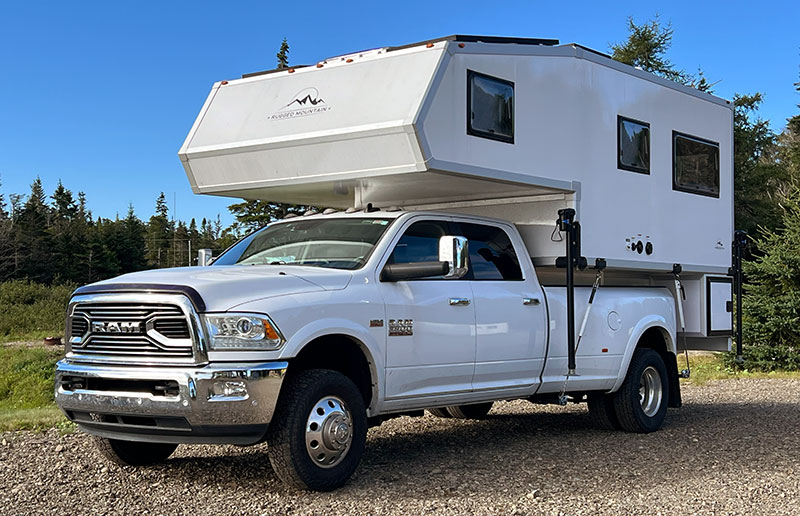
Our 2018 Ram 3500 and the Rugged Mountain Granite Platinum prototype
In January of 2026, Rugged Mountain announced that they were adding composite-panel construction to their build options. Rugged Mountain had been producing wood-frame, hung-wall, non-slide and multi-slide truck campers for a decade, but had also been searching for a high-performance composite-panel system. After several years, Jesse finally found what he was looking for with Globe Trekker, a domestic composite-panel and extrusion manufacturer.
In his interview, Jesse explained how his search went beyond the wood-free, water-proof, rot-proof, high-rigidity nature of composite-panel construction. Above all, he wanted a true thermal break to stop the transfer of heat and cold through the camper structure. In his own testing, Globe Trekker’s 1.5-inch composite-panel and aluminum/PVC corner extrusion system was the first to provide that thermal performance. Globe Trekker was also willing to work directly with Rugged Mountain to refine and develop components specific to their non-slide and multi-slide floor plans.
Globe Trekker’s composite panels employ a PIR (polyisocyanurate) foam core with FRP (fiberglass-reinforced plastic) skins and reinforced sub-laminates. The in-house-engineered and proprietary aluminum and PVC corner extrusions join with structural adhesives, with nary an internal frame or fastener in the mix. It’s this combination of aluminum exterior extrusions and PVC interior corners—rather than aluminum interior corners—that creates the system’s thermal break and forged the Rugged Mountain and Globe Trekker partnership. Additionally, Globe Trekker had the capability to accept CAD files and CNC-cut the composite panels and extrusions to Rugged Mountain’s requirements.
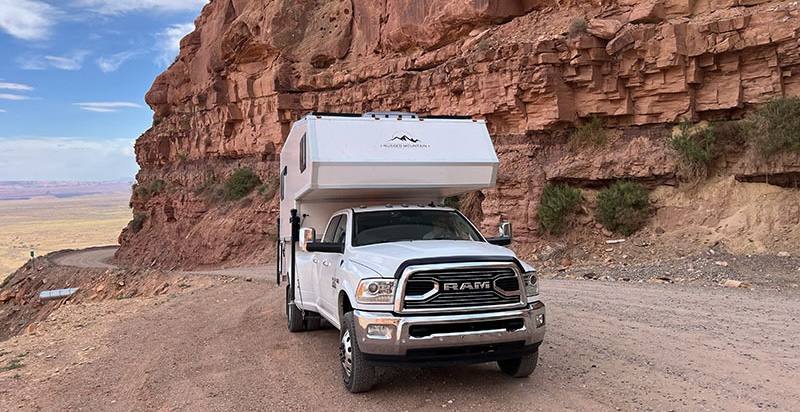
Taking the Rugged Mountain Granite Platinum prototype up the Moki Dugway in Utah
At first blush, the Globe Trekker composite panel exterior walls and aluminum extrusions were unmistakable. Looking at the expansive, one-continuous-panel sidewalls, I had to remember that this camper had no internal framing—wood, aluminum, or otherwise.
Also missing from the unit were screws, trim, or really anything we’ve all become accustomed to seeing on framed hung wall or laminated campers of this size. In their place was a shiny white fiberglass skin reflecting with a uniform woven texture. If we looked at the unit from an angle, we could just make out where the structural PIR foam panel sections joined to create the wall assembly, but the camper sidewalls were otherwise remarkably seamless.
Did you almost stop reading at no screws? Like many composite-panel campers, the Granite Platinum’s structural shell is held together with industrial adhesives rather than conventional internal framing. Specifically, Globe Trekker employs Sikaflex 552, a high-strength, flexible structural adhesive designed for vehicle assembly. Once Sikaflex 552 cures, it has a published tensile lap-shear strength of 290 pounds per square inch. This stuff is literally designed for structural bonding applications in transportation and vehicle assembly.
So how did this impressive-on-paper and even-more-impressive-in-person presentation stack up in real life? Well, it’s complicated.
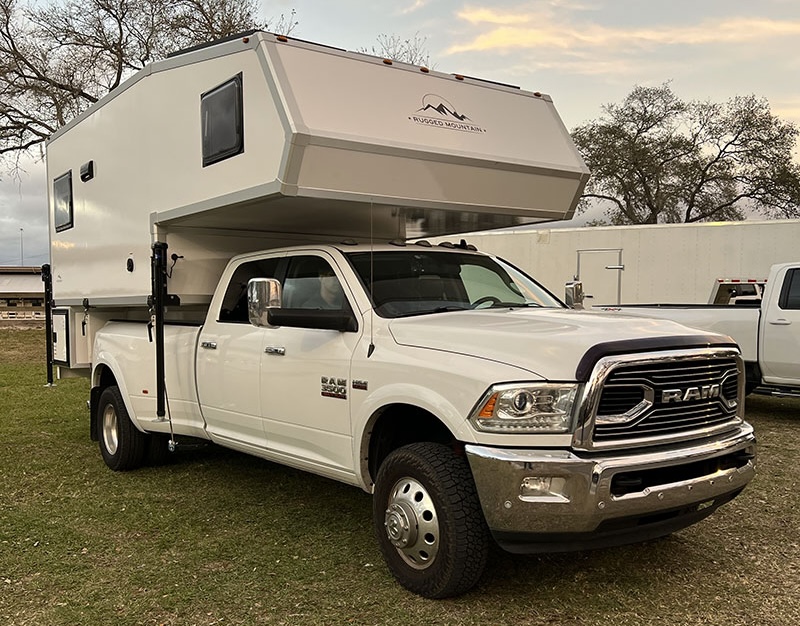
Moments after we loaded the Granite Platinum prototype at the Florida RV SuperShow
We loaded the Rugged Mountain Granite Platinum prototype (say that three times fast) onto our 2018 Ram 3500 dually the evening the Florida RV SuperShow closed. With a clean T base, loading the camper was a relative breeze. Unfortunately, the fitment left tall gaps between the truck bed rails and the camper sidewalls and above the truck cab. The sidewall gaps also stretched our Torklift turnbuckles beyond their maximum length requiring additional quick links—one on either front side—to reach the tie-down points.
Jesse Collinsworth, Founder and CEO of Rugged Mountain, and Bill Sands, Founder and Owner of Globe Trekker, were on hand took notes to improve the fitment for future Rugged Mountain units and Ram owners.
On the two-hour drive home, the camper’s taller and further-back-than-ideal center of gravity (COG) was instantly tangible. This came in the form of more side-to-side sway and body roll than normal. Fortunately, the center of gravity improved greatly once we filled the 30-gallon fresh water system, and improved again once we loaded the camper with our normal multi-month camping stuff: clothes, food, gear, etc. The Granite Platinum COG was never as low or forward as our personal camper, but it stopped constantly calling attention to itself.
Another area the taller front wall gap made itself known was with wind noise and fuel mileage. The wind noise eventually faded into the background, but the fuel mileage hit stayed with us throughout our five month trial. With our camper, which is nearly identical in size, floor length, and weight to the Granite Platinum prototype, we average about 11 miles per gallon with our 2018 RAM 3500 6.4L gas. With the Granite Platinum, we were lucky to break 10. This was an expensive reminder that proper truck and camper fitment and overall aerodynamics matter.
As was our charter, we reported all of this to Jesse at Rugged Mountain. He was thankful, and made more notes for future Granite Platinum builds. It was refreshing to have a manufacturer be so open about constructive feedback.
It has long been believed that a composite-panel camper would be lighter than its internally-framed hung wall or laminated peer, and darn near everyone who heard we had the Granite Platinum prototype asked us about this point. To find out, we weighed the truck and camper separately.
After the two-hour drive to pick up the Granite Platinum, we unloaded the camper so we could use our truck. A short time later, with the truck already empty, we drove the half-hour to our closest certified CAT scale.
For the first weigh, we filled the truck’s fuel tank, drove across the scale, hopped out of the truck, and stepped off the scale before pushing the intercom button.
The result: 7,720 pounds.
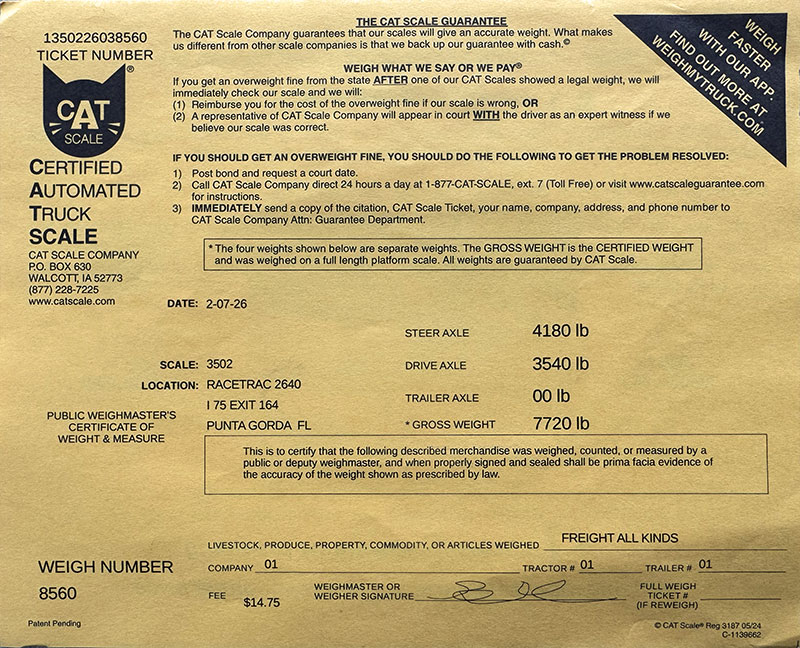
The CAT scale ticket for our empty 2018 Ram 3500
Before loading the camper for a camping trip, we returned to the same CAT scale. We removed everything that wasn’t part of the Granite Platinum, verified that both the camper and truck were truly empty, filled the truck with fuel, and drove across the certified scale. Before we hit the intercom button to request a weigh, we got out of our truck and stepped off the scale.
The result: 12,060 pounds.
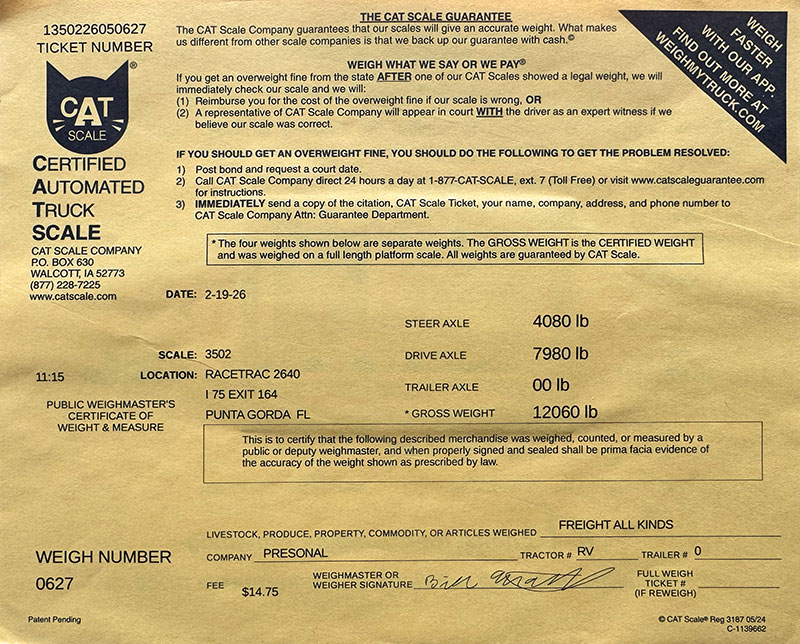
The CAT scale for our empty 2018 Ram 3500 and dry Rugged Mountain Granite Platinum prototype
With those two CAT scale tickets, we could take the total dry rig weight (12,060 pounds) and subtract the dry truck weight (7,720 pounds) to get a camper dry weight.
The result: 4,340 pounds.
Naturally we immediately looked at the weight sticker on the back of the Platinum. It read 3,898 pounds with standard equipment, 30 gallons of water, 40 pounds of gas (propane), and a 10 cubic foot refrigerator.
Given that this is a prototype, and that Rugged Mountain was adding components right up to day they shipped the camper to Florida, we’ll chalk this up as a reminder to never take an external camper weight sticker at face value. All too often these rear stickers reflect the lowest possible weight a camper could possibly be, not the camper they’re attached to. They often do not account for installed options, upgrades, or other components added during or after production.
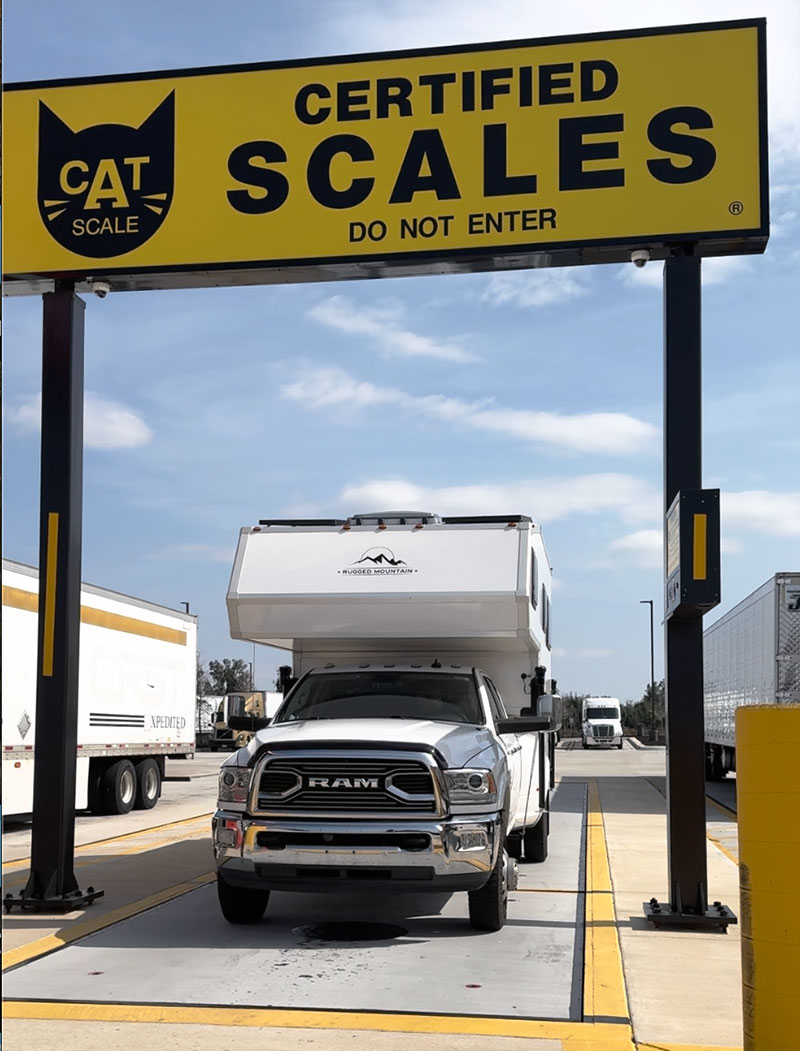
After weighing the truck, and subtracting from the combined truck and camper weight, the resulting dry weight was 4,340 pounds
We have conducted the exact same CAT scale test with our 2018 Ram 3500 and 2004 Alpenlite 1100 rig and were able to do a direct comparison between the two campers. With CAT scale tickets in hand, our camper weighs in at 4,180 pounds dry.
That’s right, our twenty-two year old aluminum-framed and vacuum-laminated, camper—with Crane Composite side walls, spray-on Flex Armor roof, and extensive aluminum structure added after our 2018 accident—is 160 pounds lighter than the composite-panel Granite Platinum prototype. How is this possible?
The answer is simple. First, the 1.5-inch composite-panel walls aren’t exactly light. Even Rugged Mountain stated that there wasn’t much weight savings—if any—between the Globe Trekker composite-panel builds and their wood-frame hung wall builds.
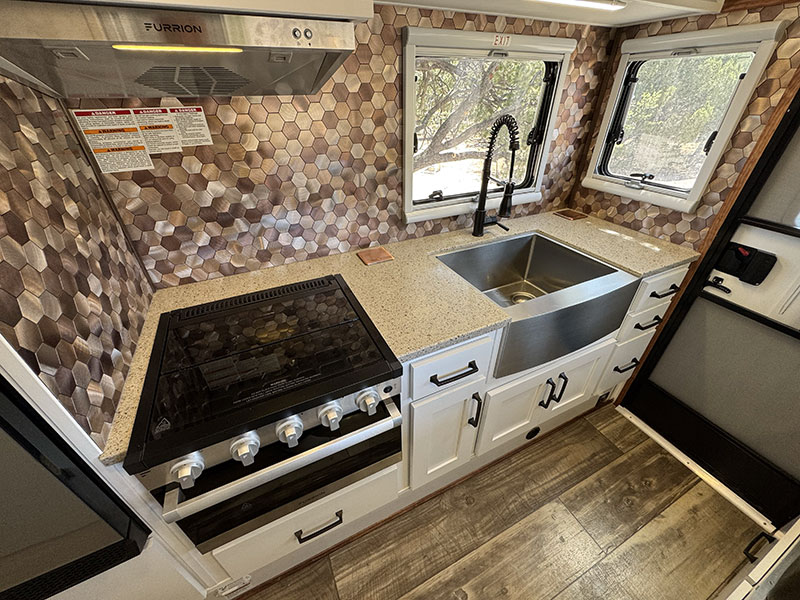
Second, we’re not comparing apples-to-apples. For starters, the Rugged Mountain camper has five 200-watt solar panels on the roof and a full multi-component Victron system. Our camper has two 220-watt bifacial solar panels and a Goal Zero Yeti Pro 4000 all-in-one lithium battery system.
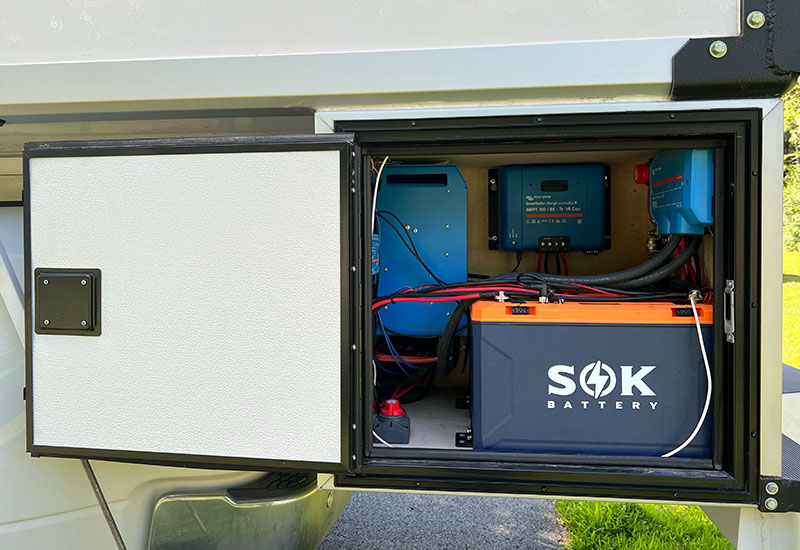
The Rugged Mountain Granite Platinum prototype has an extensive battery electrical system: 628Ah of lithium, 1,000 watts of solar, a 3,000 watt inverter, and a full Victron electrical system
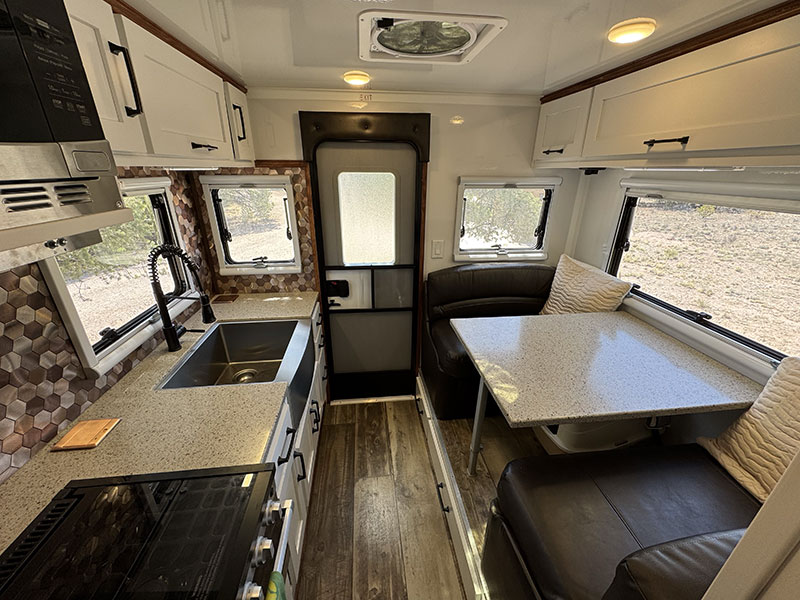
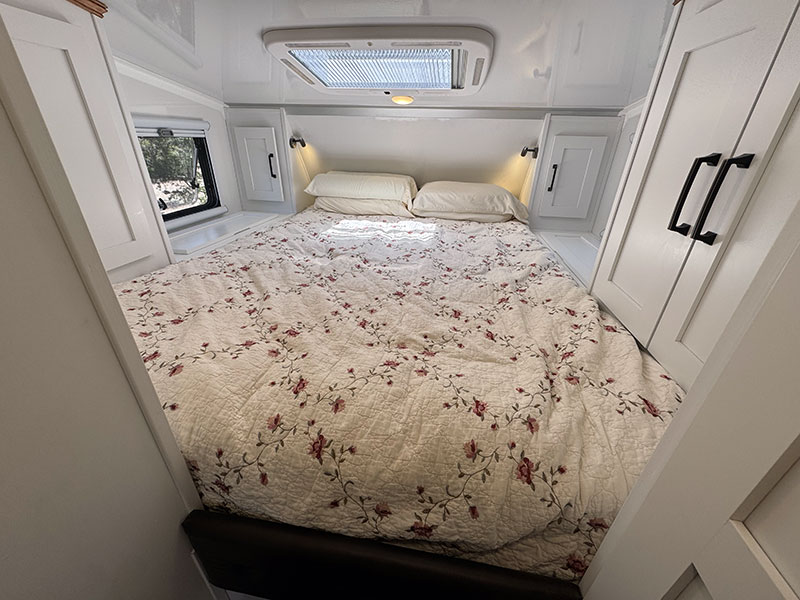
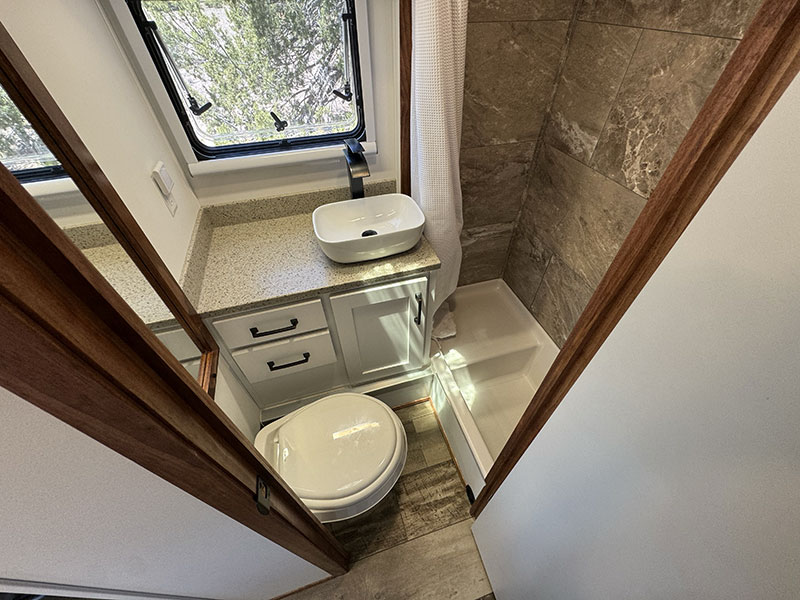
There are also numerous differences in cabinetry, components, and other details. In short, these two campers are remarkably similar in size, floor length, floor plan, and overall features, but they’re not identical.
The overall lesson here is that composite panel construction isn’t a guarantee of a lower overall camper weight. It’s also important to point out that not all composite panels and extrusions are the same. Different composite materials, adhesives, extrusions, and wall thicknesses can result in different composite-panel systems weighing more or less than others.
That stated, weight wasn’t the reason why Jesse selected the Globe Trekker system. He was after something he considered to be much more important.
Right after questions of composite panel weight we would get questions about the insulation quality. It’s fair to assume that a camper with near perfect foam composite insulation coverage throughout its structure would be amazing in cold weather. Well, tee up that ball and go deep because this camper is about to smack that one clear out of the park—with a catch.
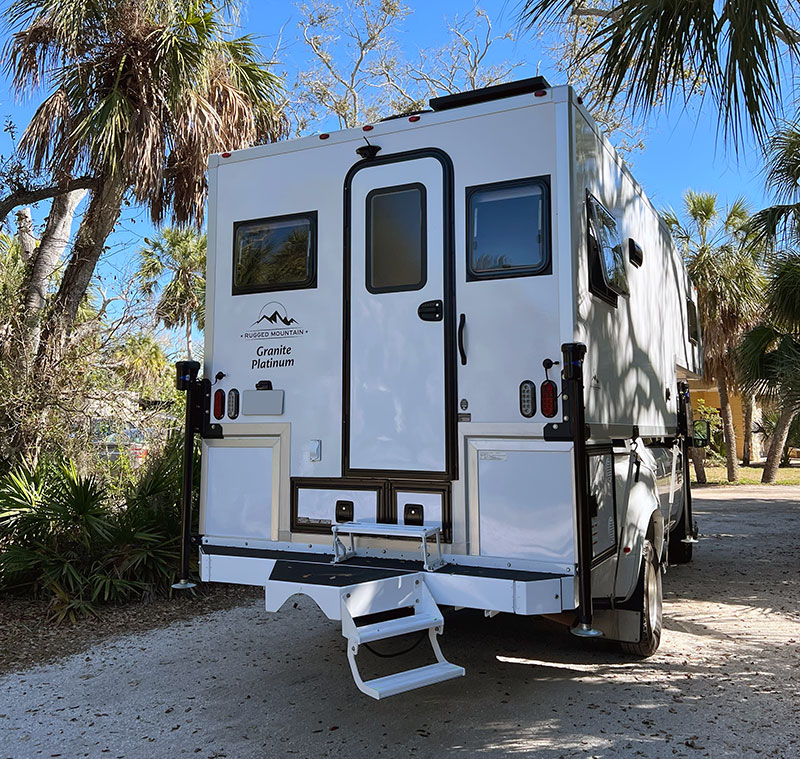
Camping in Florida at Fort DeSoto Park
During our first few mornings in the Granite Platinum, something was quietly different. Sure, it had cooled off a touch since the previous evening, but we were comfortable inside the unit. The funny thing is, we didn’t really notice the temperature difference until we opened the entry door. Outside, the late-April temperatures in northern Florida, Louisiana, and Texas—we were headed to Expo West—were about ten to fifteen degrees cooler than inside the camper.
The only other camper that ever achieved this trick was a 2018 Cirrus 920 outfitted with an Alde hydronic heating system. The difference here is that the Granite Platinum did it without anything more than composite panel walls and thermal pane windows—no furnace use required.
Like with the Cirrus before it, this experience repeated morning after morning. We would wake up in a comfortable temperature only to find out what the outside temperature really was when we opened the door. And every day, we were impressed. I would even joke, “What temperature do you think it is outside, Angela?” And she’d say, “Who knows? Open the door.”
Our personal camper with its single pane glass windows and aluminum framing would have been much closer to the outside temperature by morning. We typically crank our propane furnace for a few minutes to take the chill off, but that wasn’t necessary with the Granite Platinum.
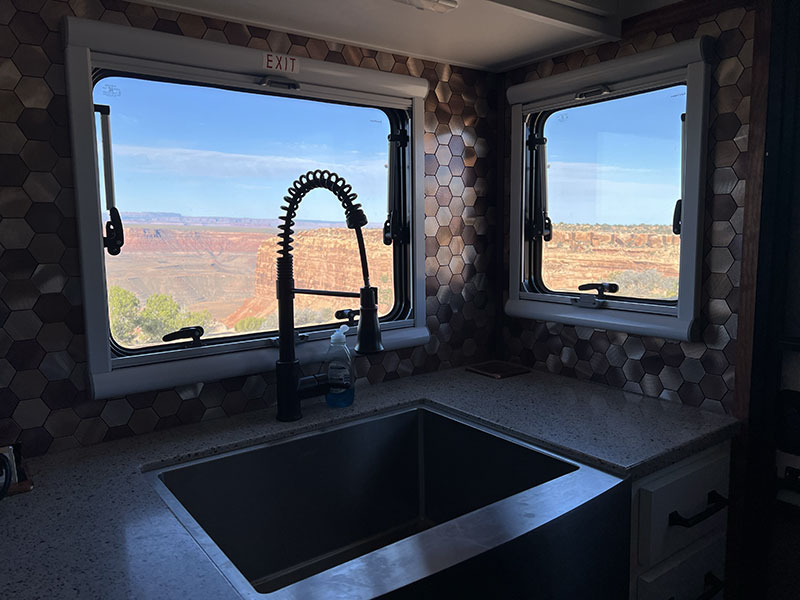
Thermal pane acrylic windows looking out from the kitchen of the Granite Platinum prototype
Now before you jump to the obvious “it’s the composite panels you nitwit” answer, one must recognize that the Granite Platinum has a major thermal advantage over our camper: dual pane acrylic windows versus single pane glass windows. We’ve camped in many campers with either glass or acrylic thermal pane windows and the difference is unmistakable. Single pane glass windows are fine for fair weather, but thermal pane is superior for the extremes of winter and summer. Obvious? Sure, but it’s also true.
That aside, thermal pane windows cannot fully account for the thermal performance of the Globe Trekker composite paneled Granite Platinum. From five months of full-time camping, there can be no doubt that the 1.5-inch composite panel structure—walls, floor, and roof—are passively holding in the warmth better than anything in our previous experience.
Unfortunately, there’s a catch. The Globe Trekker foam-core and FRP-skinned composite panels not only keep heat inside the camper but also trap humidity. On a routine basis, we would go to sleep comfortable, and then wake up sweating. With both of us, and our cat, Cosmo, in the cabover, the cabover would intensify this trapped humidity to the point of being unbearable.
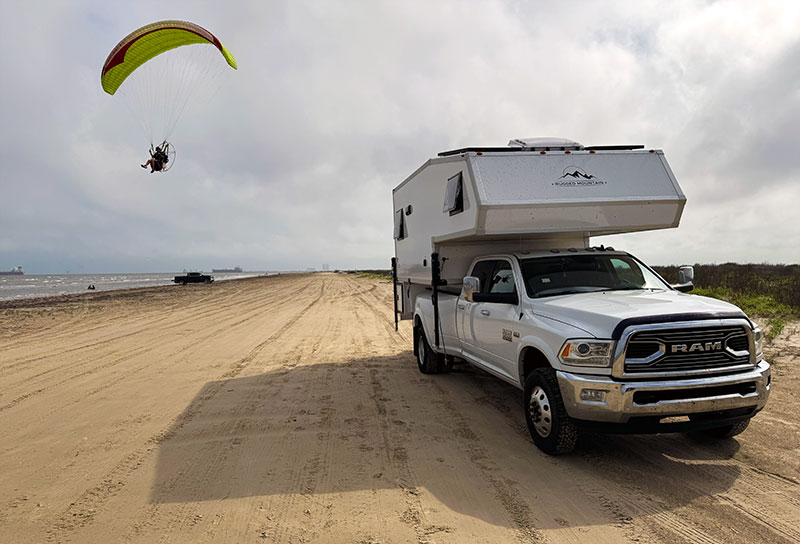
Camping at Bolivar Beach, Texas, with the windows open and the MaxxAir fan on for airflow
The solution was simple. We would open the cabover hatch and/or windows, and turn on the MaxxAir vent in the main living area. The airflow would relieve the humidity and we would drift back into la-la land.
The obvious preventative strategy was to leave the cabover hatch and/or windows cracked open before we went to bed, but that wasn’t always possible. For example, we had numerous times this summer when a nearby neighbor was smoking something or having a roaring campfire. Other times it was raining and the outside humidity was already elevated.
In both scenarios, the 13,500 BTU Houghton Bel Air 3400 air conditioner was our savior. In fan mode (not air conditioning), the Houghton AC brought in air without bringing in the offending odor or smoke helping to bring down the humidity enough for us to drift back into la-la land. At only 75-watts in fan mode, this made a small dent in the Granite Platinum’s 628Ah lithium battery bank, and the rooftop 1,000 watts of solar panels topped that off with the morning sun.
The takeaway here is that owners of composite-panel campers may need a different approach to ventilation than traditionally built campers. For manufacturers of these units, additional attention needs to be made to facilitate that ventilation in all conditions. This means windows that can stay open in the rain and fans and/or air conditioners that can run quietly and efficiently through the night. Do that, and this problem will be no sweat.
The same bright white and shiny reflective FRP skin that adorns the Rugged Mountain Granite Platinum exterior also adorns the interior. The interior sidewalls, back wall, and front nose walls are the same bright white and shiny reflective FRP skin. Oh, and the entire ceiling is the same bright white and shiny reflective FRP skin.
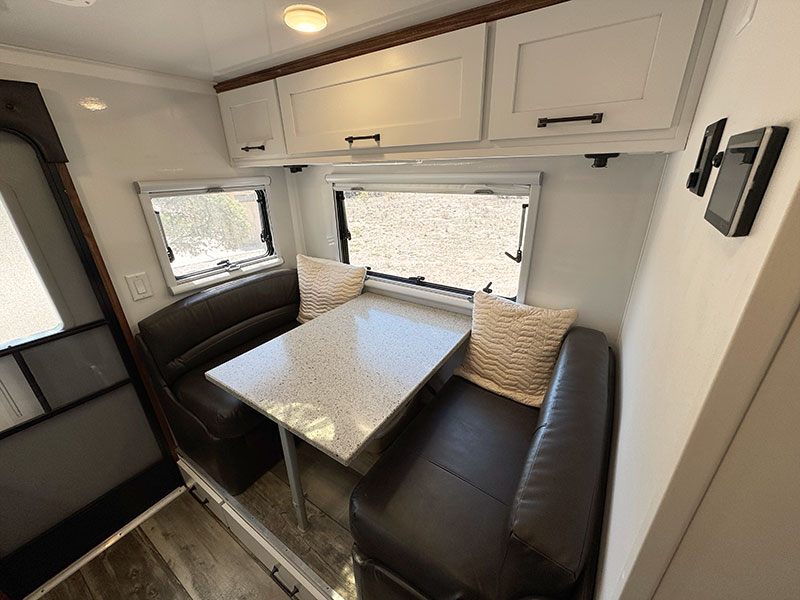
Bright walls in the Rugged Mountain Granite Platinum prototype
During the day, the FRP skin gives the camper a distinctively bright and modern vibe. The reflections and woven texture underneath also give the interior a sense of added depth and sophistication. As an added bonus, the FRP skin wipes clean if something gets spilled on it. There’s no stainable RV wallpaper here.
At night, it’s a different story. If there’s any light in the camper, or if any gets around the window shades, that light is reflected and amplified throughout the unit. From the LED on the CO detector to the clock on the microwave to outside lights coming in around the shades, even a small amount of light will bounce throughout the camper.
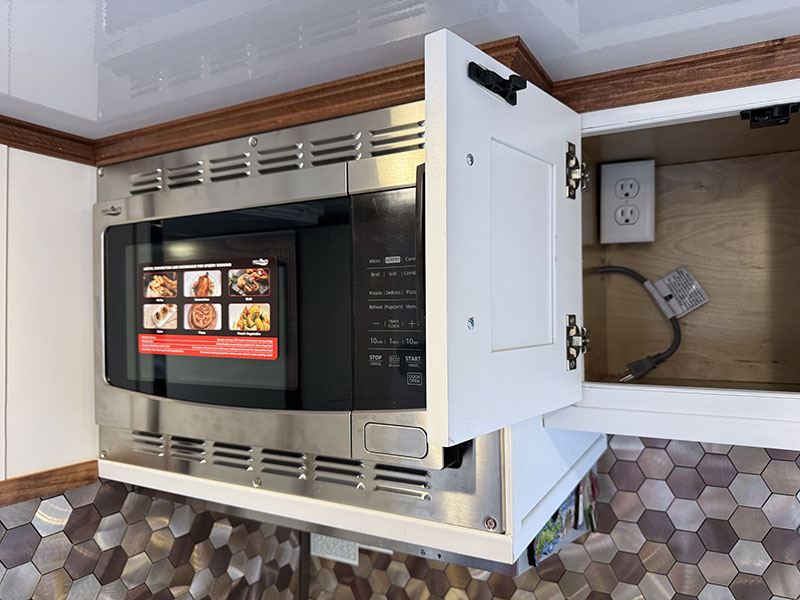
The solution was to unplug the microwave, put a small piece of black electrician’s tape over the LED on the CO detector, and hang a small quilted creation over the rear door window—which otherwise had no way of blocking light. This made a huge difference, and darkened the camper enough to let us sleep.
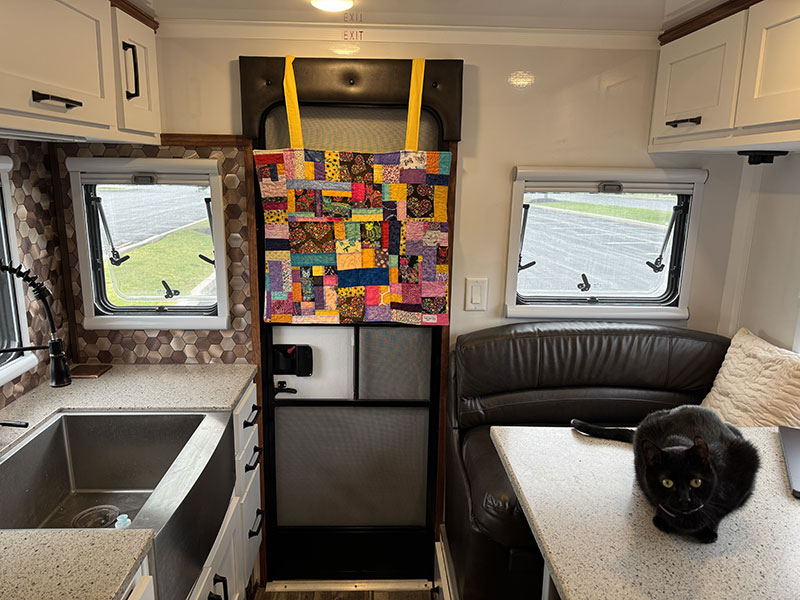
Cosmo posing with the quilted door covering to block out light from the door at night
Camper manufacturers are required to install CO detectors, and they don’t make microwaves or the other light-emitting offenders modern consumers often want. If you’re a light sleeper—no pun intended—you may need to follow our protocols. Do that, and it’s lights out.
The long-term viability of Rugged Mountain’s implementation of Globe Trekker’s composite-panel construction is still evolving, but our five-month impressions of the Granite Platinum prototype were undeniably promising.
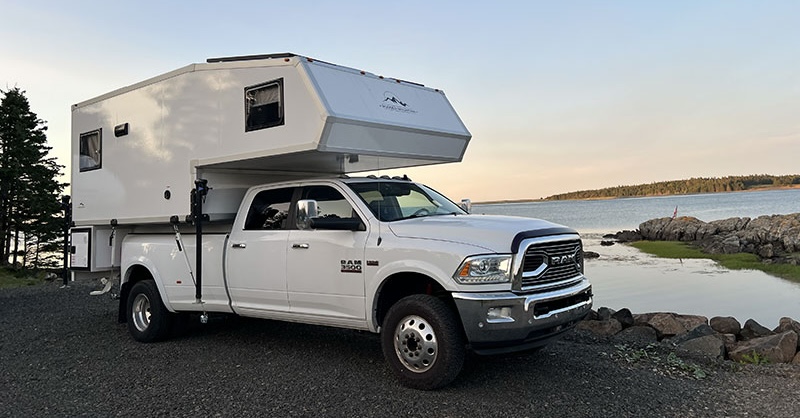
The Rugged Mountain Granite Platinum prototype on Grand Manan Island in New Brunswick
If I had an overall takeaway, it’s that manufacturers and consumers need to approach composite-panel campers differently than campers built with other construction methods. Composite-panel campers have advantages and disadvantages, and need to be designed and manufactured to enhance these benefits while mitigating the potential negatives. In turn, composite-panel camper owners need to understand the inherent pros and cons of composite-panel construction and adapt their truck camping lifestyle and habits accordingly.
At the end of our experience, we had a new found respect for the potential of composite-panel construction. And if the Sikaflex 552 holds, it’s hard to deny that a composite-panel camper will outlast darn near everything else on the market. That stated, there is no best construction material or build approach for every camper manufacturer or consumer. Factors like cost, weight, repairability, and even aesthetics need to be evaluated. What’s the best? That’s up to you and your specific needs.
For their first-ever composite-panel prototype, the Rugged Mountain Granite Platinum is an impressive implementation of Globe Trekker’s materials and technology. It also demonstrates the fearless, forward-thinking gumption of Jesse Collinsworth and the Rugged Mountain crew. I, for one, am excited to see how the Granite Platinum evolves.
Keep innovating, Rugged Mountain. You’re definitely onto something.
For more information on Rugged Mountain, visit their website at ruggedmountaincustomrv.com. Click here to get a free Rugged Mountain brochure.