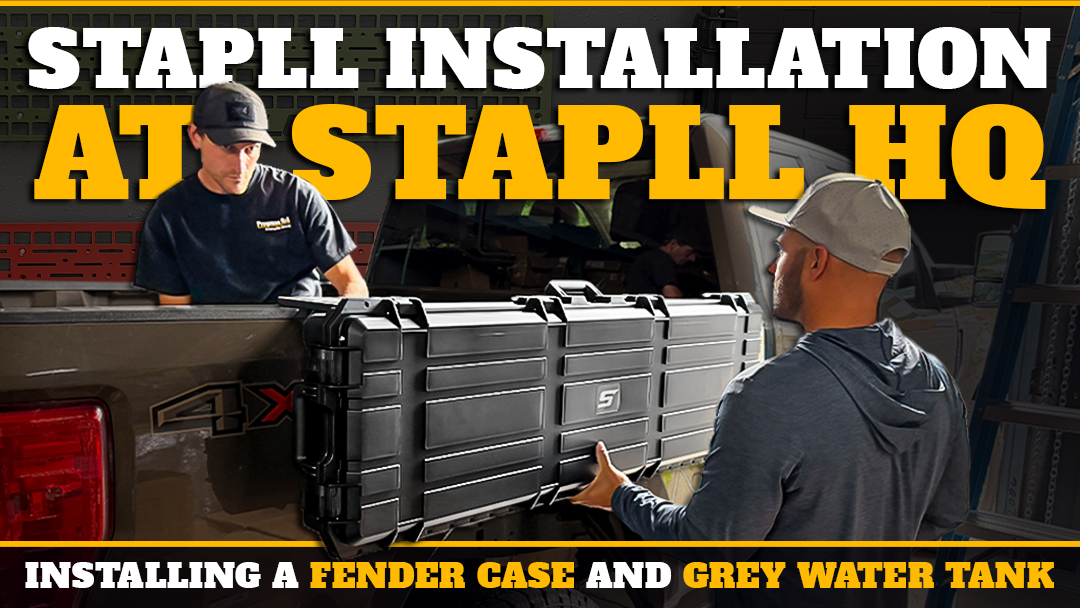
From the unboxing to the final bolt, we documented the installation of a STAPLL Fender Case Kit and a RotopaX grey water tank on a Ford F-250. Here’s an inside look at the reader-selected 2025 Truck Camper Magazine Innovation of the Year. Ready. Set. STAPLL.
Colorado has been a natural incubator for outdoor and overland products since the very beginning of the truck camper industry. Steep mountain passes, rough mining roads, and remote campsites demanded equipment that could travel where conventional RVs couldn’t. Long before overlanding became a movement of its own, Colorado manufacturers were designing and refining truck campers and outdoor products to meet those challenges. The result was a legacy of innovation that continues to influence the truck camper industry today.
One of the newest companies carrying that Colorado tradition forward is STAPLL. The space outside the truck bed and below the camper wing has been overlooked for decades. STAPLL saw that space as an opportunity.
Truck Camper Magazine readers took notice, voting STAPLL the 2025 Innovation of the Year. That was the excuse we needed to schedule a visit to STAPLL’s headquarters in 2026.
This past Memorial Day weekend, the Truck Camper Magazine team left Utah and headed east up the Rocky Mountains. At 6,512 feet above sea level, we arrived in Durango, Colorado. The plan was to tour the STAPLL facility, film social media content, and catch up with Co-Founders Charlie and Bruce Hoch. Then Charlie’s phone rang.
A pair of Outpost 6.5 owners were passing through on a road trip and wanted to have a STAPLL Fender Case and a RotopaX grey water tank installed on their Ford F-250. What started as a short visit quickly became an opportunity to watch the installation firsthand and ask a truckload of questions along the way. Let’s get our STAPLL on.
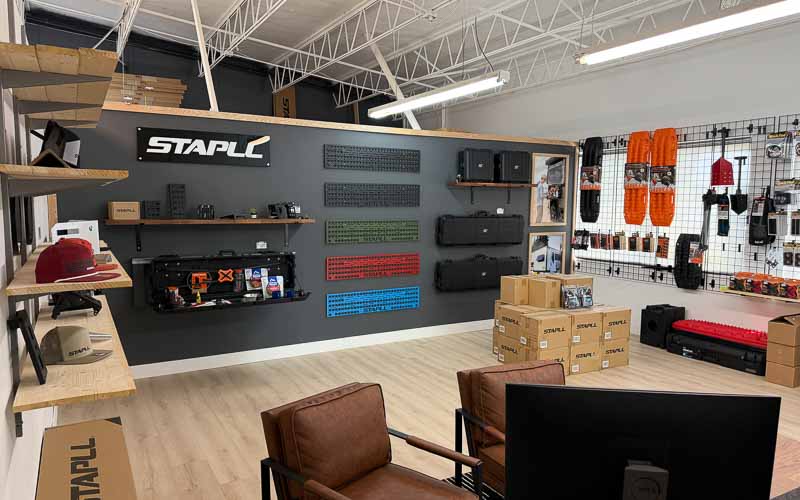
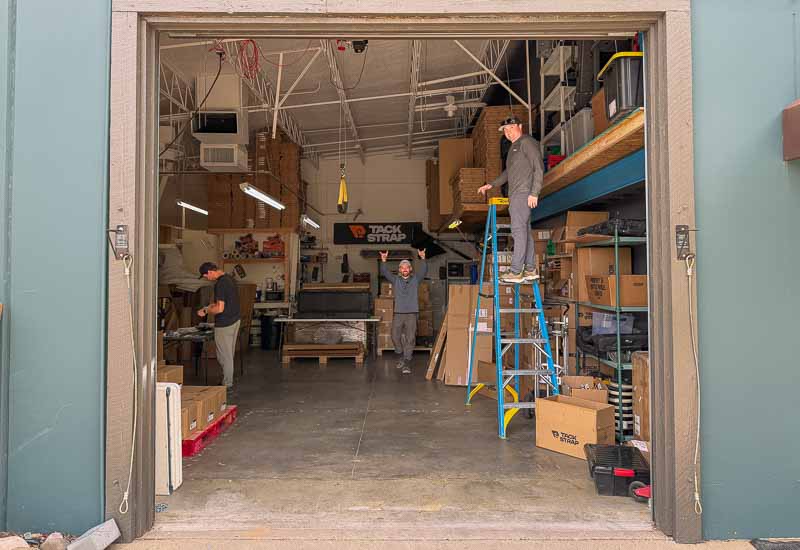
STAPLL showroom in Durango, Colorado
Heidi and Dave had been traveling the West for more than two weeks when they arrived at STAPLL’s front doors. They had owned their Outpost 6.5 for nearly two years, and told us that they rate their Outpost experience at a “twelve out of ten.” But no matter the truck camper setup, every trip can reveal a little inconvenience, a piece of gear that feels out of place, or a routine that could be made simpler.
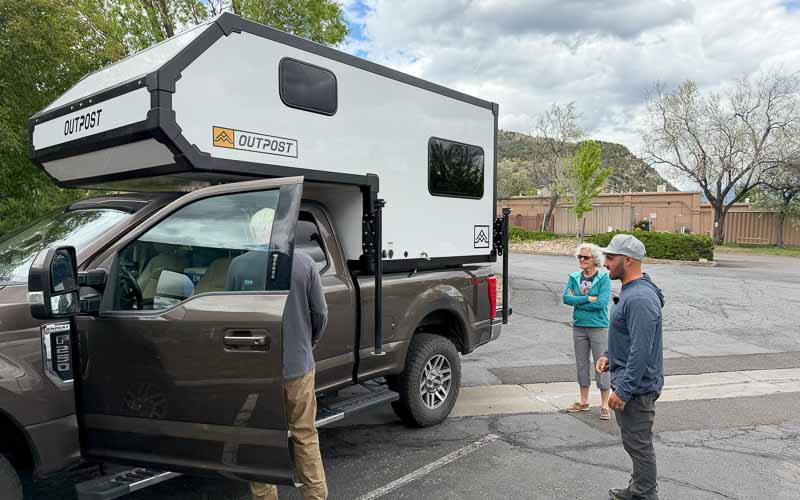
Charlie meets Outpost 6.5 owners, Heidi and Dave, outside of STAPLL headquarters
Those lessons led Heidi and Dave to STAPLL. They wanted a better place for all the dirty items that never seem to belong inside their truck camper, including a shovel and leveling blocks. They also wanted exterior grey water storage to meet self-contained campground requirements.
STAPLL prefers customers arrive with the camper already removed from the truck, but road trips don’t always follow the ideal script. Charlie was happy to accommodate the situation. He showed Heidi and Dave to the showroom, recommended a nearby brewery for lunch, and got to work. A few minutes later, the Outpost was in the air, the truck stood bare, and the installation officially began.
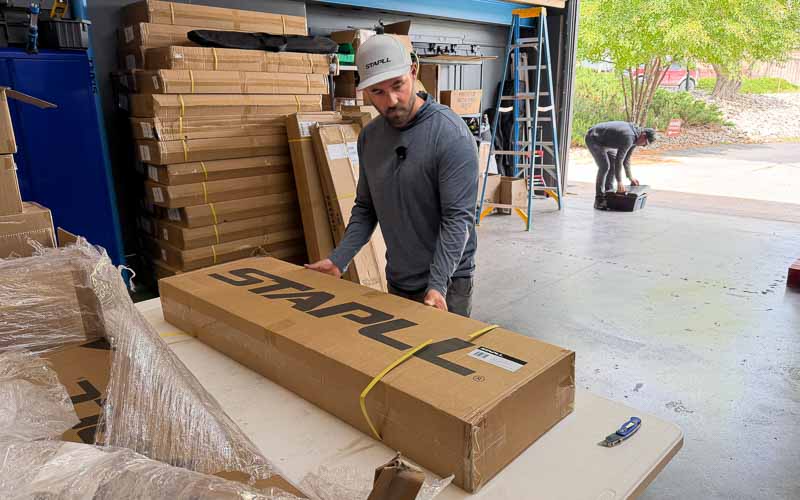
Charlie opened the 56-liter Fender Case Kit and laid out the parts. Every piece of hardware needed for the installation was organized inside a single box. This would be easy to overlook, but when you consider the number of truck manufacturers and bed rail designs, getting the right combination of hardware into one box is no small feat.
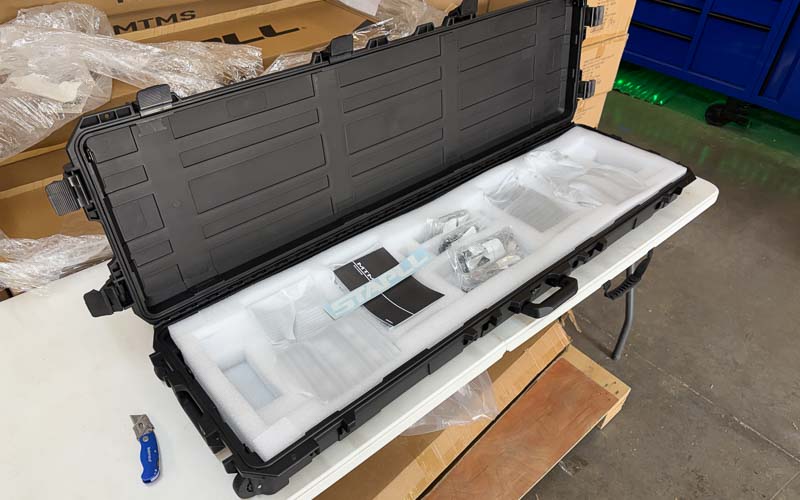
56-liter Fender Case Kit with installation hardware
As Charlie unpacked the kit, I found myself asking the same questions many of you probably would. Could I install this in my own driveway? What would I keep in the Fender Case? Which Fender Rack configuration would make the most sense for the way I camp?
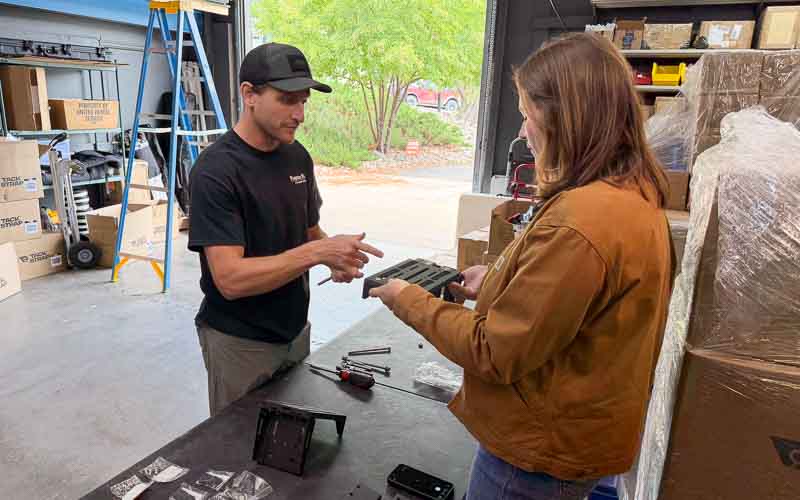
STAPLL Install Technician, Cody Geringer, explaining the STAPLL hardware to TCM’s Editorial and Creative Lead, Sarah Hyde
Looking at all of the hardware on the table, it wasn’t immediately obvious how everything worked together. Fortunately, STAPLL’s Install Technician, Cody Geringer, had done this enough times to break the system down for us. I’ll do my best to pass that same explanation along.
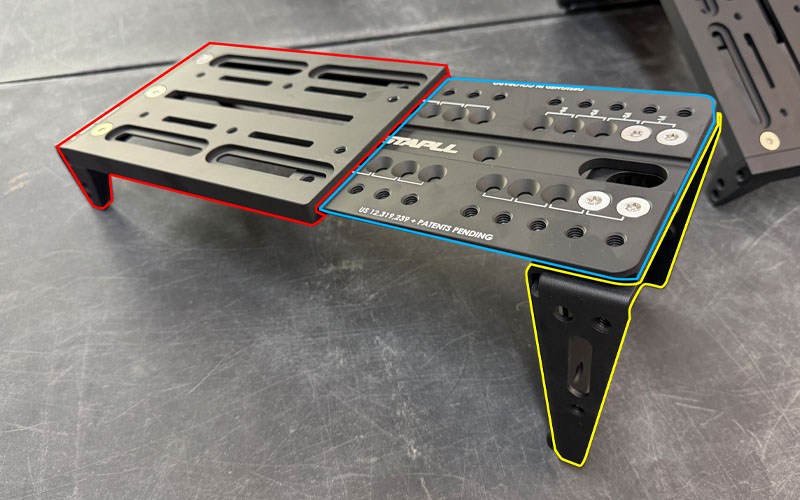
STAPLL slide plate (red), thread plate (blue), and brace (yellow)
The slide plate, thread plate, and brace form the foundation that every STAPLL Fender Rack is built upon. The brace mounts vertically against the inside of the truck bed while the thread plate rests on top of the bed rail. The thread plate and slide plate interlock to allow the rack to move in or out to accommodate different truck beds and storage solutions.
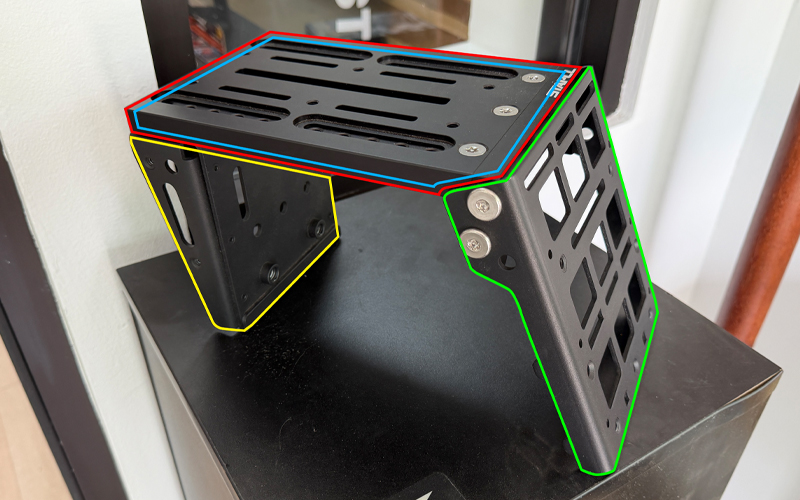
STAPLL brace (yellow), slide plate (red), thread plate (blue), and MOLLE panel (green)
A MOLLE panel then attaches to the slide plate, turning the mounting hardware into a versatile platform for storage cases, recovery gear, RotopaX containers, and other accessories.
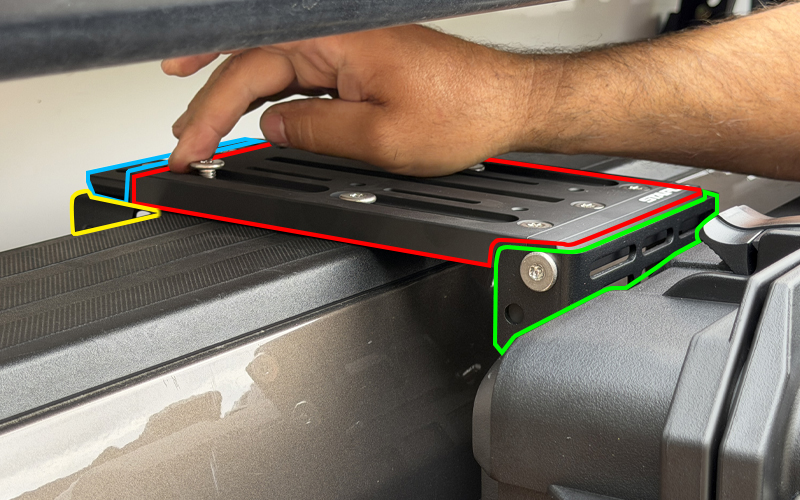
STAPLL Installed: brace (yellow), thread plate (blue), slide plate (red), and the MOLLE panel (green) with a Fender Case (bottom right)
When I watched these components come together on the truck, the engineering behind the design came to life.
I’ve installed enough aftermarket truck accessories over the years to expect the instruction manual to eventually say, “Drill a hole into your truck.” That moment never came with the STAPLL system.
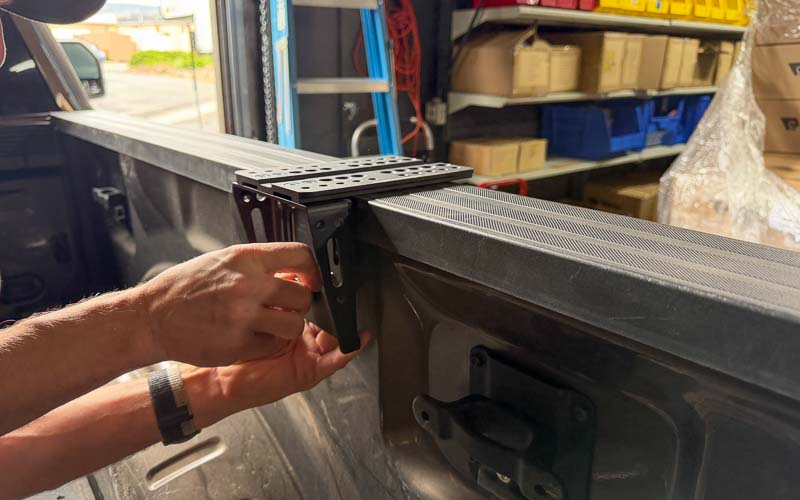
Installing the brace and thread plate to the truck bed rail
As Cody positioned the brace against the bed rail, I found myself looking less at the hardware and more at the truck. Modern pickup beds are anything but flat. Ribs, curves, stamped reinforcements, and subtle variations run the length of the bed. Every manufacturer seems to have its own way of doing things.
When you add different bed lengths and model years, the challenge becomes obvious. How do you build a mounting system that works for nearly every truck?
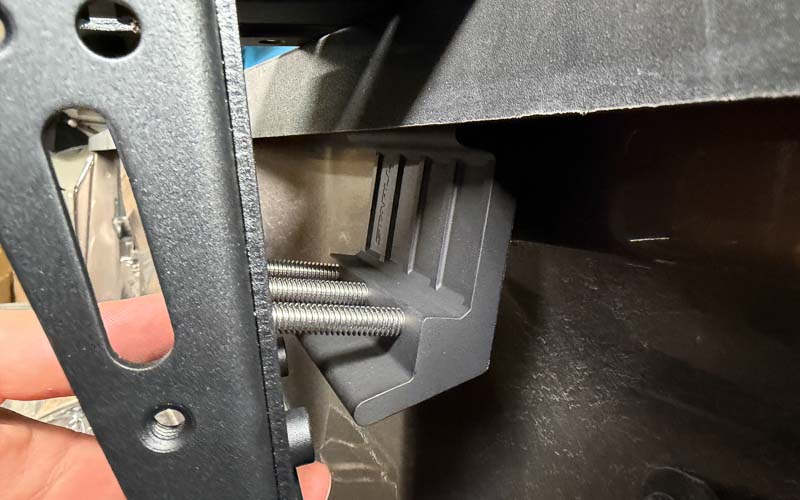
Brace (left) and mounting clamp (right)
The answer started with the clamp. The brace pulled tight against the truck rather than relying on a drilled mounting point. Before sliding it into place, Cody applied a quarter-inch rubber backer to the contact surface.
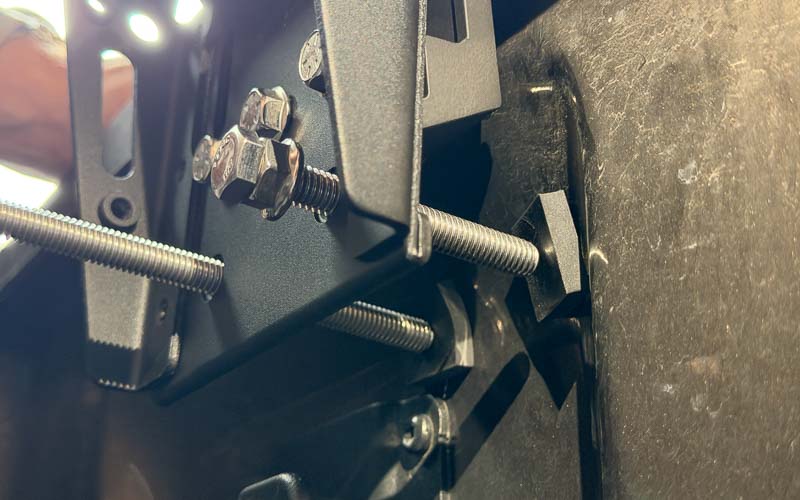
Brace with stability bolts pressing against rubber backers
Next came two stability bolts threaded through the lower portion of the brace. The stability bolts push gently against the truck bed through another set of rubber backers. These two additional points of contact counterbalance the force of the clamp, locking the hardware into place.
When we first introduced STAPLL, some TCM readers asked: What keeps the hardware from rubbing through the paint? The rubber backers are the first part of that answer. They cushion the contact points, isolate the mounting hardware from the truck, and help absorb vibration over rough roads. But what about the outside of the truck bed? Charlie had an answer for that, but it comes a little later in the installation.
With the hardware installed, Charlie set the Fender Case in place for the first of several test fits. Parts went on, came back off, shifted slightly, and went back on again. Nothing was permanently mounted until Charlie was satisfied with how everything lined up.
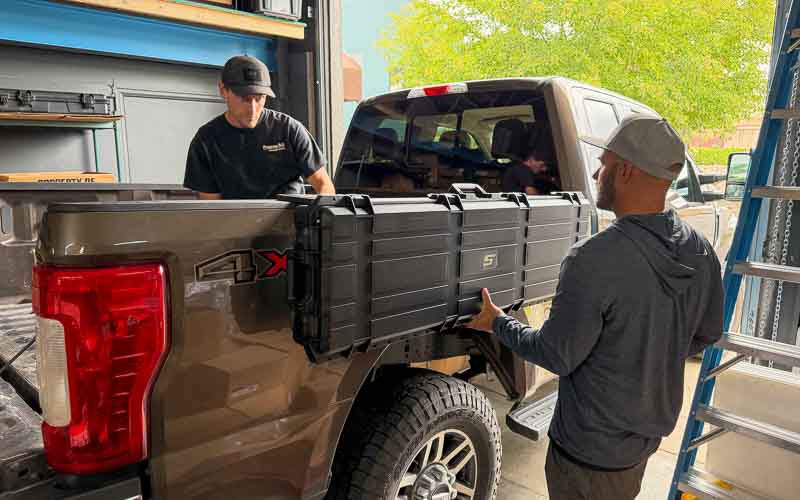
If you’re following along with plans to install a STAPLL system of your own, here’s one piece of advice worth remembering: don’t drill into the case until you’ve seen how everything fits together on your truck.
At this point, I was confident I could do this in my own garage. My questions shifted from installation to ownership. Does the camper still load and unload as easily with the brace and thread plate installed? Can the Fender Case be used for anything other than storage? And much like the TCM readers, I wanted to see how STAPLL prevents their Fender Racks from rubbing against the outside of the truck bed.
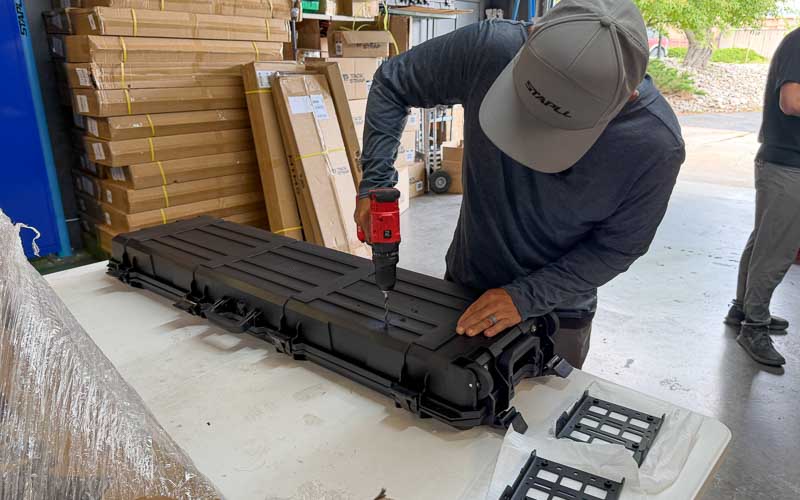
The next step was mounting the six-by-seven-inch MOLLE panel to the back of the Fender Case. Charlie’s hands stayed busy while the instruction manual stayed closed. It was safe to assume he’d done this a few times.
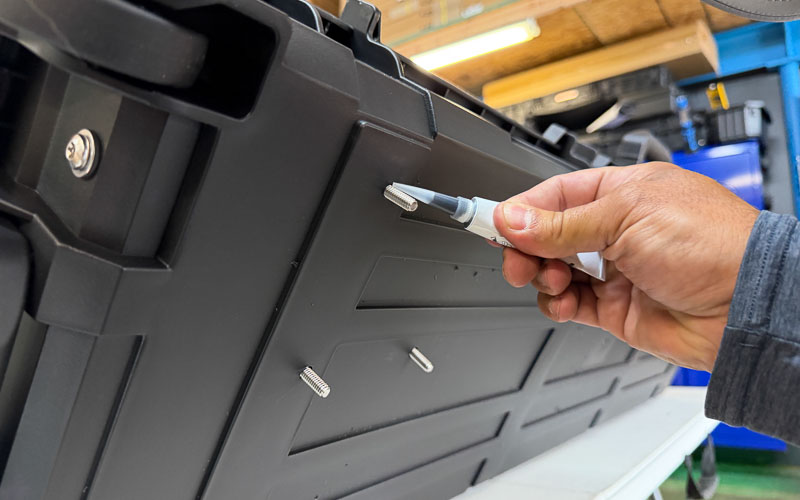
After each bolt passed through the case, Charlie applied sealant to both sides of the opening. Aside from water intrusion, this protects against the fine Colorado dust that can work its way into the smallest of openings.
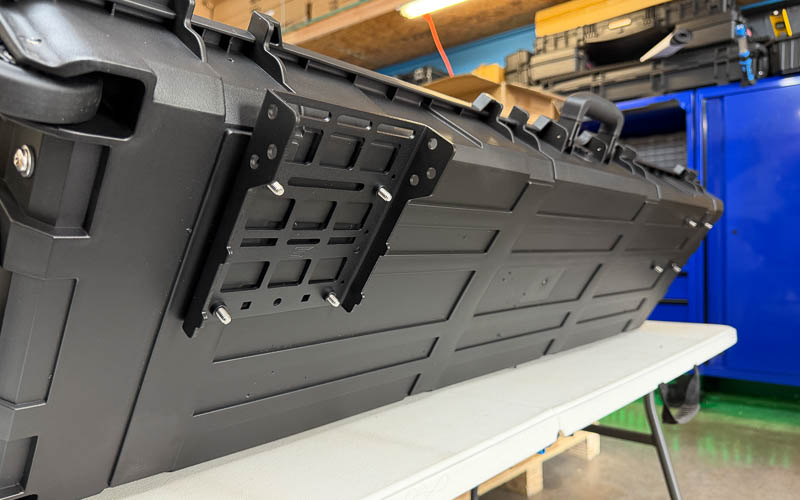
6×7″ MOLLE panel mounted to the Fender Case
A second six-by-seven-inch MOLLE panel would eventually be mounted to the opposite side of the case, creating two attachment points that distribute the load across the mounting hardware. Together, they’re rated to support up to eighty-four pounds of gear.
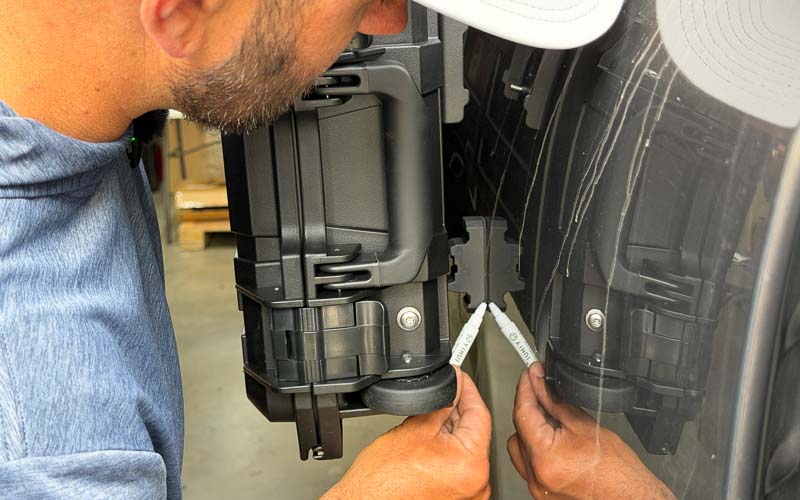
Charlie marking the position for a rubber spacer with a liquid chalk marker
After installing the second MOLLE panel and slide plates, Charlie lifted the Fender Case onto the truck for a final test fit. He stepped back, looked at it from a few angles, and made a small adjustment before marking the location for two rubber spacers. The rubber spacers would create two additional contact points against the truck.
My next thought was immediate: rubber or not, something needed to protect the paint underneath.
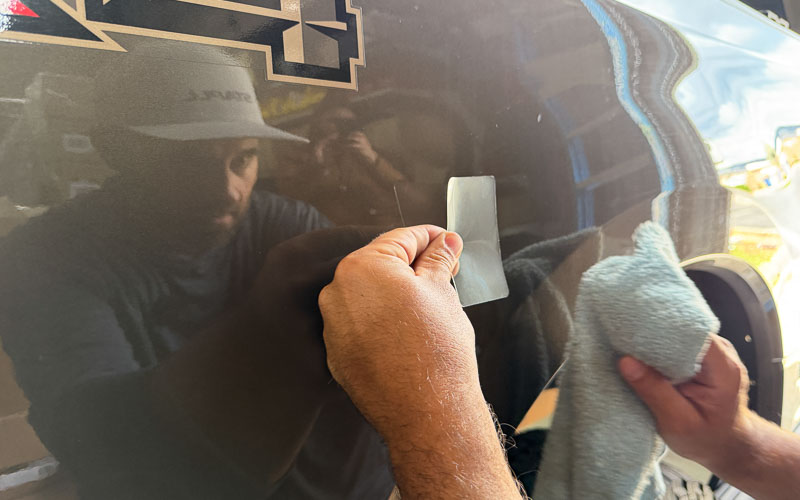
Charlie applying the protective 3M Paint Protection Film
Before attaching each rubber spacer, Charlie applied a small piece of 3M Paint Protection Film (PPF) to the truck. PPF is a clear, durable urethane film commonly used on hoods, fenders, bumpers, and even behind door handles. It protects areas that are subject to repeated contact or where road debris is likely to wear through the paint.
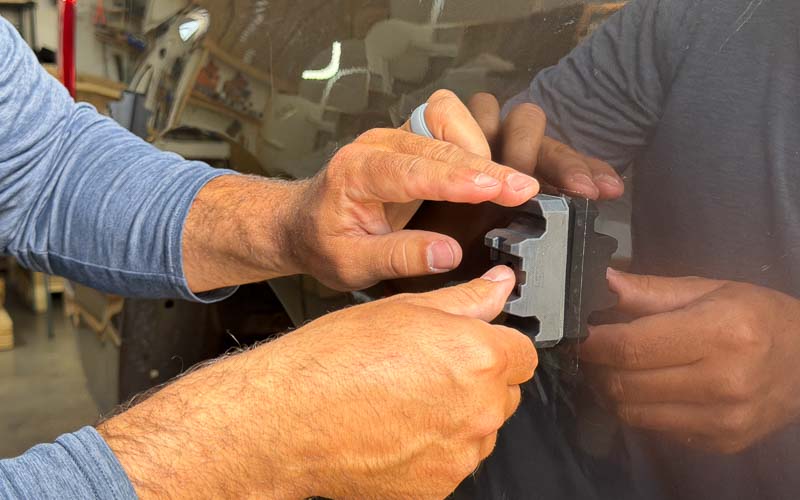
The rubber spacer is then adhered to the PPF rather than directly to the truck using double-sided 3M adhesive tape. Like the rest of the STAPLL system, it isn’t meant to be permanent. If your setup changes down the road, the contact points can change with it.
Until this point, every piece of the STAPLL system had been installed with the camper off the truck. It was time to lower the Outpost 6.5 into the truck bed and see how it cleared the new hardware.
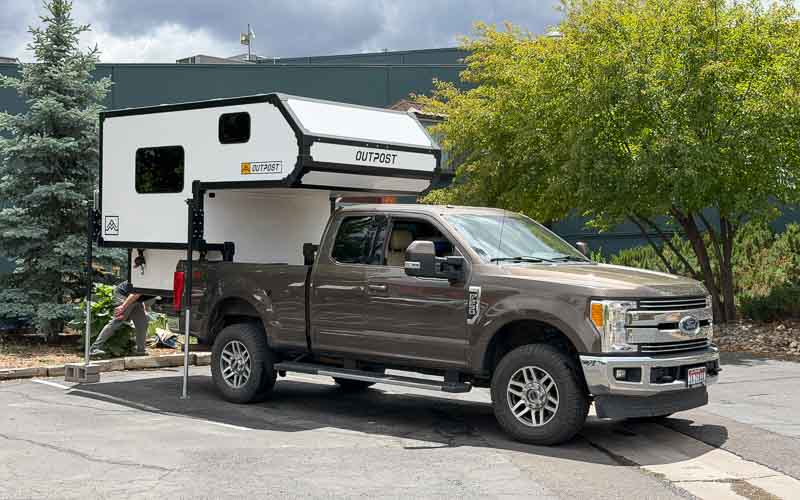
I’ve loaded enough truck campers to know this is the point where you either help or get out of the way. It was clear that Charlie and Cody had a routine down, so I stayed focused on the STAPLL hardware.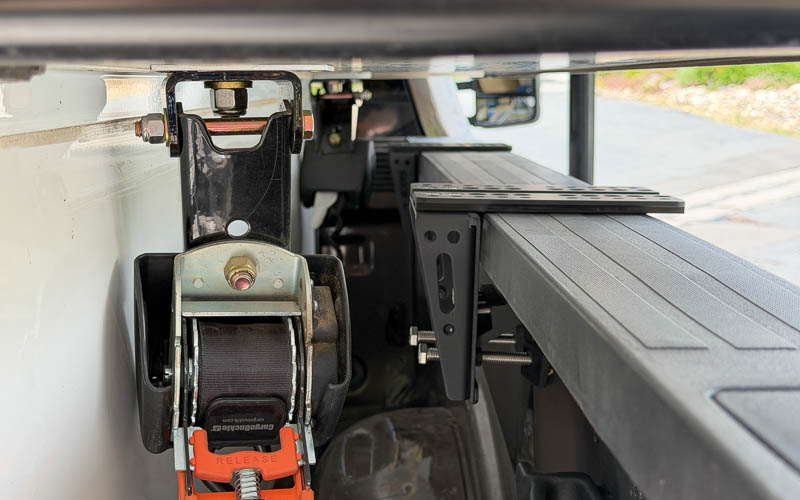
As the Outpost eased into the bed, I closely watched the mounting plates and the camper tie-downs. They slipped through with room to spare.
Charlie explained that the brace and thread plate extended just 1.75 inches into the bed. That measurement closely mirrors the tailgate bump-outs found on most pickups, allowing the system to occupy space that truck campers are already built to accommodate. So far, that 1.75-inch profile has cleared every truck camper STAPLL has encountered.
Of course, every truck and camper combination is a little different. The clearances that work on one setup may be tighter on another, so it’s always worth taking your time and having a second set of eyes outside the truck while loading.
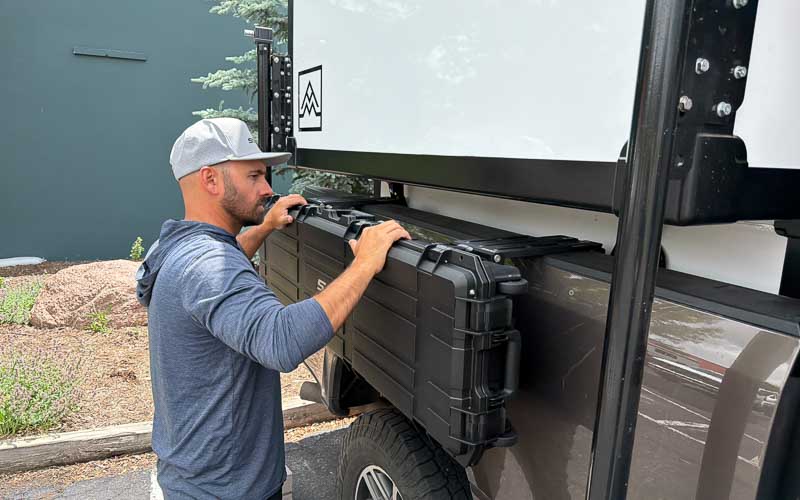
Charlie didn’t lower the camper all the way onto the truck just yet. Instead, he left it raised a few inches on the jacks, giving himself room to work.
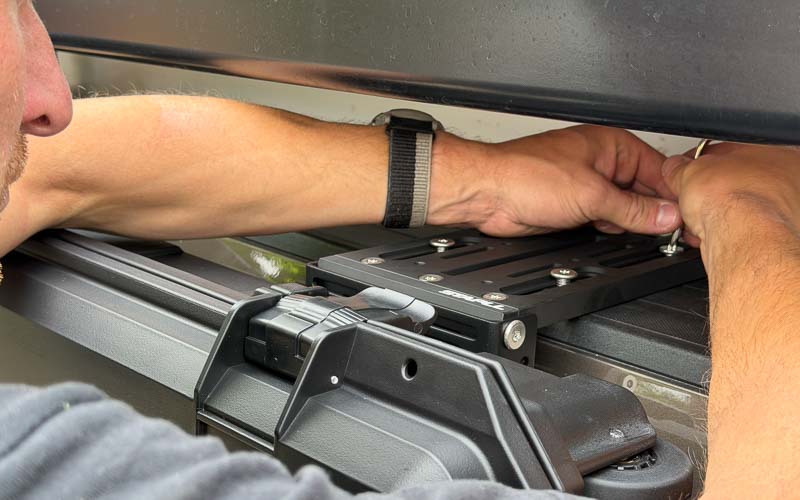
Charlie pushed the slide plate and Fender Case until it sat snug against the rubber spacers, then Cody tightened everything into its final position. The combined slide and thread plate sat just 0.55 inches above the bed rail, leaving plenty of clearance beneath the wing of the Outpost 6.5.
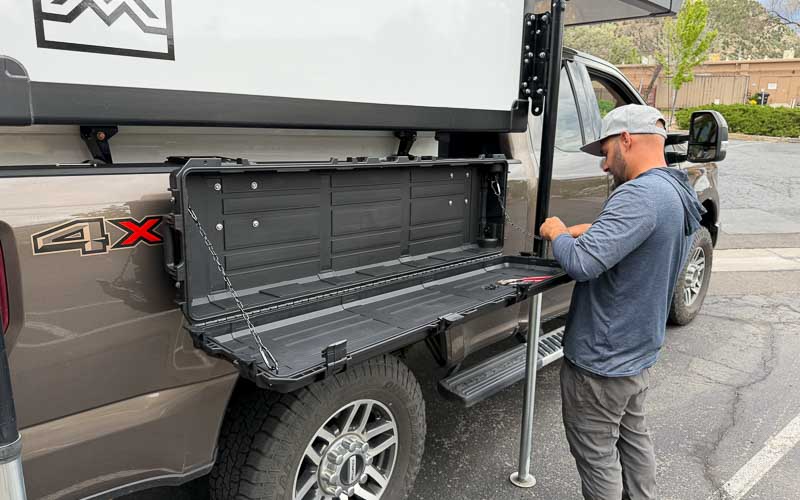
Earlier that morning, I kept asking myself what I would put in a STAPLL Fender Case. Recovery gear, leveling blocks, muddy gloves, and tools were the obvious answers. Then Charlie opened the lid.
Supported by a pair of chains, the lid of the Fender Case stopped at ninety degrees. My mind immediately wandered beyond storage to what was possible on this flat surface. I could picture making coffee on an induction cooktop before sunrise. Sarah would probably claim it for arranging one of her wildflower bouquets.
Truck campers have a way of giving every flat surface a purpose. I have a feeling this wouldn’t stay “just a storage box” for very long.
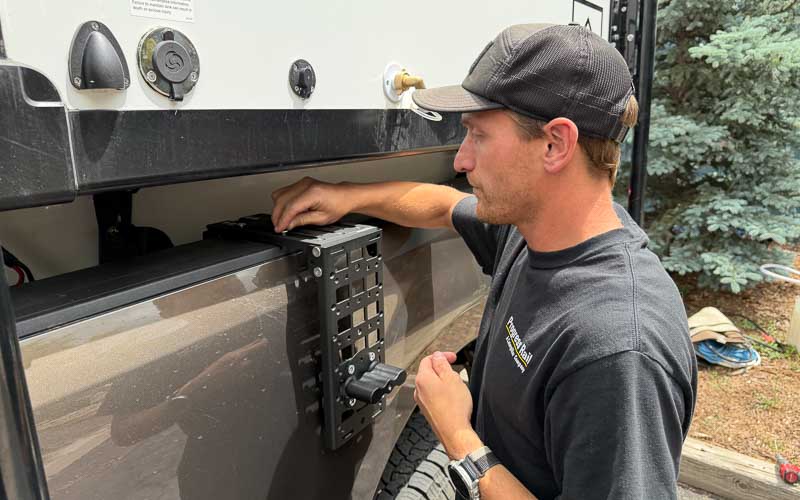
6×13″ MOLLE panel with DLX Pack Mount
While Charlie wrapped up the Fender Case, Cody moved to the opposite side of the truck to install a six-by-thirteen-inch MOLLE panel. Earlier in the day, he had prepped the driver’s side of the truck bed with a brace and thread plate for the second accessory—a grey water container.
Of course, portable grey water containers have been around for years, and plenty of truck campers use them successfully. Heidi and Dave wanted a solution that was ready whenever they needed it.
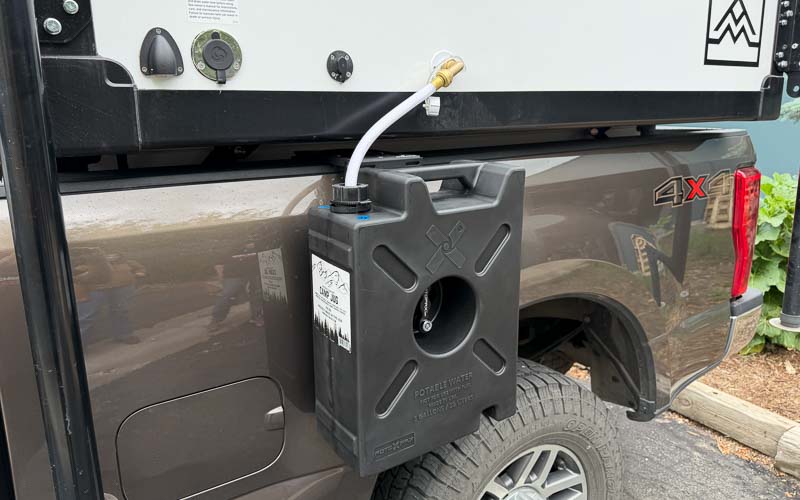
The six-by-thirteen-inch MOLLE panel was fitted with a DLX Pack Mount and a five-gallon RotopaX container. I liked that this solution didn’t force a permanent change on Heidi and Dave’s camper. When they need a grey water container, it’s there. When they don’t, it comes off. That’s a very truck camper approach to solving a problem.
A couple of hours after pulling into STAPLL headquarters, Heidi and Dave hopped into their truck, waved goodbye, and continued their trip to Montana.
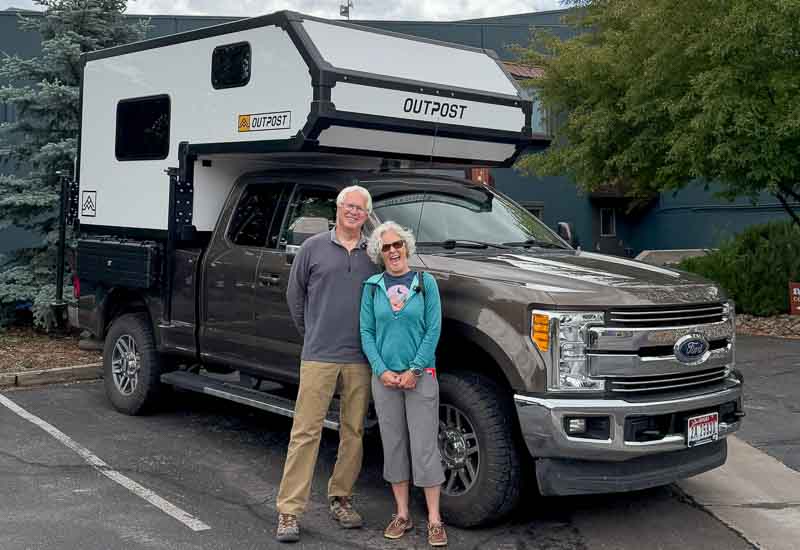
That’s truck camping. You meet people in parking lots, at gas stations, around campfires, and sometimes in the middle of a shop while a project is underway. Most of the time, you never know if your paths will cross again. I hope ours will someday.
Cody (left), Charlie (center), and Bruce (right)
Before we hit the road, our conversation with Charlie, Bruce, and Cody had long since moved beyond STAPLL. We traded stories about truck camping, mountain biking, surfing, snowboarding, snowmobiling, and the next excuse to get outside.
That’s why I started this article in Colorado instead of inside the shop. Brothers Charlie and Bruce Hoch fit into a long line of Colorado entrepreneurs whose businesses grew out of weekends spent outdoors, not boardrooms.
Around here, the adventure often comes first. The product is what follows.
For more information on STAPLL, visit their website at STAPLL.com. Click here to request a free STAPLL brochure.