With a Host triple-slide as home base, Tim McMaster tows his hand-built Bonneville Salt Flat running machines to Speed Week, and lets them rip. Crawl under the roll cage and strap in. We’re going for a record.
Perhaps at one point in your likely younger life you saw a wide open stretch of roadway before you and floored the throttle. As you watched the speedometer pass 70, then 80, and possibly even 90 miles per hour, voices in your head began to speak. Maybe the voices said, “What are you doing?” and “Are you trying to get killed?” Hopefully, most of us answered in the negative before hitting triple-digits and slowed down.
While we didn’t ask Tim McMaster this question, we’re pretty sure he didn’t. In fact, Tim was probably sitting in a car or truck he purpose-built to break not just the speed limit but every other limit that vehicle was designed for. Now, human nature dictates that he, too, likely heard the voices asking what in the heck he was doing. Little could he have known that he was building his future career and going exactly where he needed to be.
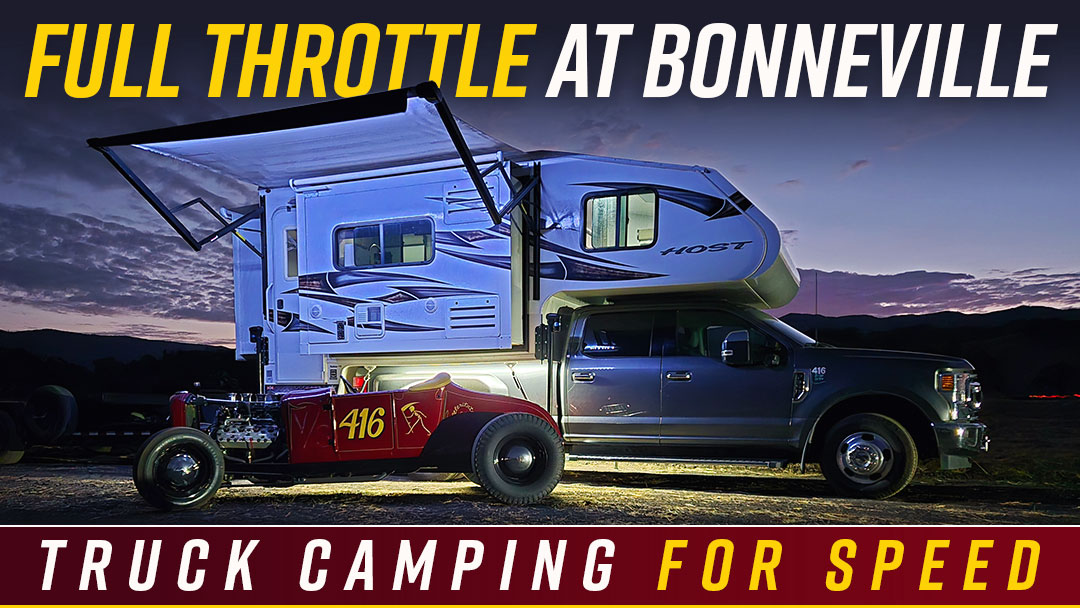
Tim came to our attention through a 2026 calendar photo depicting his Host Yukon triple-slide truck camper and 1929 Ford Roadster Model A modified to do one thing and one thing only—land speed race. We contacted Tim and asked for more information about the circumstances behind the truck, camper, car and photo. His answers sent us racing for an all-out interview.
You’ve had a number of truck campers over the years. Where did your story with truck campers begin?
My first truck and camper was a 1958 Alaskan and a 1958 Ford F-100. I used that truck and camper combination for many years. I was very happy with our vintage Alaskan, but after a while, my wife found it limiting in comfort and amenities. So, we got a 2005 Lance 805 with a bathroom, air conditioner, and a generator. That was fun, but as much as we liked to go out, it was limited in space.
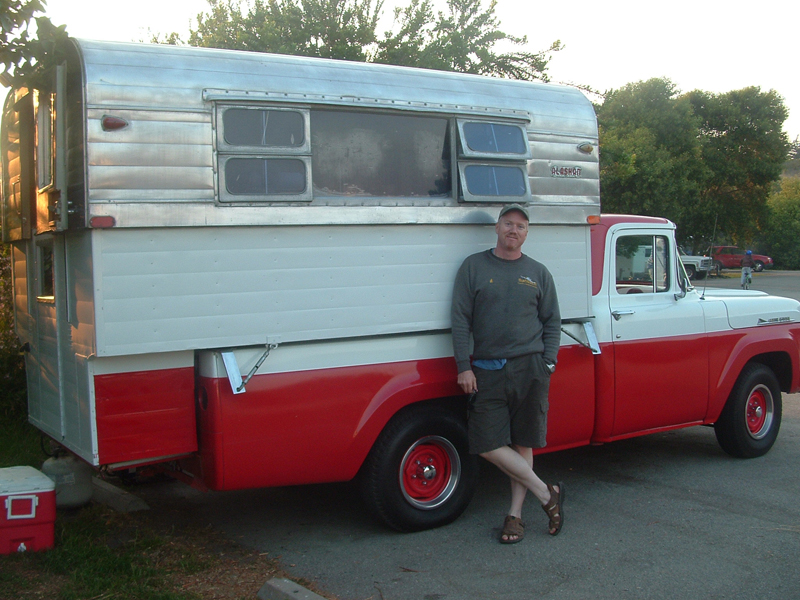
Which explains your current triple-slide Host.
Yes. Now we have a Host. We chose the Yukon because we wanted the roomiest truck camper we could find, and it was lighter than the other triple-slide options. Everywhere we go, we can’t believe we’re in the back of a pickup. It has plenty of floor space. I am constantly asked questions about the camper and asked to give tours. We like to boondock and find our Host to be very comfortable in the wild.
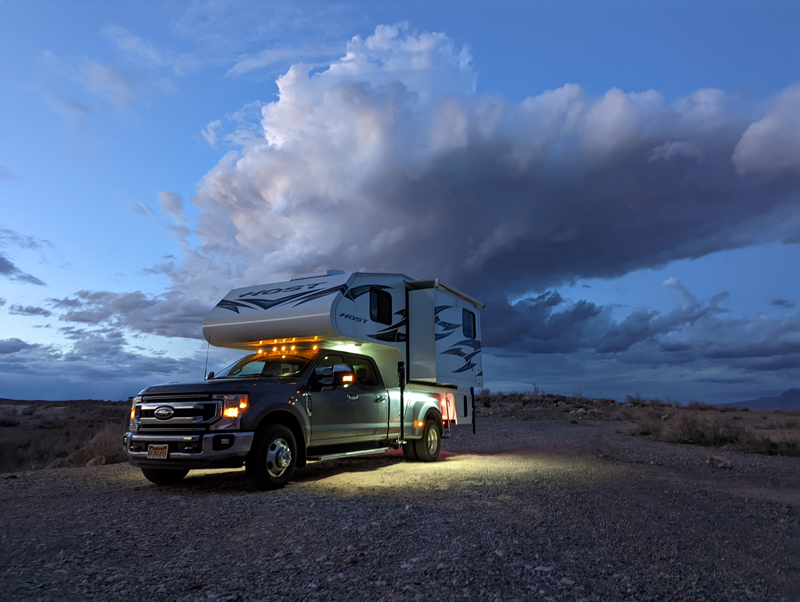
Above: 2022 Ford F-350 with 2022 Host Yukon
The photos you sent in with your racecars are tons of fun. How did you get into auto racing?
In high school, I was a country drag racer. Like most kids back then, we had a main drag we cruised. I met up with friends in the gas station parking lot, went out to Avenue 320, and we’d race out there. I’ve never been a professional, but I do land speed racing at El Mirage and Bonneville Salt Flats.
I’ve also been a motorhead from a young age, and have been fortunate enough to make a career out of it. I think I was like most little boys in the 70s. I’d ride my bicycle or go skateboarding. My dad bought a go-kart and, after that, I rebuilt a motorcycle. In high school, I was the top guy in auto shop class. My auto shop teacher recommended that I attend a vocational school, and I’m glad he did. After that, I started working at Hanford Auto. Forty-some years later, I own the place.
There’s a lot of farm equipment in the Central Valley of California. In the last ten to fifteen years, we’ve been getting more and more vintage engine business—Cadillacs and Oldsmobiles and such—because not many shops will touch them anymore. I’m also known as the Y-Block Guy. The Y-Block was an interim Ford engine, only made for ten years. It’s definitely a forgotten power plant with an unwarranted reputation that isn’t exactly stellar. I am a rooter of the underdog. It’s interesting and different to work with.
I was trained by an old man who would be 105 today. He knew how to work on the old stuff, and I learned through osmosis. With the advent of the internet, my name is out, and people know to come to me. I’m not where I expected to be 40 years ago, but I’m very happy with where I am.
Why is your truck camper a good choice for what you do?
We tow a race car trailer behind our truck and camper because I participate in auto races. It’s a hobby and my life. With my Host and Ford, I can pull my trailer with my race car to places where you can’t get a camp trailer.
Nearly everyone who owns a motorhome uses it only when they need to. When they don’t use them, they’re sitting and rotting. You have to repair them when you take them out because they’re sitting so much. I take my camper off and drive my truck like a daily driver. Host has remote control electric jacks, so I can have my camper off the truck in ten minutes.
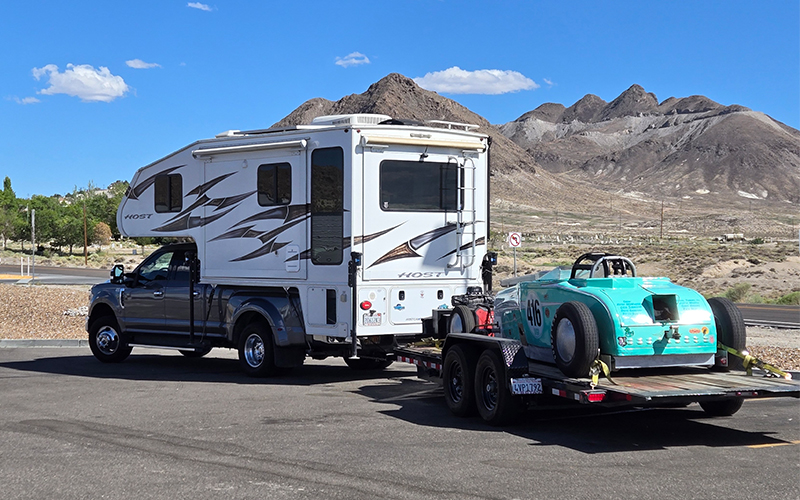
Tell us about your towing setup.
To get past the Host overhang, I have a Torklift 4-foot extension for my hitch. My one-ton truck has 3-inch receiver for larger tow setups. It’s well supported, and has a special setup with stabilizing chains. It pulls the trailer just fine. You have to know how to set it up. It’s very stable.
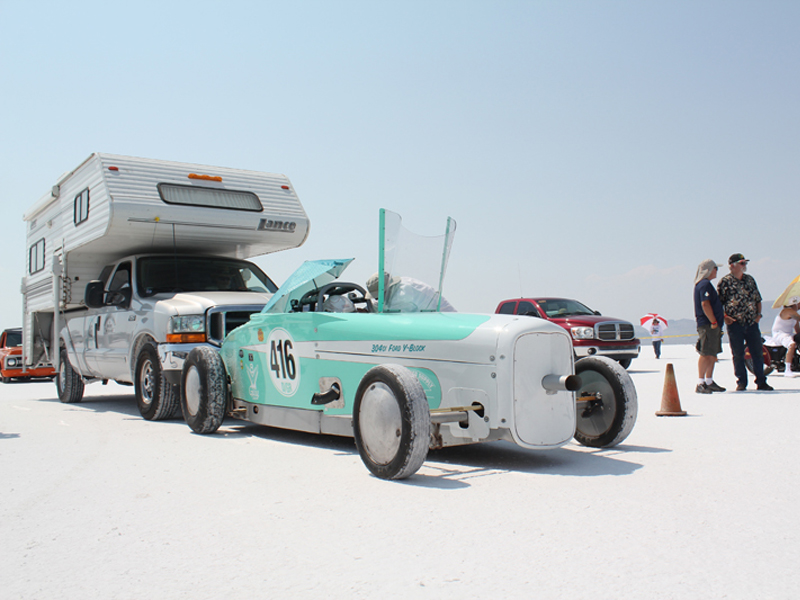
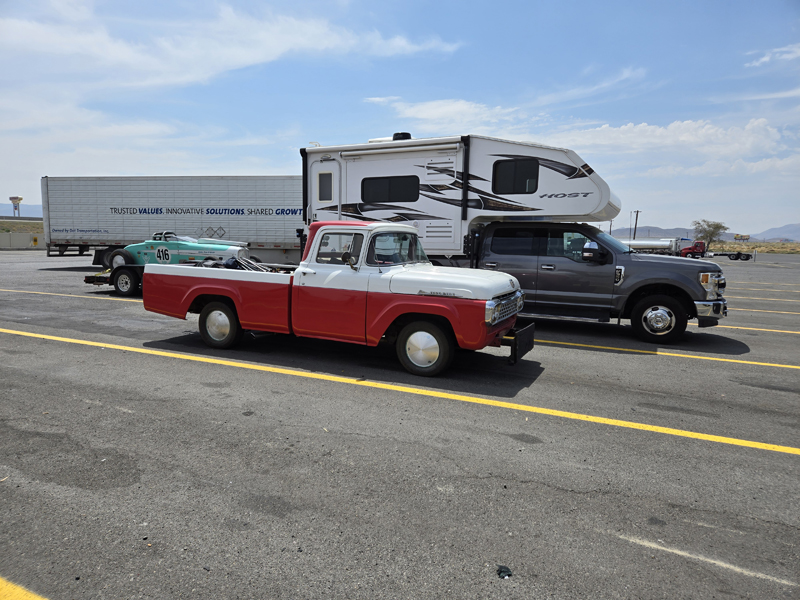
If I’m not racing or just going to the mountains or a national park for fun, I’ll tow a 1964 CJ-5 Jeep or a Model A Ford on a trailer for transportation. I like to have a get-around vehicle. The photo I sent of the Model A Sport Coupe on a trailer was for my wife’s daughter’s wedding in Washington. My car was in the pictures for the wedding and we also used it to get around.
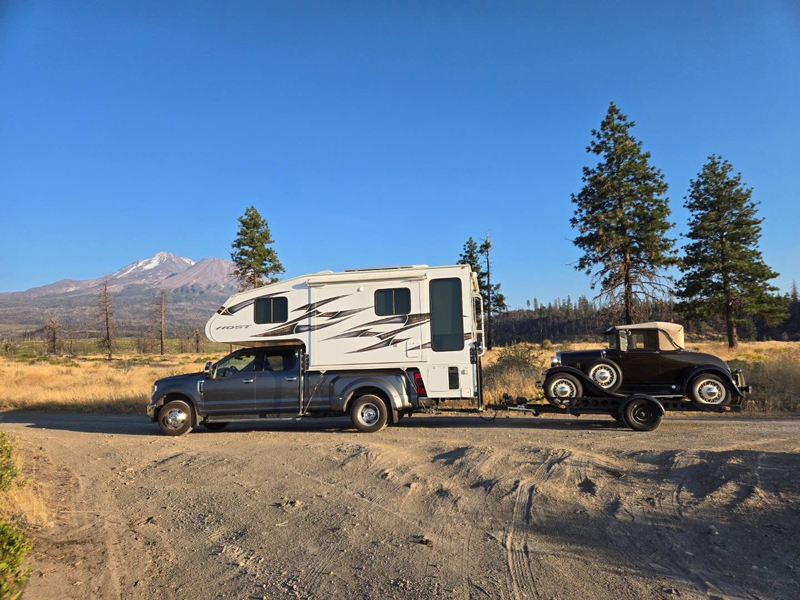
What’s the car in the photo with your Host Camper?
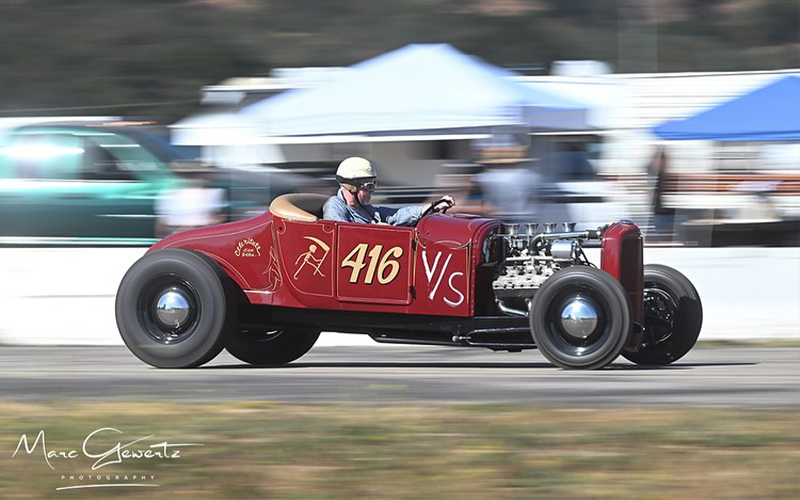
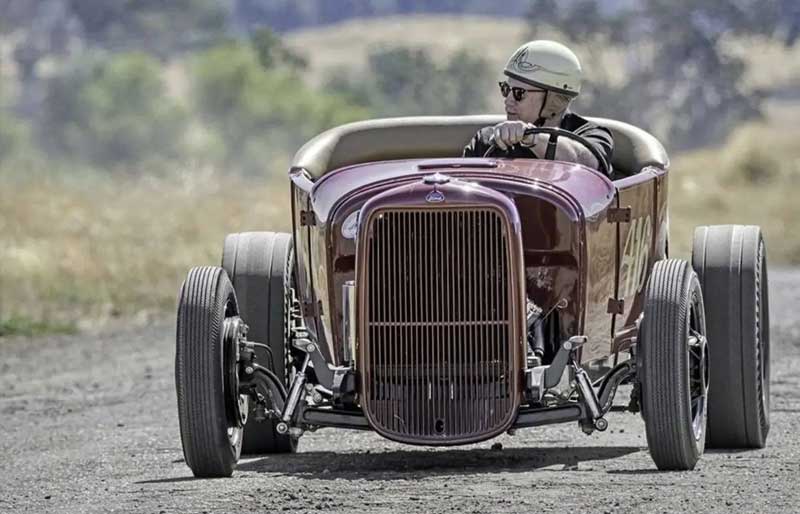
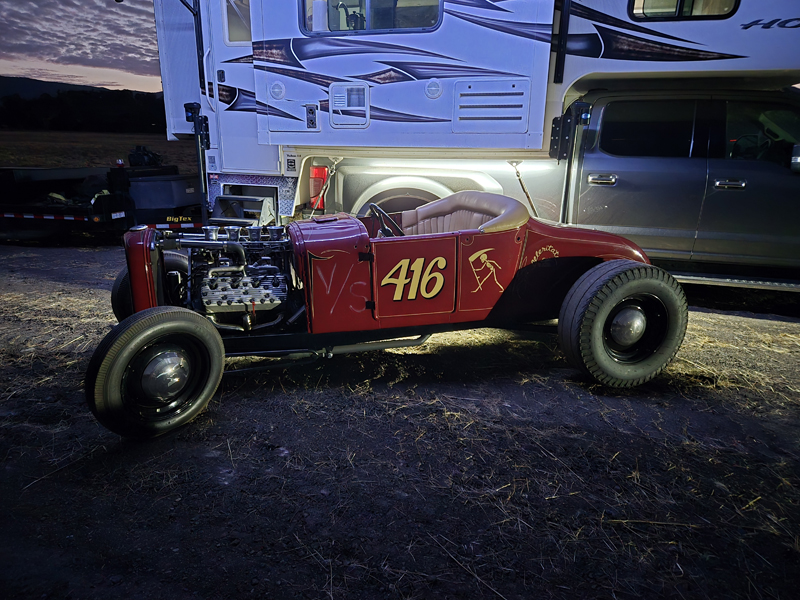
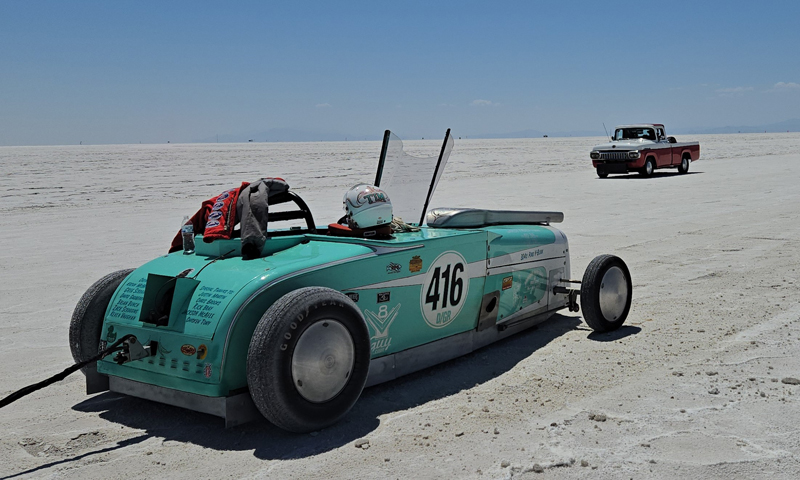
It’s a 1929 Ford Model A Roadster that’s been highly modified. You will notice the number 416 on all of my cars. That’s the competition number that the Southern California Timing Association (SCTA) assigned to me.
I also race a red 1927 Model T Ford Roadster. On the 1929 Ford Roadster, the back half of the body is original. Everything else is custom made. I’m in the “D Gas Roadster” class.
What does “D Gas Roadster” mean?
The higher the letter, the smaller the engine. You know when someone says their engine is a 7.3 or 5-liter? That’s the engine displacement, or the cubic inches in the engine. My Roadster is a D class because it’s between 260 and 305 cubic inches. For perspective, 305 cubic inches is equivalent to a 5-liter engine.
So, what class would the 6.4L Hemi in our Ram truck be?
A 6.4L Hemi is about 392 cubic inches, so it’s a B class.
I am about the only one in the SCTA running a Y-Block. The Y is the shape of the engine. It’s a V8. Your Hemi is technically a Y-Block.
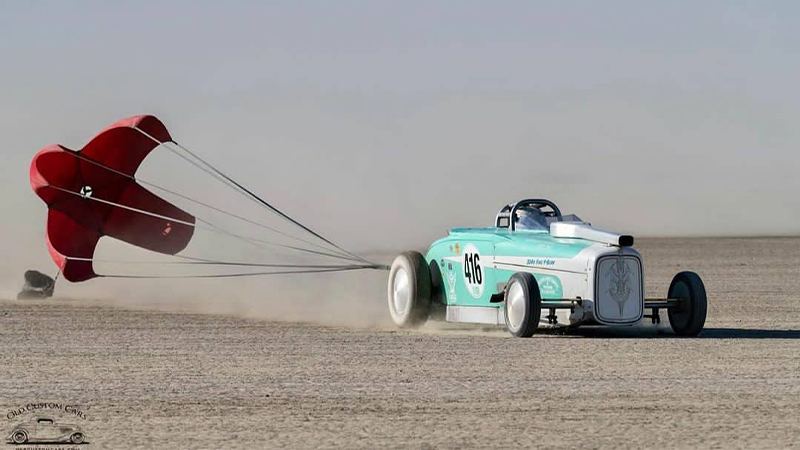
You sent us an insane video of a car racing on the Bonneville Salt Flats. What was that experience like?
I definitely get an adrenaline high, like one you might get by jumping out an airplane. At the end of the run, I’m shaking a little bit, but it’s a good thing. I’m pumping hard, but then fifteen minutes later, I’m ready to take a nap. You could call me a thrill seeker. I’m not a sit on the couch person. My wife is a long-distance runner; that’s how she gets her high.
If you watch the video, you’ll see that I’m wearing a full fire suit and a helmet. It’s hard to hear anything, and you definitely get the sensation of speed. You can’t pick that up in the video.
Above: Video by Michael Herrington
What’s the fastest you’ve ever gone?
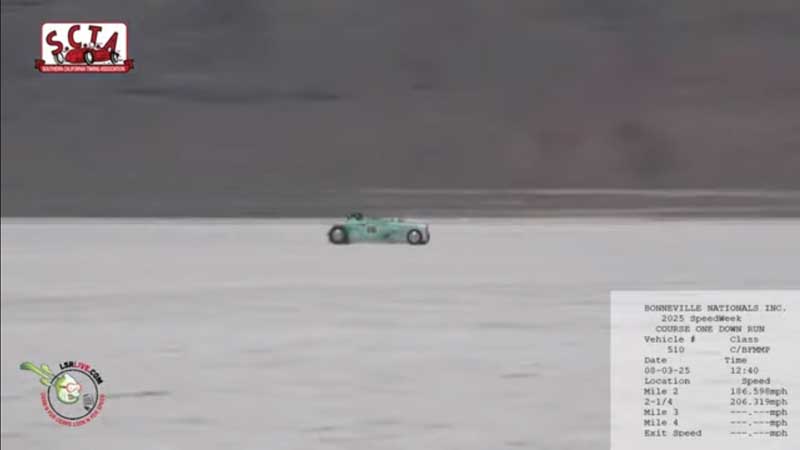
I went 197.550 miles per hour last August. There are cars during Speed Week that go over 400 mph, but going 200 mph, the sensation is still there. I’m not trying to downplay the 400 mph, but fast is fast, and once you get to 200 mph, it all feels pretty fast.
On the Bonneville Salt Flats, there’s not much to judge speed. It’s like the surface of the moon. Once you stop, you can’t see anything but the curvature of the earth until your tow vehicle meets up with you. It’s a surreal experience. I’ve been doing this for a number of years, and the first time was awe-inspiring.
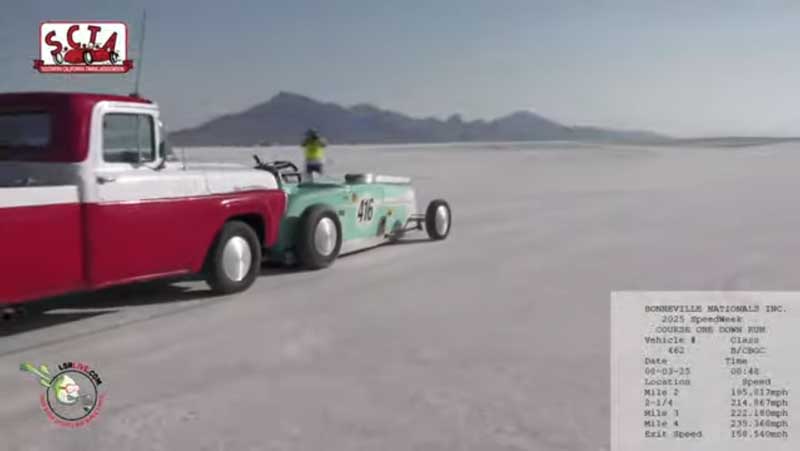
My tow vehicle is the same vehicle that was at the beginning of the race. It runs down the return road that parallels the race course. The only time my Roadster is under power is on the course. Otherwise, it’s pulled or pushed.
How do you practice?
Every run is practice. Most people start with a slower car. My old Ford pickup has a record of 118 mph. Nothing compared to what we’re doing now.
What are you racing against?
As you see in the video above, I’m by myself. I am racing against someone else’s record, or my personal best. Each time I go out there, I’m trying to do my best.
When you’re at Bonneville, you legally license up. You start by going under 150 mph. Once you manage at that speed, they bump you up to 175, and then 200. After 250 mph, you’re unlimited. At Bonneville, you’re not supposed to go ‘balls out’ right away.
Tell us about the land speed events and how they work.
There are three or four events at Bonneville each year. The video is from Speed Week at the beginning of August. People have been racing at Bonneville since 1914, but SCTA didn’t start until 1948.
Speed Week is a sanctioned event with 300 to 500 vehicles, including motorcycles and race cars. There are records and classes. A stock body Model A went 90 mph, which was a record this year. During Speed Week, 416 mph was the record this year.
I started racing on dry lakes in El Mirage, California. It’s a dirty lake bed in southern California. It is an interesting type of racing. People support each other and will help you break their record.
Can anyone sign up and race a vehicle at Speed Week?
You buy a rule book to see what mods need to be done to your vehicle. Then, you have to pass a tech inspection. You have to gut the interior of your vehicle and install a full roll cage. Beyond that, almost anyone can go out there. You have to do rookie runs and work your way up.
If you want to race in your car, there’s World of Speed in September. It’s sanctioned by USFRA, the Utah Salt Flat Racing Association. They have a 130mph club. Any streetcar can run it as long as you have safety belts, a helmet, and you keep it at 130mph.
How about going to Speed Week as a spectator in a truck camper rig?
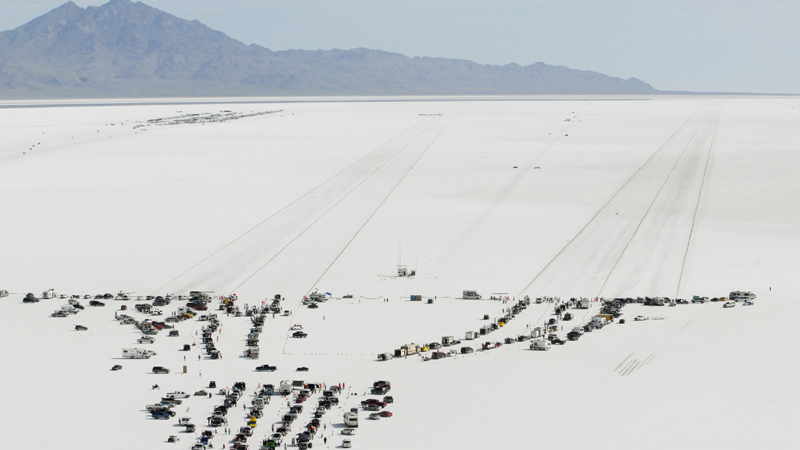
Spectators can come to Speed Week. It’s a big event. Beginning weekend, there are people from all over the world. There are lots of Australians and Europeans. They have salt flats in Australia and ship their cars here.
The starting line is four miles from the pits. That’s four miles of people lined up. The run is nine miles long, but they only time you for five miles. I take a mile to slow down.
Is it dangerous?
Yes. Chris Raschke was killed in a vehicle called Speed Demon III during Speed Week this year. It was the fastest car out there that had won the trophy for over 15 years. He was working to go 500 mph, got to 283 mph, went airborne, and flipped. He was dead on the scene. That’s the first time I’ve experienced someone being killed while I was there. It’s a risky business. They shut down racing for that day, and moved the course over.
Safety equipment has gotten progressively more advanced over the years. You can see in the video that there’s a full roll cage, and I get strapped in tight. It’s as safe as possible, but stuff happens. Out there, we have a mindset of safety. On the highway, I wonder what some people think.
Where do you stay in your camper when you’re at Speed Week?
The picture of my camper is at “the Bend in the Road” on the approach to the salt flats. I’m not taking my truck camper out on the salt. Fords have aluminum bodies, so I don’t want to take it out. I set up camp with our camper with the trailer. Then the red truck goes out to the pits where I set up. It can be as much as ten miles. When you enter the salt, it’s five miles to the pits.
The “Bend in the Road” is on BLM, and it has salt, but it’s not thick salt. It’s more like salty mud. Because it’s BLM, we get free camping there. During Speed Week, they set up portable potties.
The camping can be a zoo sometimes. At night, it’s gotten pretty wild. One year, they brought a band on a semi-truck trailer. They whooped it up. I’ve got to sleep because I’ve got to drive.
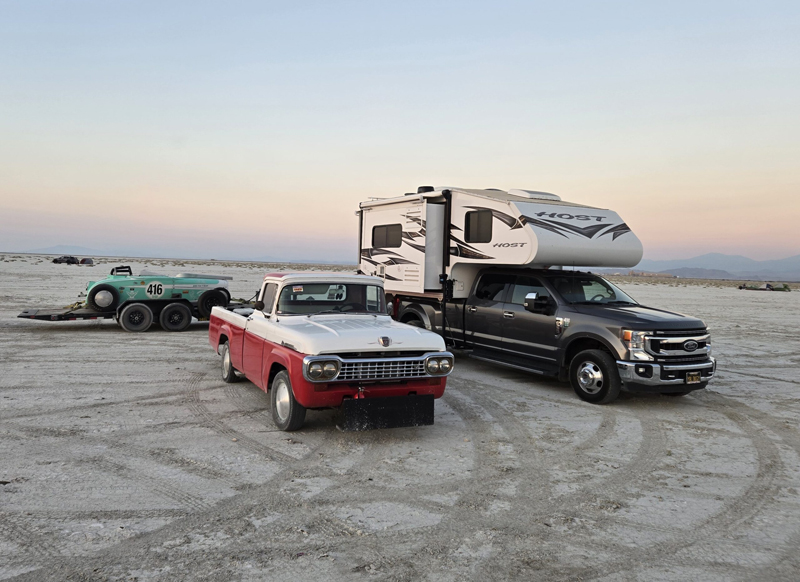
Above: Camped at “the Bend in the Road”
Do you attend other land speed racing events?
I went to the RPM Nationals this past September. That’s another racing event I do. It’s all vintage Ford hot rods with Flathead Ford V8s and four bangers. I’ve won the V8 class the last two years and, in 2020, I won with my 1927 Model T Roadster.
When we go to El Mirage, California, I run my pickup. I have a 1962 unibody Ford painted like the Roadster. It runs in D/PP Production Pickup.
I also go to some big car shows. “THE Gathering at the ROC” in Oklahoma had 600 cars there. There’s also the Grand National Roadster Show in Los Angeles. Those big events are a social thing for me. We meet up with the guys we know through racing.
From about April to November, I’m busy going to events. Winter is when I fix everything I break. Since I own the business, I will probably never retire, but I take long weekends and vacations when I feel like it. I like to have the freedom.
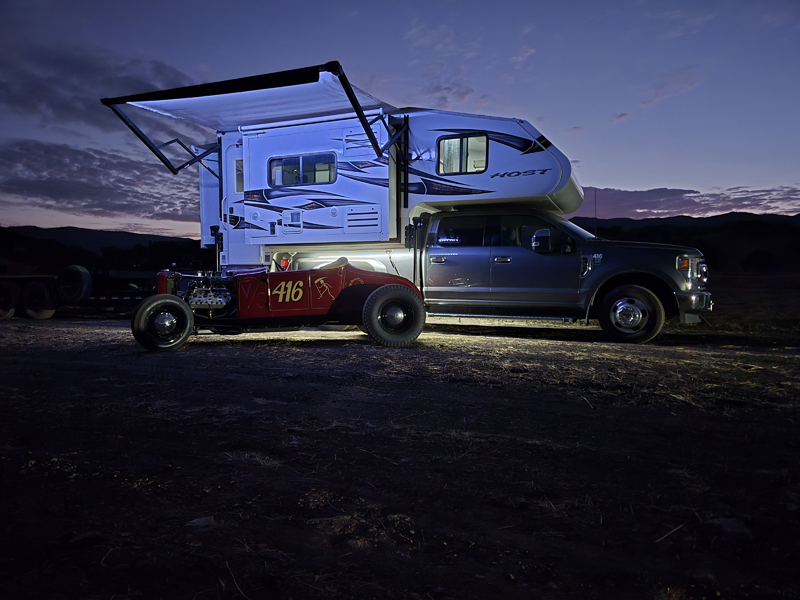
Tim McMaster’s Rig
Truck: 2022 Ford F-350, two wheel drive, dually 7.3L gas “Godzilla”
Camper: 2022 Host Yukon
Tie-Downs and Turnbuckles: Torklift Fastguns
Suspension: The only addition is larger bumpers on the overload springs to make them engage earlier
Check out Tim’s Facebook page and personal blog at YBlockGuy.com.